Engineering · jet engines
Why are jet turbine blades grown as one crystal?
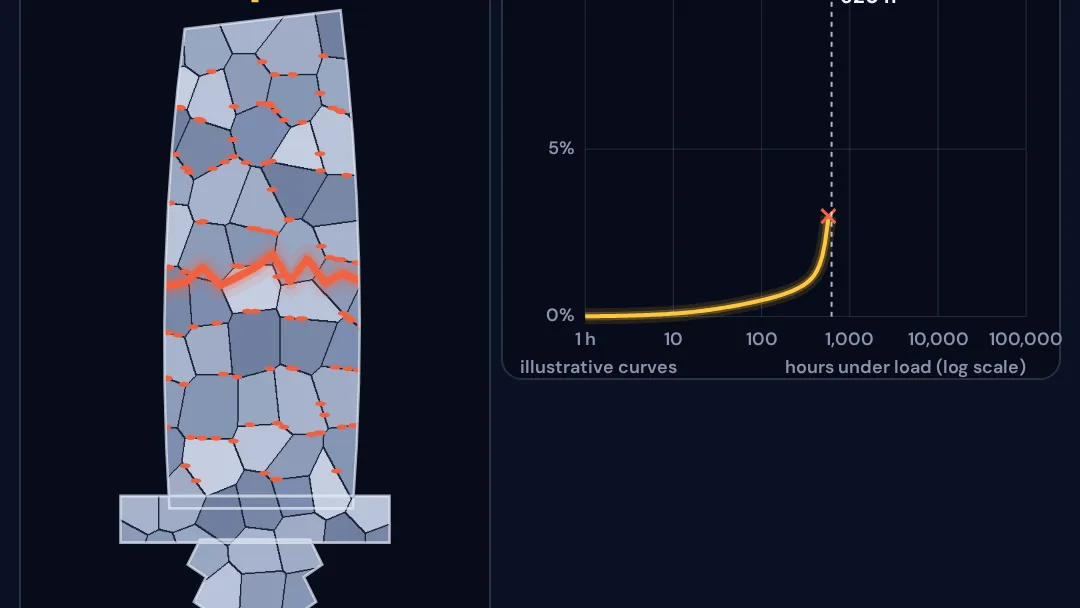
Turn “Grain structure” from equiaxed to single crystal, change the metal temperature and the time under load, or pick a preset. Watch the creep curve, the cavities and the casting.
1 See
A viral post claims a jet engine is harder to make than a nuclear weapon, because of the turbine blades. Whatever you make of the claim, the blades are remarkable: each one is grown as a single crystal of metal. Why?
2 Change
3 Understand
Model notes and sources
The claim. In November 2026 a viral post on X claimed that a jet engine is harder to make than a nuclear weapon, because of its turbine blades. We show that as a claim, not a fact we have checked, and we do not use the post’s temperature or load figures. This tool is about the part of the story that is well established: why the hottest turbine blades are cast as single crystals.
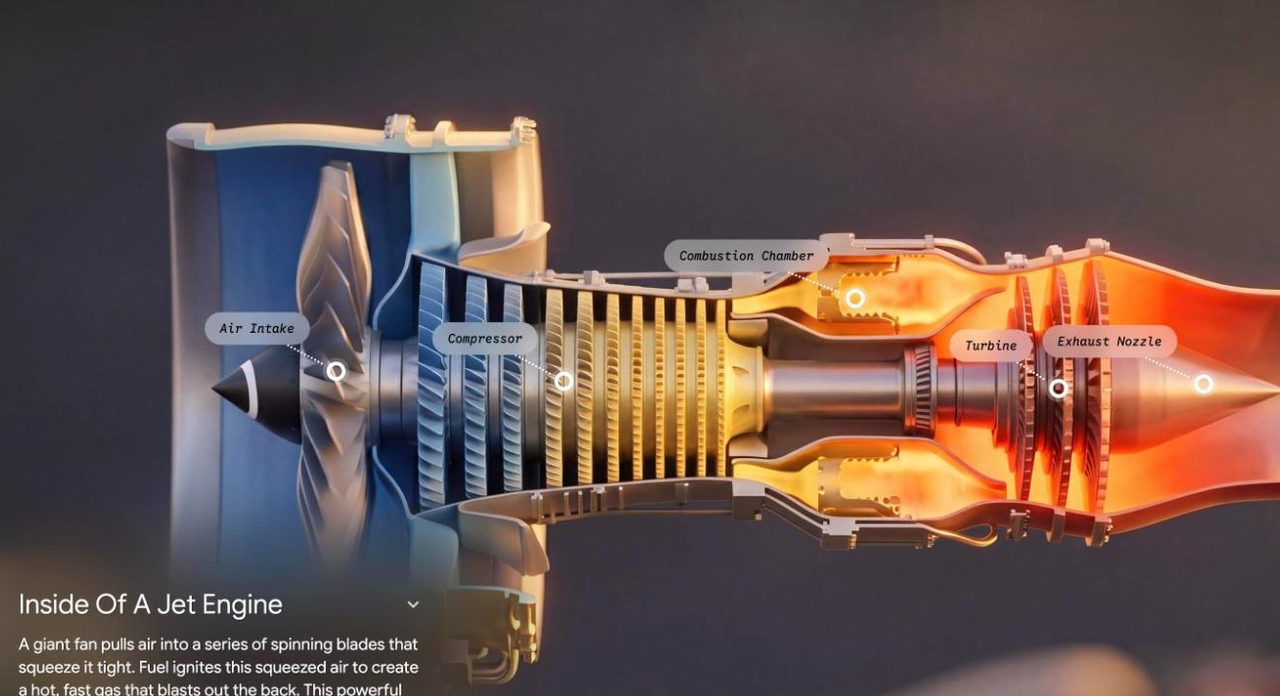
The idea. The gas leaving an engine’s combustor and hitting the first turbine blades is hotter than the melting point of the nickel superalloy they are made of, about 1,300 °C. Cooling air, fed through passages inside the blade and out of tiny film-cooling holes, and a ceramic thermal barrier coating (yttria-stabilised zirconia) keep the metal just below it. Hot metal under the steady pull of a spinning rotor slowly stretches: creep. In an ordinary casting the metal is made of many small grains, and at these temperatures damage gathers at the boundaries between them, as grains slide and small cavities open on boundaries that run across the pull. So engineers remove the boundaries. Directional solidification, freezing the blade upward from a chilled plate as the mold is lowered out of the furnace, grows long grains along the blade. Adding a corkscrew-shaped “pigtail” grain selector above the chill plate lets only one of the competing grains through, and it grows into the whole blade: a single crystal. Pratt & Whitney introduced single-crystal blades in the alloy PWA 1480 in the 1980s.
The model and its limits. This is a teaching model, not data for any alloy or engine. The grains are drawn as random cells (equiaxed), cells stretched along the blade (columnar) or a single crystal. The thermometer’s melting point (about 1,300 °C) and the creep threshold at about half the melting point in kelvin are textbook values (Reed, 2006); the hot gas is shown only as above the melting point, with no number. Rupture life follows an illustrative rule, 2,000 hours × e−(T − 900 °C)/40 °C for equiaxed grains, five times longer for columnar grains and 25 times longer for a single crystal; only the ordering and the steep fall with temperature are meant. The creep curves use an illustrative shape (a short first stage, a steady second stage and an accelerating third stage) with illustrative strains at rupture of 3, 6 and 9 %, and the blade’s stretch is drawn exaggerated (four times in the film, twice in the tool). Cavities are drawn on boundaries that run across the pull. Real blades also carry bending and vibration loads, and their single crystals are grown in a chosen orientation. The temperature profile through the wall and the furnace are schematic, with no temperatures except the melting point; the casting is speeded up.
The film. The mechanism is drawn in code by ExplainerTools, with no AI-generated pictures. The Short also uses short real excerpts, picture only, a few seconds each and credited on screen: Warped Perception, @WarpedYT (YouTube); AgentJayZ (YouTube); Safran, @GroupeSafran (YouTube). The numbers in the film come from the model, not from the footage.
Sources: R. C. Reed, The Superalloys: Fundamentals and Applications (Cambridge University Press, 2006); Rolls-Royce, The Jet Engine; H. K. D. H. Bhadeshia, “Nickel based superalloys” (University of Cambridge); Wikipedia, “Single-crystal superalloy”, “Creep (deformation)” and “Thermal barrier coating”.
An ExplainerTools Original. Materials science: Reed (2006), Rolls-Royce, University of Cambridge. Video excerpts: Warped Perception (@WarpedYT); AgentJayZ; Safran.