Topic guide · Space and networks
Why does Starlink have less lag than older satellite internet?
Because its satellites fly far closer to you. Older internet satellites sit in geostationary orbit, 35,786 km above the equator. A request and its reply cross that gap four times, so light alone needs about half a second. Starlink uses low Earth orbit, a few hundred kilometers up, where the same trip takes under 10 milliseconds. That is only the floor. Routing, radio scheduling and queueing add the rest of what you measure.
- Geostationary orbit
- 35,786 km
- Light-only round trip
- ≈ 480 ms
- Low-orbit example
- 500 km
- Light-only round trip
- ≈ 6.7 ms
Model · light only Straight up and down, four crossings, light in a vacuum.
Interactive · ExplainerTools
Low Orbit Internet
Drop one satellite from 35,786 km to 500 km and watch the light-only delay fall.
Model · light-travel time only
Where does the lag come from?
Latency is round-trip time: your request goes out, and the reply comes back. Part of it is propagation, the time the signal spends in flight. Radio travels at the speed of light, about 300,000 km every second. That sounds instant until the path is 143,000 km long, as it is to geostationary orbit and back.
The rest comes from the network. Starlink’s own engineering note on latency lists ground routing, radio scheduling, queueing, processing and congestion. It puts the light-travel part for Starlink normally under 10 ms. Low orbit shrinks one ingredient. It cannot remove the others.
Try it: how much does altitude matter?
- 1 See
Open Low Orbit Internet. A signal climbs to one satellite and comes back down.
- 2 Change
Tap Geostationary · 35,786 km, then Starlink · ~500 km. Or drag the altitude yourself.
- 3 Understand
The light-only delay falls from about 478 ms to 7.5 ms. Overhead for falls from “always” to a little over four minutes.
What is the catch with low orbit?
A geostationary satellite circles once a day, matching Earth’s spin. It seems to hang still, so a fixed dish can stare at it. A satellite 500 km up laps Earth in about an hour and a half. From any one spot, it is high overhead for only minutes.
So a low-orbit network needs many satellites, and dishes that hand the link from one to the next. Ryan Sael’s Home internet from space shows that handoff, and the laser links that can relay a signal between satellites.
Where does this explanation stop?
The numbers here are teaching calculations. They assume a straight path, light in a vacuum and no waiting anywhere. Real dishes rarely sit right under a satellite, so slant paths run longer. Low Orbit Internet places you and a ground station 500 km apart. That is why it reads a little above the straight-up figures.
Traffic may also hop between satellites or come down far from you. We make no promise about anyone’s measured latency, speed or satellite count. For current service details, read Starlink’s technology page.
Explore by question
Grouped by the question each one answers, with why it belongs here.
Change the altitude yourself
Our model isolates one ingredient of lag: the distance light travels.
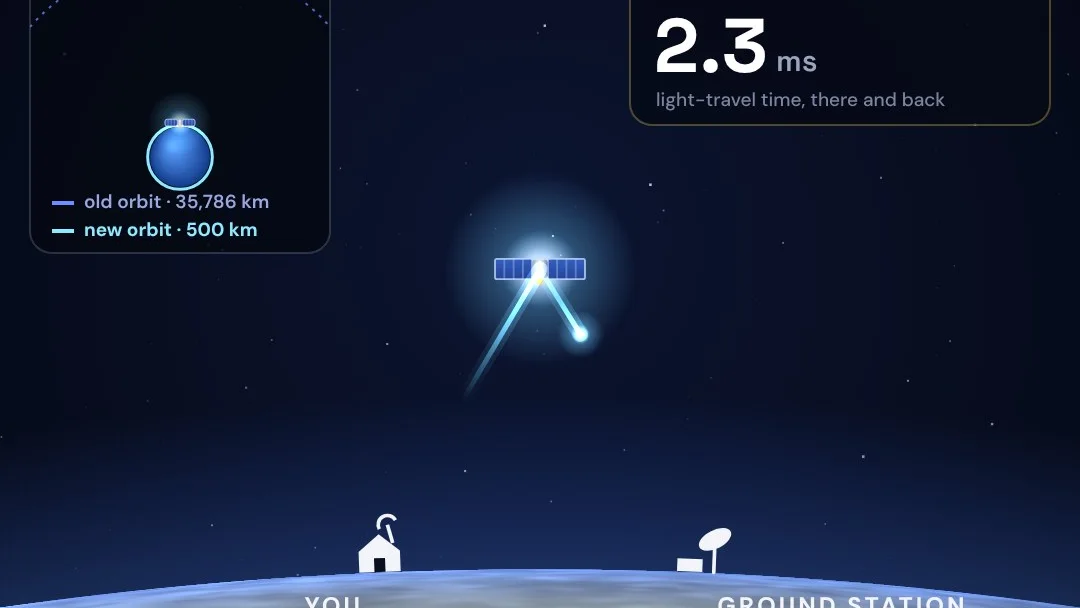 Interactive · Low Orbit InternetWhy does Starlink feel so fast?Drop one satellite from 35,786 km to 500 km and watch the light-only delay fall.
- JournalWhy does Starlink feel so fast?Light is fast, but space is big. Follow one click to a satellite and back, and see why a lower orbit cuts the wait to under ten milliseconds.
Go deeper with the original
Ryan Sael’s interactive inspired our model and goes much further.
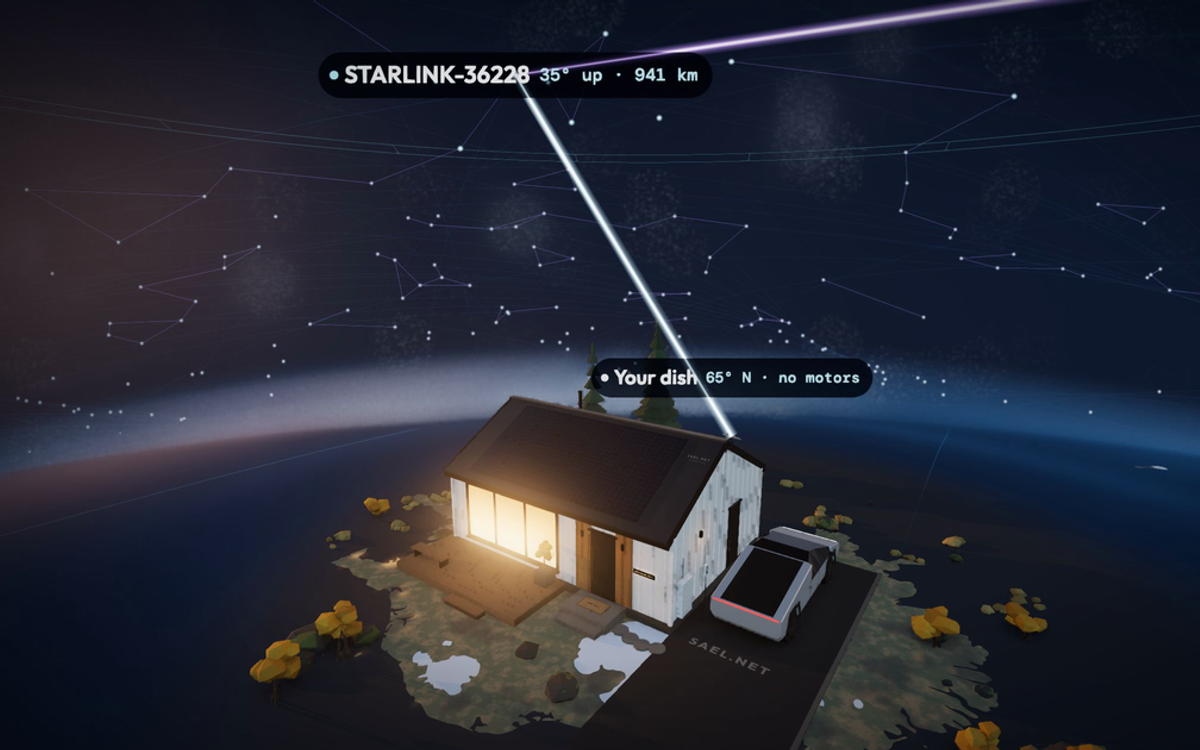 Interactive demoHome internet from space: StarlinkFollow a dish as it hands its link between low satellites and laser relays, then compare a geostationary link.by Ryan Sael · Best on a larger screen
Why low satellites stay up, and when you see them
Low orbit raises two more questions about the same satellites.
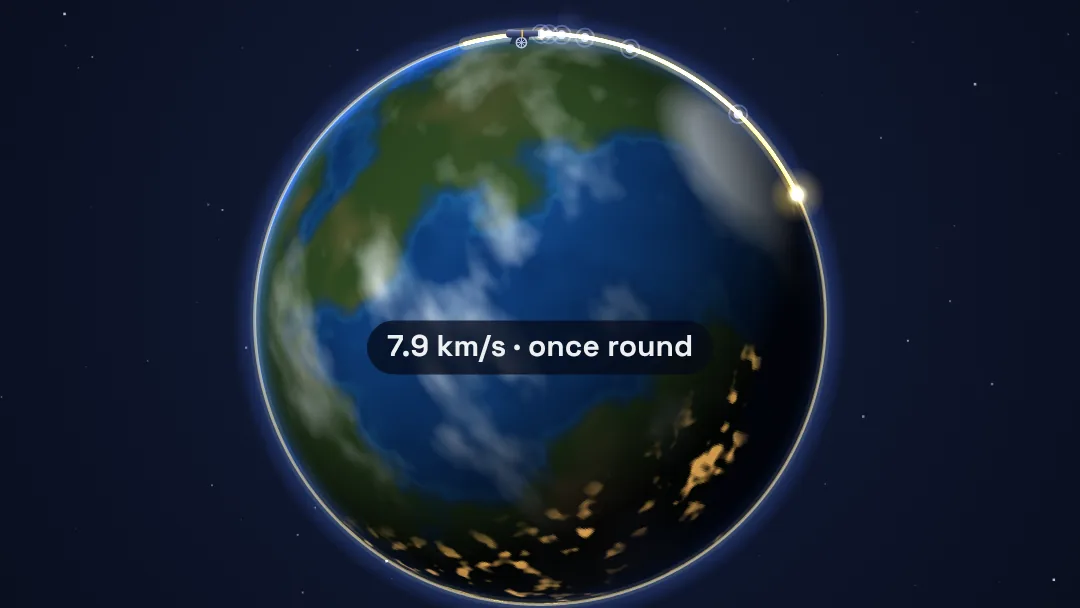 Interactive · Newton's CannonWhy don't satellites fall down?Fire Newton’s cannonball faster until the ground curves away as fast as it falls.
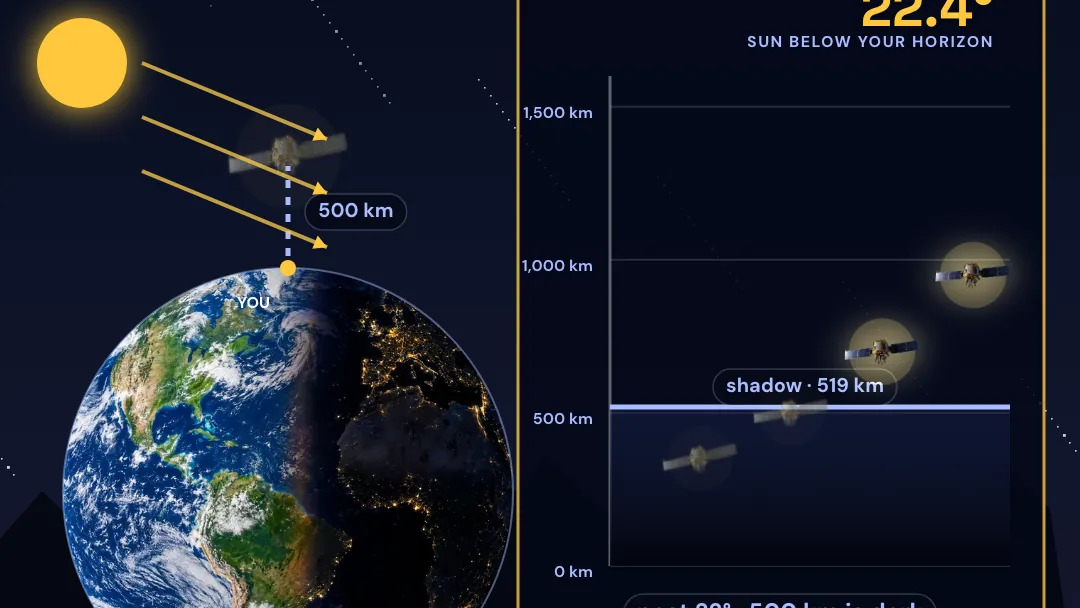 Interactive · Satellite DuskWhy do you mostly see satellites just after sunset?Move the Sun below the horizon and watch Earth’s shadow climb past a 500 km satellite.
Same timing, a different job
GPS also depends on how long satellite signals take to arrive.
- Interactive articleGPSAn illustrated, hands-on article on how GPS works out where you are.by Bartosz Ciechanowski
Common questions
Is low latency the same as fast download speed?
No. Latency is how long a round trip takes, measured in milliseconds. Throughput is how much data arrives each second, in megabits per second. A link can download quickly and still feel sluggish on a video call if every reply arrives late.
Why do geostationary satellites orbit so high?
At 35,786 km, one orbit takes a day, the same time Earth takes to spin. The satellite seems to hang over one spot, so a dish can stay fixed. The price is distance, and with it delay.
Does a lower orbit guarantee a certain ping?
No. It lowers the floor set by light travel. What you measure also depends on routing, scheduling, congestion and where your traffic leaves the satellite network. Starlink’s latency note describes these parts.
Why do you sometimes see satellites after sunset?
They shine by reflecting sunlight. Just after dusk, a satellite a few hundred kilometers up can still be in sunlight while your sky is dark. Satellite Dusk lets you watch Earth’s shadow climb past them.
Sources and credits
- Starlink · Technology The provider’s overview of its low-Earth-orbit network. Service claims are Starlink’s.
- Starlink · Latency engineering note (PDF) What makes up measured latency, including the light-travel part.
- Ryan Sael · Home internet from space The credited interactive that inspired Low Orbit Internet.
- Low Orbit Internet · model notesThe equations, assumptions and further sources behind the numbers on this page.
Every creator named here made the work we link to. Listing it does not imply a partnership or endorsement.