Topic guide · Talking to Voyager 1
How does NASA talk to Voyager 1, a light-day away?
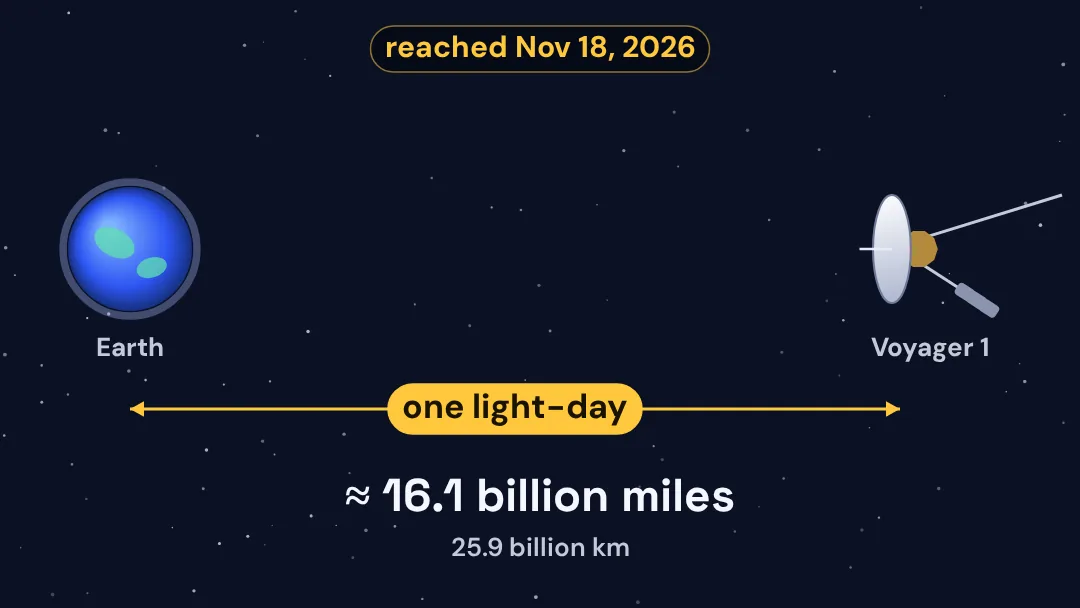
Slowly, and with very big ears. On November 18, 2026 Voyager 1 passed one light-day from Earth, about 16.1 billion miles, so its radio signal takes 24 hours to reach us and every command is a two-day round trip. Its transmitter radiates around 22 watts, like a refrigerator bulb, and the signal spreads out with the square of the distance, so NASA listens with Deep Space Network dishes up to 70 meters wide. In Light-Day Lab you can grow the distance yourself.
- Light to the Moon
- ≈ 1.3 seconds
- Light to Neptune
- ≈ 4 hours
- Light to Voyager 1 (Nov 18, 2026)
- 24 hours · ≈ 16.1 billion miles
- Signal per m² vs the Moon’s distance
- ≈ 1/4.4 billion (model)
Model · relative strength Facts from NASA JPL (November 19, 2026), NASA Photojournal PIA17037 and NASA JPL (2017). Signal strength is relative to the Moon’s distance only.
Interactive · ExplainerTools
Light-Day Lab
Turn “Distance” from the Moon to Voyager 1 and watch the round trip lengthen and the signal thin out as 1/d². Then turn “Dish diameter” from 34 m to 70 m.
Model · relative strength
How far is a light-day?
Radio waves are light, and light covers about 186,000 miles a second, so distance in space can be measured in time. Light reaches the Moon in about 1.3 seconds and Neptune in about four hours. In 24 hours it travels about 16.1 billion miles: one light-day. NASA JPL reported that Voyager 1 reached that distance at about 2:16 a.m. PST on November 18, 2026.
Why is every command a two-day round trip?
A command takes a day to reach Voyager 1 and the reply takes another day to come home, so nothing can be steered live. NASA says the team has not received science and engineering data from Voyager 1 since November 14, 2026; engineers confirmed the light-day milestone from the spacecraft’s carrier signal and trajectory calculations.
Why does the signal get so faint?
Voyager 1’s main transmitter radiates around 22 watts, comparable to a refrigerator light bulb (NASA Photojournal PIA17037). The signal spreads over an area that grows as the square of the distance, so each square metre gets 1/d2 of it: twice as far, a quarter as much. At 24 light-hours that is about 4.4 billion times weaker per square metre than from the Moon’s distance.
Why are NASA’s dishes so big?
A dish collects power in proportion to its area. The Deep Space Network’s largest dishes are 70 meters (230 feet) across and its smaller ones 34 meters (NASA JPL, 2017). With the same efficiency, a 70 m dish catches (70/34)², about 4.2 times as much as a 34 m dish.
Try it: grow the distance yourself
- 1 See
Open Light-Day Lab: a light-time ruler from the Moon to Voyager 1, a signal-strength bar and two dishes.
- 2 Change
Turn Distance, or press Moon · 1.3 s, Neptune · 4 h and Voyager 1 · 24 h. Watch the round trip and the strength readout.
- 3 Understand
Turn Dish diameter from 34 m to 70 m: the bigger dish has about 4.2 times the area, so it catches about 4.2 times as much.
Where does this model stop?
Light-Day Lab shows signal strength only relative to the Moon’s distance, for the same transmitter pointed the same way. It leaves out antenna gain, beam width, noise and data rate, and computes no absolute received power. Neptune’s light time changes with its orbit; four hours is NASA’s round figure. The drawings are schematic and not to scale.
Explore by question
Light time, faint signals and big dishes. Each card answers one part of the question.
Light-Day Lab
Model · relative strength
 Interactive · Light-Day LabHow does NASA talk to Voyager 1, a light-day away?Grow the distance from the Moon to Voyager 1 and watch the signal thin out as 1/d².
- ShortHow does NASA talk to Voyager 1, a light-day away?The light-time ruler, the two-day round trip and the 70 m dishes. Narrated and captioned.
- JournalHow does NASA talk to Voyager 1, a light-day away?Voyager 1’s radio signal now takes a full day to reach us. Here is what a two-day round trip means, why a 22-watt signal arrives so faint, and why NASA’s dishes are 70 m wide.
Distance, delay and signal
The same physics, closer to home.
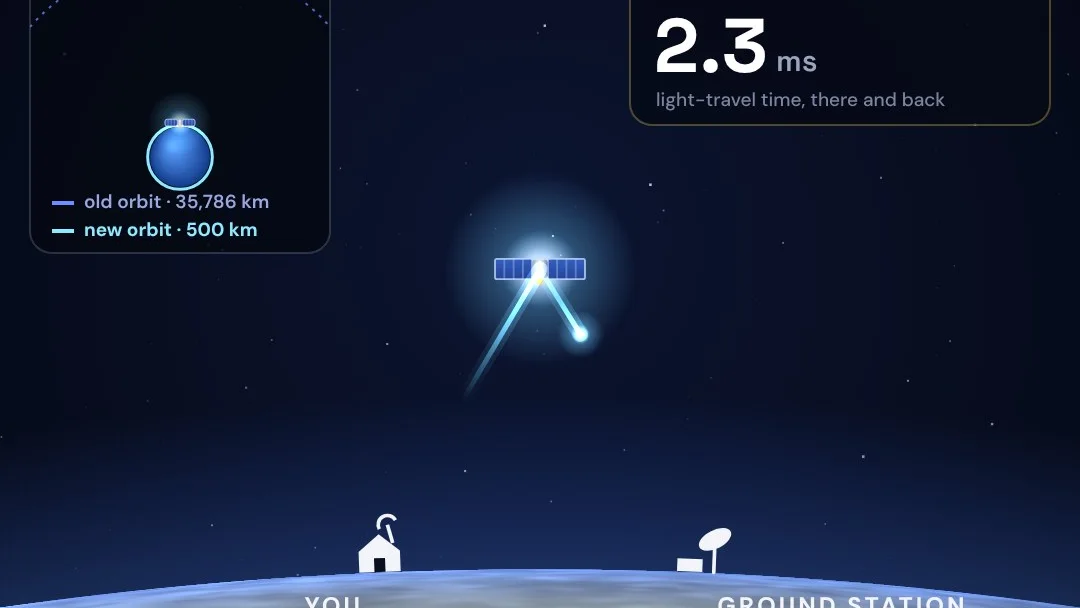 Interactive demoWhy does Starlink feel so fast?Why low-orbit satellite internet feels fast: distance becomes delay.by ExplainerTools
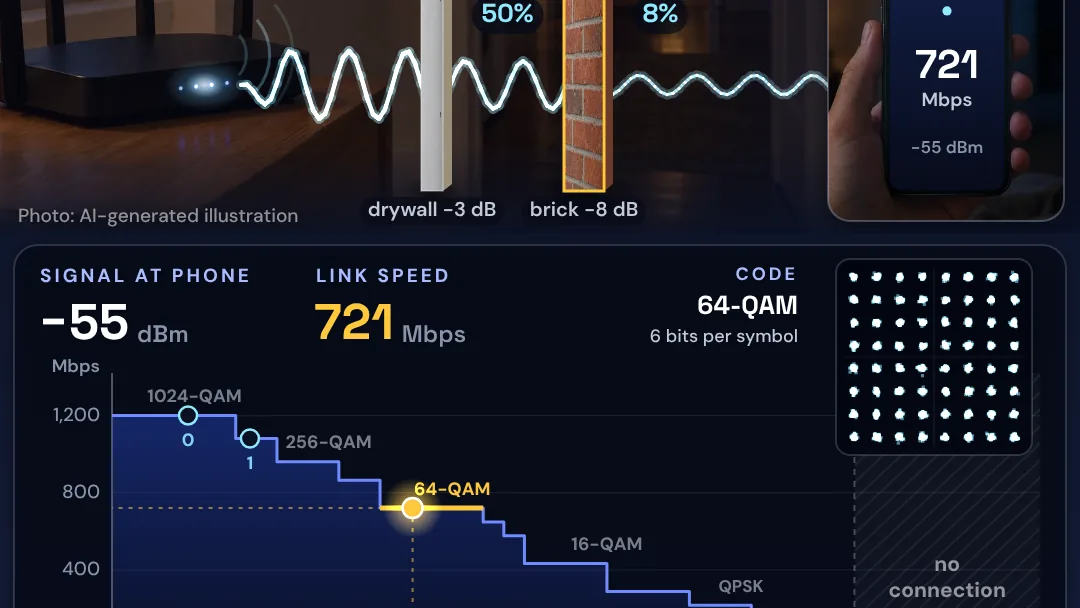 Interactive demoWhy does Wi-Fi slow down through walls?How a radio signal weakens on its way to you.by ExplainerTools
Common questions
How far away is Voyager 1?
On November 18, 2026 it reached one light-day from Earth, about 16.1 billion miles (25.9 billion km), according to NASA JPL.
How long does a message to Voyager 1 take?
About 24 hours each way, so a command and its reply take about two days.
How strong is Voyager 1’s transmitter?
Its main transmitter radiates around 22 watts, which NASA compares to a refrigerator light bulb.
Why does the signal get so weak?
It spreads over an area that grows as the square of the distance, so each square metre gets 1/d² of it. At a light-day that is billions of times weaker than from the Moon’s distance.
How big are the dishes that listen?
The Deep Space Network’s largest dishes are 70 meters (230 feet) across; a dish collects in proportion to its area.
Concepts in this guide
Each one has a plain one-line definition in Concepts A–Z, with every model, film and post where it comes up.
Sources and credits
- NASA JPL · Voyager 1 reaches one light-day from Earth (November 19, 2026) The milestone, the distance and the light times to the Moon and Neptune.
- NASA Science · What Is a Light-Day? How far light goes in 24 hours.
- NASA Photojournal · PIA17037 Voyager 1’s 22-watt transmitter, compared to a refrigerator bulb.
- NASA JPL · Two Voyagers Taught Us How to Listen to Space (2017) The Deep Space Network’s 70 m and 34 m dishes.
- Light-Day Lab · model notesRelative strength only; drawings not to scale.
Every creator named here made the work we link to. Listing it does not imply a partnership or endorsement.