Space · deep space radio
How does NASA talk to Voyager 1, a light-day away?
Turn “Distance” to grow the gap between Earth and the spacecraft, from the Moon’s 1.3 light-seconds to 30 light-hours, and watch the round trip lengthen and the signal thin out as 1/d². Then turn “Dish diameter” from 34 m to 70 m and watch Voyager’s modelled data rate climb, next to real links NASA’s Deep Space Network was carrying.
1 See
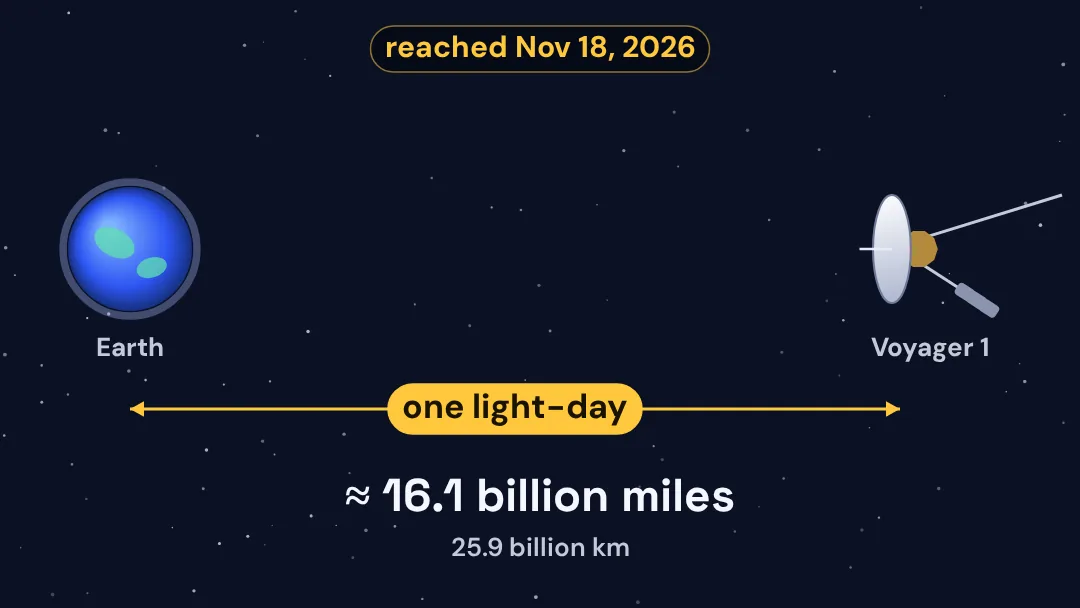
Voyager 1 is so far away that its radio signal takes a full day to reach us. Light reaches the Moon in about a second, Neptune in four hours and Voyager in twenty-four.
2 Change
3 Understand
Model notes and sources
Where this comes from. NASA’s Jet Propulsion Laboratory reported on November 19, 2026 that Voyager 1 reached one light-day from Earth at about 2:16 a.m. PST (5:16 a.m. EST) on November 18, 2026: about 16.1 billion miles (25.9 billion km). Light takes about 1.3 seconds to reach the Moon and about four hours to reach Neptune, and commands and replies each take about 24 hours. The team has not received science and engineering data from Voyager 1 since November 14; engineers confirmed the milestone from the spacecraft’s carrier signal and trajectory calculations.
Light time. Radio is light, so a signal’s one-way time is distance divided by the speed of light, 299,792.458 km (about 186,282 miles) a second. One light-hour is about 7.2 times the Earth–Sun distance (AU). A command sent to Voyager 1 arrives a day later, and its reply takes another day: a two-day round trip.
The signal thins out. Voyager 1’s main transmitter radiates around 22 watts, comparable to a refrigerator light bulb, according to NASA. As the signal travels it spreads over an ever larger area, which grows as the square of the distance, so the power landing on each square metre falls as 1/d2. Doubling the distance quarters it. The tool shows this only relative to the Moon’s distance: at 24 light-hours each square metre gets about 1/4.4 billion as much as at 1.3 light-seconds. NASA says the power reaching its antennas from Voyager is around 10−16 W; the tool does not compute absolute power.
Big dishes. A dish collects power in proportion to its area. The Deep Space Network’s largest dishes are 70 m (230 ft) across and its smaller ones 34 m (112 ft); with the same efficiency, a 70 m dish catches (70/34)2 ≈ 4.2 times as much.
Real links, real dishes. The green dots on the ruler and the data-rate chart are spacecraft that NASA’s Deep Space Network was tracking at 20:31 UTC on November 25, 2026, read from NASA’s public “DSN Now” feed: the round-trip light time the network reported (halved for one way), the receiving dish and the downlink rate. MMS 2: 0.5 s, 2.5 Mbit/s (DSS 56, Madrid). SOHO: 4.1 s, 246 kbit/s (DSS 26, Goldstone). Europa Clipper: 27 s, 31 kbit/s (DSS 25, Goldstone). OSIRIS-APEX: 4.5 min, 917 kbit/s (DSS 53, Madrid). BepiColombo: 9.3 min, 131 kbit/s (DSS 23, Goldstone). Mars Reconnaissance Orbiter: 10.2 min, 4 Mbit/s (DSS 43, Canberra). Lucy: 51 min, 20 kbit/s (DSS 35, Canberra). Voyager 1 was not being tracked at that moment. Each spacecraft has its own transmitter and antenna, so the dots do not follow one law. The feed lists one 70 m dish at each of the three complexes (DSS 14 at Goldstone, California; DSS 63 near Madrid, Spain; DSS 43 near Canberra, Australia) and four, five and three 34 m dishes; NASA says the sites are spaced around the globe so that one can always see a distant spacecraft as Earth turns.
Voyager’s data rate. NASA’s Voyager spacecraft page gives the X-band downlink as 160 bits per second normally, 1.4 kbit/s for playback of plasma-wave data and as high as 7.2 kbit/s at the planets; commands go up at 16 bits per second. The tool’s data-rate curve is a model, not a measurement: in a power-limited link the achievable rate grows with the power received, so it scales as (dish diameter/70 m)² ÷ distance², calibrated to 160 bit/s on a 70 m dish at one light-day and capped at 7.2 kbit/s. Real links also depend on coding, noise, pointing, the weather and arraying several dishes together.
The model and its limits. Strength is relative only, with the same transmitter and the same pointing at every distance; antenna gain, beam width and noise are left out. Neptune’s light time changes with its orbit; four hours is NASA’s round figure. The ruler, the strength bar and the data-rate chart use log scales; the pulse and Earth’s turn are sped up, and the globe is a schematic seen from above the North Pole. The drawings of Earth, the Moon, Neptune, Voyager and the dishes are made in code by ExplainerTools and are not to scale.
The film. The mechanism is drawn in code by ExplainerTools, with no AI-generated pictures. The Short also uses short real excerpts, picture only, a few seconds each and credited on screen: NASA Jet Propulsion Laboratory, @NASAJPL (X); Canberra Deep Space Communication Complex, @CanberraDSN (X). The numbers in the film come from the model, not from the footage.
Sources: NASA JPL, “NASA’s Voyager 1 Makes History Reaching One Light-Day from Earth” (November 19, 2026); NASA Science, “What Is a Light-Day?”; NASA Photojournal, PIA17037 (2013); NASA JPL, “Two Voyagers Taught Us How to Listen to Space” (2017); NASA, Voyager: Did You Know?; NASA, Deep Space Network; NASA, DSN Now (feed read November 25, 2026); NASA Science, “Voyager: The Spacecraft”; Wikipedia, “Inverse-square law”.
An ExplainerTools Original. Facts from NASA JPL (November 19, 2026), NASA Photojournal PIA17037, NASA’s Voyager spacecraft page and NASA’s DSN Now feed (November 25, 2026). Footage: NASA/JPL-Caltech; Canberra Deep Space Communication Complex (@CanberraDSN).