Topic guide · Reaching Mercury
Why did it take BepiColombo eight years to reach Mercury?
Because the hard part is slowing down. Falling toward the Sun speeds a spacecraft up: on the simplest path from Earth’s orbit to Mercury’s it reaches about 57.5 km/s, while Mercury moves at about 48 km/s, so it would arrive about 9.6 km/s too fast and fly right past. ESA’s BepiColombo braked on planets instead, with one flyby of Earth, two of Venus and six of Mercury, and ion engines braking in between. On November 21, 2026 it arrived slowly enough to be captured into orbit. In Mercury Brake Lab you can take the flybys away yourself.
- Launch
- Oct 20, 2018
- Flybys
- 1 Earth · 2 Venus · 6 Mercury
- Too fast on a straight drop
- ≈ 9.6 km/s (model)
- Captured into orbit
- Nov 21, 2026
Source · ESA; model figure labelled Dates and flybys from ESA. The 9.6 km/s is this site’s simplified Hohmann-transfer calculation, not a mission figure.
Interactive · ExplainerTools
Mercury Brake Lab
Turn “Flybys used” from none to all nine and “Ion-engine braking” up to the model’s cap, and watch whether the spacecraft flies past Mercury or is captured.
Model · simplified drop, illustrative flyby shares
Why does falling toward the Sun make you fast?
Every orbit trades height for speed, like a ball rolling downhill. The vis-viva equation, v² = GM(2/r − 1/a), gives the speed at each distance. On the simplest path from Earth’s orbit to Mercury’s, a half-ellipse called a Hohmann transfer, a spacecraft leaves at about 22 km/s relative to the Sun and arrives at about 57.5 km/s. Mercury moves at about 48 km/s. The difference, about 9.6 km/s, is far too much for Mercury’s weak gravity to catch. That straight drop would take only about three and a half months; the years go into slowing down.
How did nine flybys brake BepiColombo?
A close flyby bends a spacecraft’s path, and on the right side of a planet it takes away speed relative to the Sun, without fuel. ESA’s mission timeline lists:
- Earth · 2020
One flyby of home.
- Venus · 2020 and 2021
Two flybys of Venus.
- Mercury · 2021 to 2025
Six flybys of Mercury itself.
Between them, ion thrusters on the transfer module, solar electric propulsion, gave a gentle, long-lasting push that kept braking and shaping the path. The transfer module separated on September 3, 2026.
How was BepiColombo captured?
By arriving slowly. ESA reported that Mercury orbit insertion began at 18:24 UTC on November 21, 2026, using “weak stability capture”: arriving slowly enough that Mercury’s gravity captures the spacecraft. The two orbiters, ESA’s MPO and Japan’s Mio, are due to separate on December 9–10, 2026, with science from April 2027.
Is Mercury really closer to us than Mars?
Sometimes, and on average it is the closest planet to Earth: because it never strays far from the Sun, it is never on the far side of the solar system the way Mars can be (Stockman, Monroe & Cordner, Physics Today, 2019). Being close is not the same as being easy to reach.
Try it: take away the flybys yourself
- 1 See
Open Mercury Brake Lab: a spacecraft arriving 9.6 km/s too fast and flying past Mercury.
- 2 Change
Press Ion engines only · max, then All 9 flybys, no engines. Neither gets under the capture limit.
- 3 Understand
Press BepiColombo’s mix: nine flybys plus ion-engine braking, and the path closes into an orbit.
Where does this model stop?
The tool uses circular orbits in one plane and a single Hohmann drop. Each flyby’s share of the braking is illustrative: real gravity assists reshape the whole orbit rather than subtracting a fixed amount. The ion-engine cap (4 km/s) and the capture limit (0.5 km/s) are illustrative too, and the captured orbit is drawn for illustration. It explains why braking dominates, not how ESA planned the trajectory.
Explore by question
Orbits, speed and braking. Each card answers one part of the question.
Mercury Brake Lab
Model · simplified drop, illustrative flyby shares
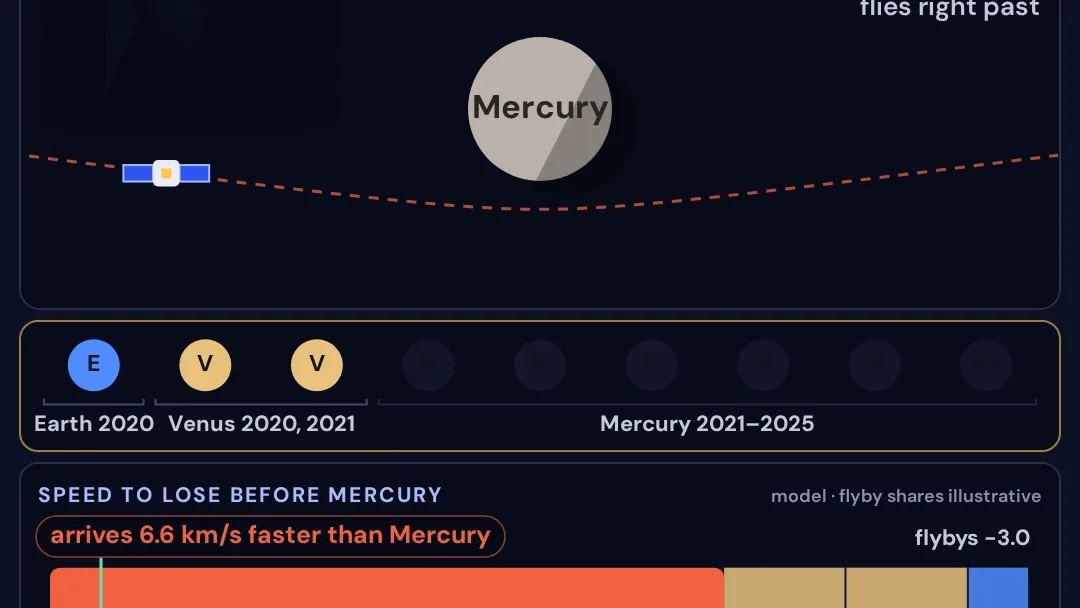 Interactive · Mercury Brake LabWhy did it take BepiColombo eight years to reach Mercury?Add or take away the nine flybys and the ion-engine braking and see if the spacecraft is captured.
- ShortWhy did it take BepiColombo eight years to reach Mercury?The drop toward the Sun, the nine flybys and the capture. Narrated and captioned.
- JournalWhy did it take BepiColombo eight years to reach Mercury?Mercury is sometimes closer than Mars, yet BepiColombo took 8 years. Falling toward the Sun speeds you up; nine flybys and ion engines did the braking.
What an orbit is
Fast enough sideways and you keep falling around.
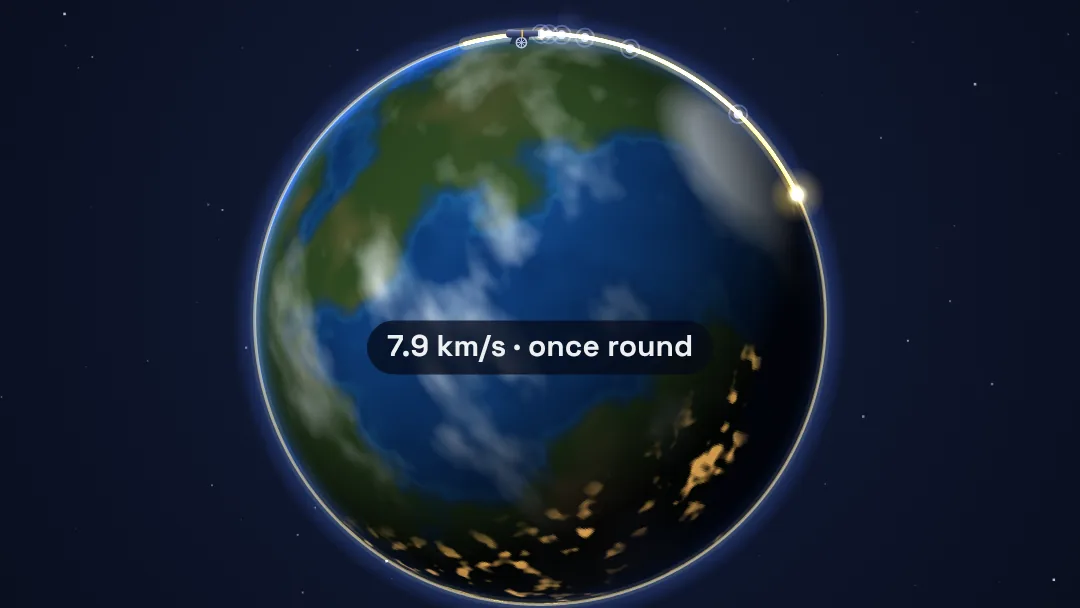 Interactive · Newton's CannonWhy don't satellites fall down?Fire a cannonball faster and faster until it falls around the Earth.
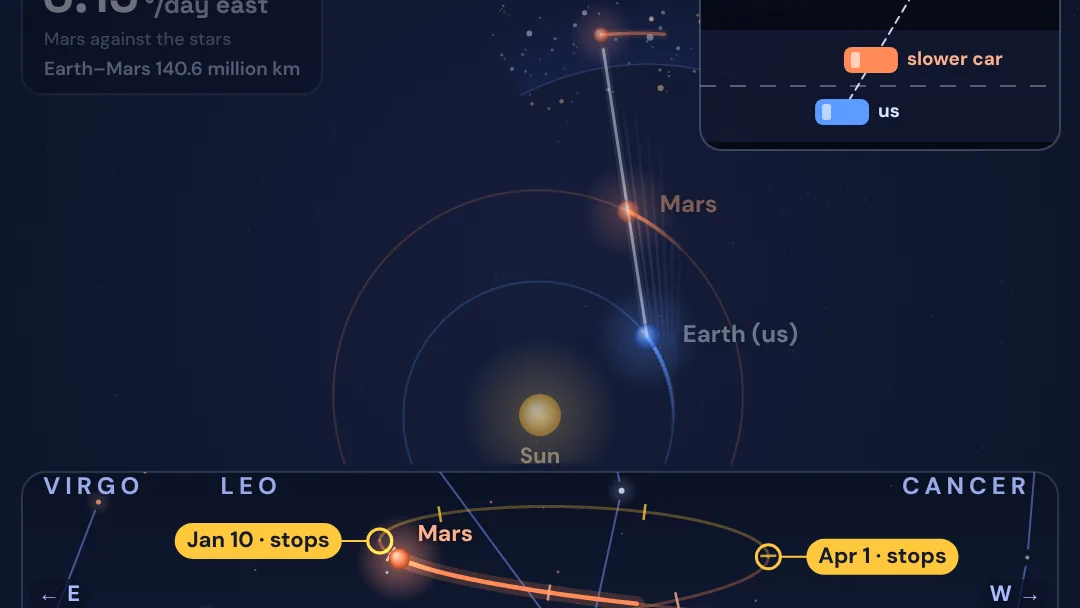 Interactive · Mars LoopWhy does Mars seem to move backward?Inner planets lap outer ones: why Mars seems to move backward.
The Sun’s pull
Every planet is falling around the same star.
 Interactive articleEarth and SunEarth and Sun by Bartosz Ciechanowski: orbits, seasons and the sky.by Bartosz Ciechanowski
Common questions
Why did BepiColombo take eight years to reach Mercury?
Falling toward the Sun speeds a spacecraft up, so on a direct path it would arrive several km/s faster than Mercury and fly past. Nine flybys (one of Earth, two of Venus, six of Mercury) and ion engines braking in between slowed it down enough to be captured.
When did BepiColombo arrive at Mercury?
ESA reported that Mercury orbit insertion began at 18:24 UTC on November 21, 2026, using weak stability capture. It launched on October 20, 2018.
What is weak stability capture?
Arriving so slowly that a planet’s gravity can capture the spacecraft, instead of braking hard with a big engine burn on arrival.
Is Mercury closer to Earth than Mars?
Sometimes, and on average Mercury is the closest planet to Earth (Stockman, Monroe & Cordner, 2019).
Concepts in this guide
Each one has a plain one-line definition in Concepts A–Z, with every model, film and post where it comes up.
Sources and credits
- ESA · BepiColombo Launch, flyby timeline, ion propulsion and the November 2026 orbit insertion.
- T. Stockman, G. Monroe & S. Cordner · Venus is not Earth’s closest neighbor (Physics Today, 2019) On average Mercury is the closest planet to Earth.
- Wikipedia · Vis-viva equation Orbital speed at each distance.
- Wikipedia · Hohmann transfer orbit The simplest path between two circular orbits.
- Mercury Brake Lab · model notesThe simplified drop, the illustrative flyby shares and the capture limit.
Every creator named here made the work we link to. Listing it does not imply a partnership or endorsement.