Space · orbit arrival
Why did reaching Mercury take 8 years?
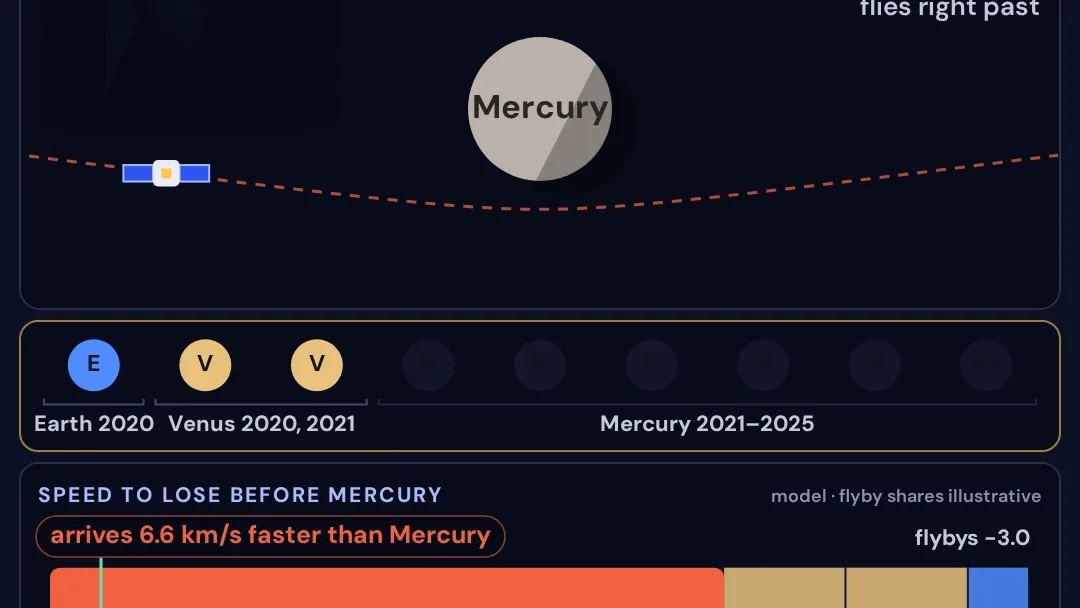
Turn “Flybys used” from none to all nine and “Ion-engine braking” up to the model’s cap, or pick a preset. Watch whether the spacecraft flies past Mercury or is captured.
1 See
Mercury is sometimes closer to us than Mars, yet ESA’s BepiColombo took eight years to get into orbit around it. The problem is not getting there. It is slowing down.
2 Change
3 Understand
Model notes and sources
What happened. ESA’s BepiColombo launched on October 20, 2018. On the way it flew past Earth once (2020), Venus twice (2020 and 2021) and Mercury six times (2021 to 2025), and its transfer module carried ion thrusters (solar electric propulsion) that braked in between. The transfer module separated on September 3, 2026. ESA reported on November 23, 2026 that Mercury orbit insertion began at 18:24 UTC on November 21, using “weak stability capture”: arriving slowly enough that Mercury’s gravity captures the spacecraft. A software issue ended the insertion burn early and put the spacecraft in safe mode, leaving it in an orbit of about 75 hours instead of the planned 58 or so; ESA said no extra burns are needed. The two orbiters, ESA’s MPO and Japan’s Mio, are due to separate on December 9–10, 2026, with science from April 2027.
The idea. Falling toward the Sun is like rolling downhill: you speed up. In this tool’s simple drop from Earth’s orbit to Mercury’s, the vis-viva equation gives about 22.3 km/s on leaving Earth’s orbit and about 57.5 km/s on reaching Mercury’s, where Mercury itself moves at about 47.9 km/s. So the craft arrives about 9.6 km/s faster than Mercury and flies straight past. Each flyby steals some speed, the ion engines brake in between, and only when what is left is small can Mercury hold on to the spacecraft.
The model and its limits. This is a teaching model, not BepiColombo’s trajectory. Orbits are circles in one plane (Earth 1 AU, Mercury 0.387 AU, Mars 1.524 AU); the drop is a single Hohmann transfer, which would take about 3½ months but arrive far too fast. Each flyby’s share of the braking (Earth 0.6 km/s, each Venus flyby 1.2, each Mercury flyby 0.7; 7.2 km/s in all) is illustrative: real gravity assists reshape the whole orbit rather than subtracting a fixed amount. The ion-engine braking is one number capped at an illustrative 4 km/s, standing in for the limits of fuel and time. The capture limit of 0.5 km/s is also illustrative, a stand-in for weak stability capture plus the final insertion burn. The path past Mercury is a two-body hyperbola for the arrival speed; the captured orbit is an illustrative ellipse, not the real orbit. The “Mercury closer than Mars” picture is one real alignment of circular orbits; on average Mercury is the closest planet to Earth (Stockman, Monroe & Cordner, 2019).
The ion engines. BepiColombo’s transfer module carries four QinetiQ T6 gridded ion engines, up to two firing at once, about 145 mN each. The engine panel uses that thrust, a specific impulse of about 4,000 s and the 4,100 kg launch mass in the rocket equation to estimate the firing time and xenon for the chosen braking (about 365 days and 230 kg for 2.3 km/s). It ignores the mass lost along the way and the real thrust arcs, which were split into many periods; the cruise chart simply spreads the ion braking evenly over the eight years.
The film. The mechanism is drawn in code by ExplainerTools, with no AI-generated pictures. The Short also uses short real excerpts, picture only, a few seconds each and credited on screen: European Space Agency (YouTube), sixth Mercury flyby film; ESA Operations, @esaoperations (X). The numbers in the film come from the model, not from the footage.
Sources: ESA/BepiColombo/MTM flyby image sequences (CC BY-SA 3.0 IGO); ESA, BepiColombo mission pages, timeline and orbit-insertion update (November 23, 2026); T. Stockman, G. Monroe & S. Cordner, “Venus is not Earth’s closest neighbor”, Physics Today (2019); Wikipedia, “Vis-viva equation”, “Hohmann transfer orbit” and “Gravity assist”.
An ExplainerTools Original. Mission facts: ESA. Footage: ESA/BepiColombo monitoring cameras and ESA animation.