Topic guide · Sound and the voice
How does one buzz become every vowel?
With two parts that work almost independently. Your vocal folds turn air from your lungs into a buzz: a puff of air about 110 times a second for an average man, a row of harmonics at 110, 220, 330 Hz and up. That buzz is the same for every vowel. The throat and mouth above it are a tube that rings at its own resonances, the formants, and passes the harmonics near them loudly. Move your tongue and jaw and they move: tongue high and forward, an average man’s tube rings at about 340 and 2,300 Hz, “ee”; jaw down and tongue back, about 770 and 1,330 Hz, “ah”. In Vowel Lab you can drag between them and hear it. The first two formants are enough to tell most vowels apart.
- Buzz of an average man’s voice
- ≈ 110 Hz
- “ee” (heed): F1 · F2
- 342 · 2,322 Hz
- “ah” (hod): F1 · F2
- 768 · 1,333 Hz
- Adult male vocal tract
- ≈ 17 cm
Measured averages · men Formants are the mean values Hillenbrand, Getty, Clark and Wheeler measured in 1995 from 45 men saying /hVd/ words; women’s and children’s are higher. Vowel Lab uses these averages.
Interactive · ExplainerTools
Vowel Lab
Drag the gold dot around the vowel map, pick a vowel or change the voice, and press “Hear this vowel”: the same buzz, shaped by the tube’s resonances.
Model · formants of an average voice
How does your body make a voice?
In three steps, from the bottom up.
- Breath
Your lungs push air up the windpipe at a little more pressure than the room.
- Buzz
At the top of the windpipe, the vocal folds close and are blown open again and again, letting the air out in puffs: about 110 a second for an average man’s speaking voice, about 200 for a woman’s. That stream of puffs is the buzz.
- Tube
The buzz passes up through the throat and mouth, and out through the lips (and the nose, for sounds like “m” and “n”). That tube shapes it into a vowel.
Phoneticians call this the source–filter model: the folds are the source, the tube above them the filter. Gunnar Fant set it out in 1960, and it still underlies how speech is analysed and synthesized. The two parts are almost independent, which is why you can sing any vowel on any note.
Why is one buzz a row of pitches?
Because it is a train of sharp puffs, not a smooth wave. A sound that repeats 110 times a second, but is not a pure sine wave, is made of a whole row of pure pitches at 110, 220, 330, 440 Hz and up, the harmonics, each a little weaker than the last. For a voice they fall by roughly 12 dB an octave. You hear the lowest as the note; the rest make it sound like a voice instead of a whistle.
Sing higher and the harmonics spread further apart; sing lower and they crowd together. But they come out of the vocal folds the same whatever vowel you are about to say. The vowel is added on the way out.
How does the tube turn the buzz into “ee” or “ah”?
A tube rings at certain pitches, its resonances, like a bottle you blow across. Harmonics near a resonance come out loud and the rest are damped, so the tube draws a shape over the row of harmonics. The peaks of that shape are the formants, numbered from the lowest: F1, F2, F3.
Moving your tongue, jaw and lips reshapes the tube and moves the formants. Roughly, F1 rises as the jaw opens and the tongue drops, and F2 rises as the tongue moves forward. With the tongue high and forward, an average man’s tube rings at about 342 and 2,322 Hz: “ee” as in “heed”. Drop the jaw and pull the tongue back and the peaks slide to about 768 and 1,333 Hz: “ah” as in “hod”. Those are the averages Hillenbrand and colleagues measured in 1995 from 139 speakers. Plot F1 against F2 and the vowels spread into a map, which is why the first two formants are usually enough to tell them apart; listeners also use F3, how long the vowel lasts and how it glides.
What changes when you sing?
Mostly the source. Singing holds the buzz at a steady pitch and moves it from note to note, often with vibrato, a regular wobble of about five or six times a second. The formants still set the vowel, which is why a choir can sing “ah” on every note of a chord.
There are limits. When a soprano sings a high note, her buzz’s harmonics are so far apart that some formants fall between them, so vowels get harder to tell apart up there, and singers adjust their mouths to keep a harmonic near the first formant. Trained singers also learn to cluster the third to fifth formants together, the “singer’s formant” near 3 kHz, which helps a voice carry over an orchestra.
Can a computer simulate the whole thing?
That is what CHIMERA tries to do. Jameson Hodge’s free, open-source synthesizer runs in the browser and makes every sound from a simulated airway: air moving from lungs through vocal folds into a branched network of tubes for the throat, mouth and nose. It speaks typed text, sings from a piano roll and beatboxes, and in early November 2026 people made it sing barbershop and Queen. Its vowel shapes were tuned to Hillenbrand’s averages, and by its own calibration file their formants land within about 2% of their targets.
Hodge contrasts it with Vocaloid, which, he writes, “stitches together and pitch-shifts phoneme recordings.” It does not sound human yet, and he says he is “still working on improving naturalness by tuning it against recordings of real singers.” Its documents put numbers on the gap: in the project’s own test, the Whisper speech recognizer gets about 37% of its words wrong, against 2.7% for 23 real speakers. Its vocal folds follow a set pattern rather than vibrating on their own, and its “s” sounds are too weak. Held vowels are the easy part; consonants, timing and the folds are hard.
Try it: one buzz, every vowel
- 1 See
Open Vowel Lab. It starts on ee · heed: F1 342 Hz, F2 2,322 Hz. Press Hear this vowel.
- 2 Change
Tap ah · hod, or drag the gold dot down and to the right. F1 rises to 768 Hz and F2 falls to 1,333 Hz; the harmonics stay where they were, only their loudness changes.
- 3 Understand
Turn Pitch of the buzz up and down: the vowel stays “ah”. Then set Voice to Child: every formant moves up, because a shorter tube rings higher.
Where does this model stop?
Vowel Lab is a formant model of an average voice: a buzz with harmonics falling 12 dB an octave, shaped by four resonances placed at measured averages. Real vowels glide, change with the sounds around them, and vary widely between speakers and accents; the averages hide that spread. The model has no nose, no breath noise and no consonants, and its sound is a classic formant synthesizer’s, robotic on purpose.
The side view of the airway is simplified and not to scale. It follows the rule of thumb that F1 tracks the jaw and F2 the tongue’s front-to-back position, which is a textbook simplification, not a measurement. CHIMERA’s figures are from its own repository: its calibration compares the formants of its static vowel shapes, not of its rendered audio, with their targets.
Explore by question
A buzz, a tube and the ear. Each card answers one part of the question, with why it belongs here.
Vowel Lab
Model · formants of an average voice
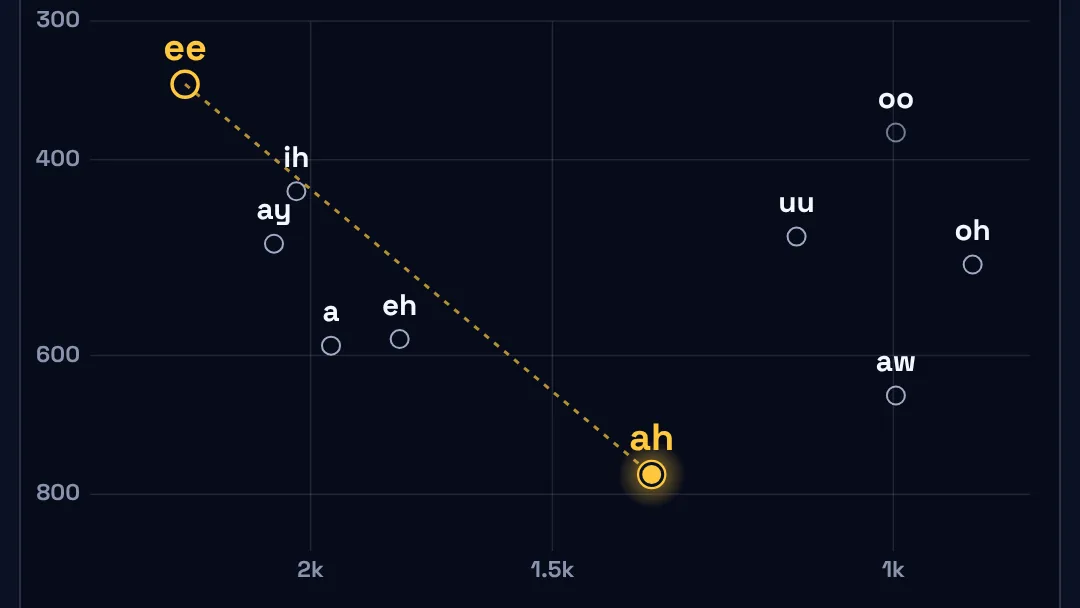 Interactive · Vowel LabHow does one buzz become every vowel?Drag the tongue around a vowel map and hear the same buzz become “ee”, “ah” and “oo”.
- Short · 67 secondsHow does one buzz become every vowel?CHIMERA speaks and sings, then the same buzz slides from “ee” to “ah”. Narrated and captioned.
- JournalHow does one buzz become every vowel?Your vocal folds make the same buzz for every vowel. The throat and mouth are a tube, and its resonances, the formants, decide whether you hear “ee” or “ah”.
A voice simulated from the airway
CHIMERA models the air itself, from lungs to lips and nose, and shows the formants live.
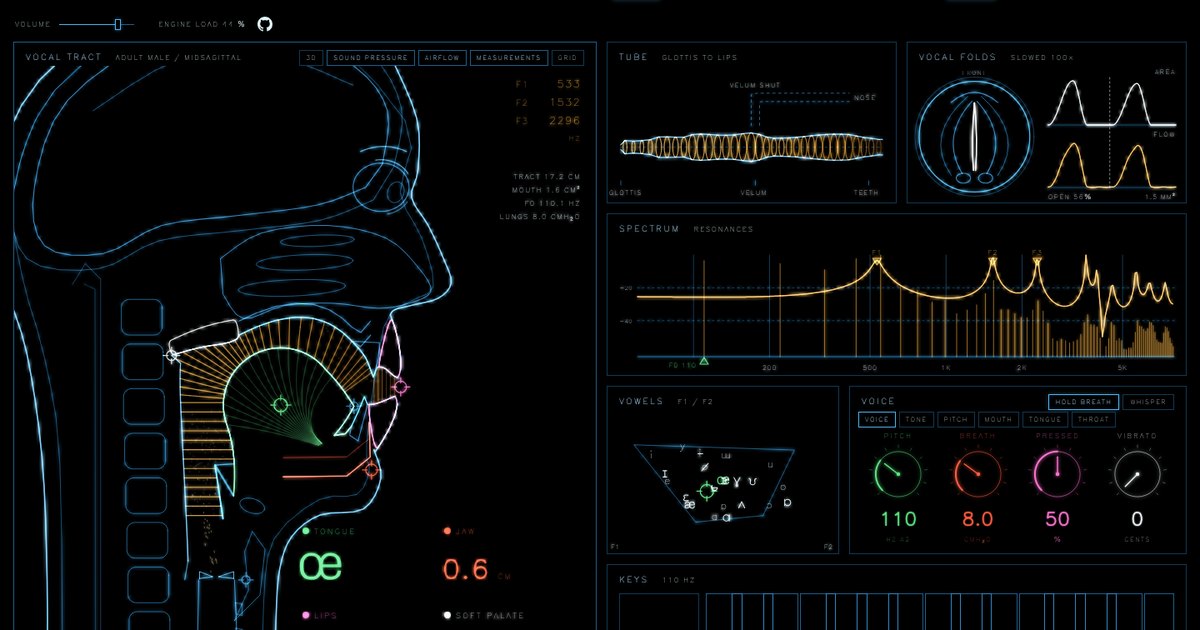 Interactive demoCHIMERA vocal synthDrag the tongue, lips and jaw, type something to say, or sing from a piano roll, and watch the pressure and formants move.by Jameson Hodge
What sound is
A voice is a pressure wave in air like any other sound.
 Interactive articleSoundAn illustrated, hands-on article on how sound travels through air as waves of pressure.by Bartosz Ciechanowski
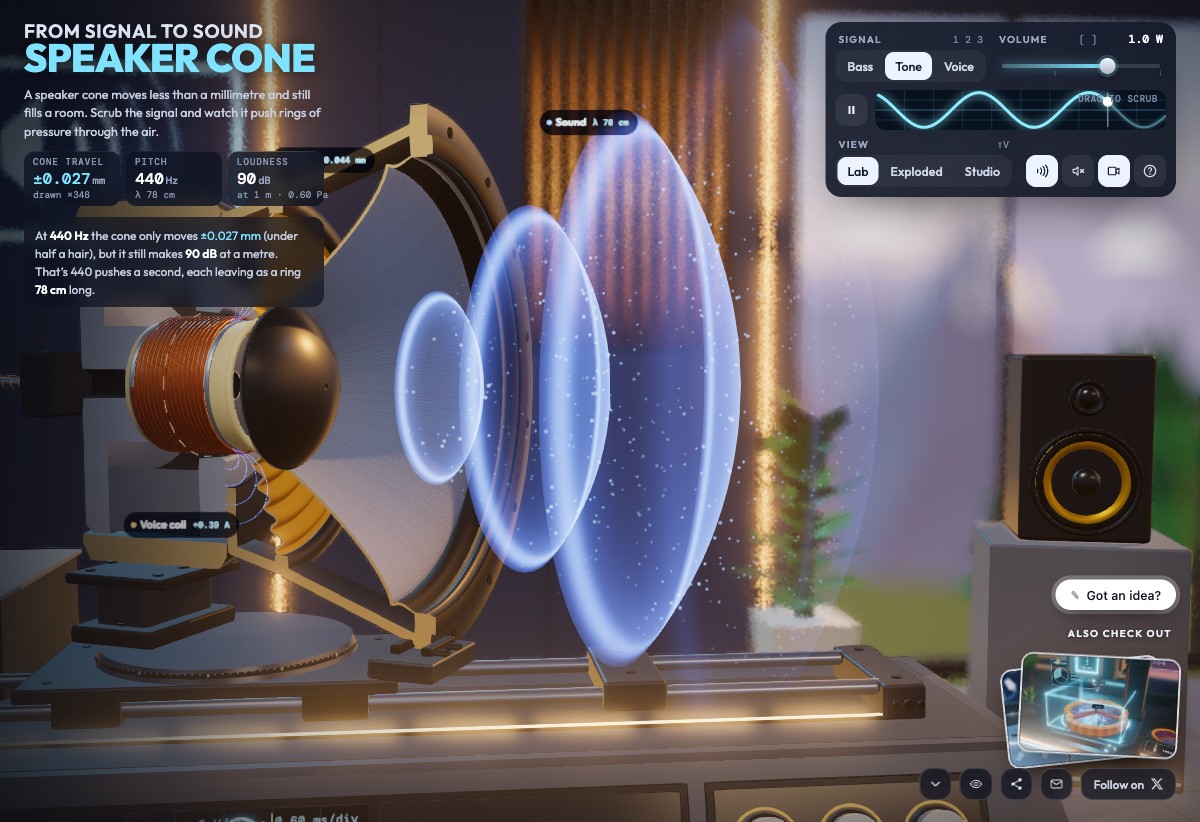 Interactive demoSpeaker Cone LabHow a speaker cone pushes air back and forth to make sound, the electrical cousin of a voice.by Ryan Sael · Opens on the creator’s site
One sound, many pitches
The buzz is a row of harmonics; any repeating sound can be built from pure tones.
- Interactive demoFourier SeriesAdd sine waves together and hear a buzz, a square wave or a sawtooth take shape.by Paul Falstad
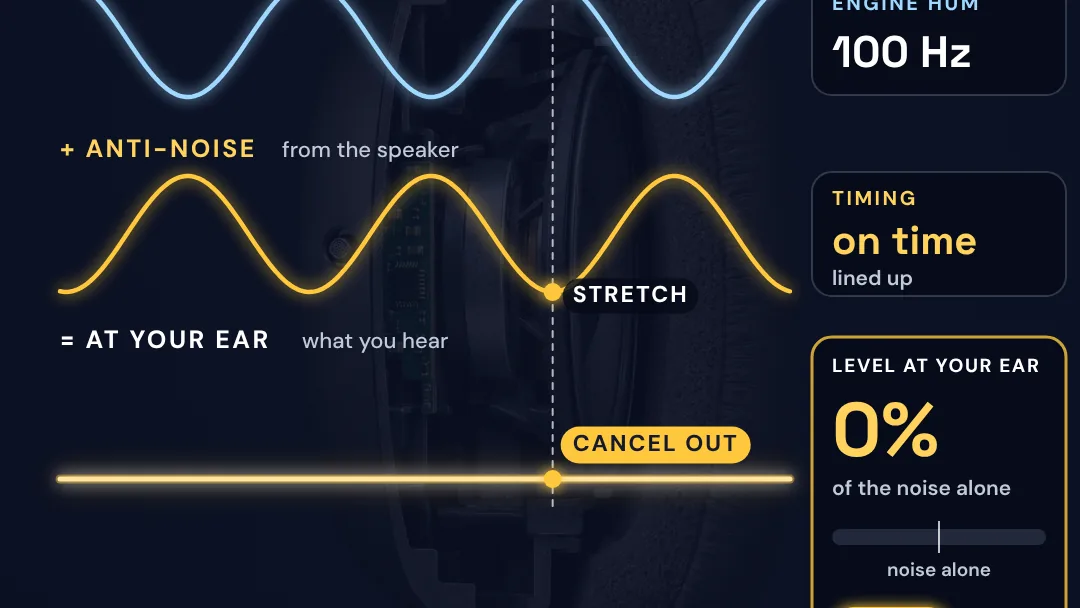 Interactive · Noise Cancelling LabHow do noise-cancelling headphones work?Sound waves add and cancel: play anti-noise against a hum and watch it disappear.
Common questions
Why can I sing any vowel on any note?
Because the note and the vowel come from different places. The note is how fast your vocal folds buzz; the vowel is the shape of the tube above them. Change one and the other can stay put, though very high notes make vowels harder to tell apart.
What is a formant?
A resonance of the throat and mouth: a band of pitches the tube lets through loudly. The first two, F1 and F2, are enough to tell most vowels apart. For an average man, “ee” rings at about 342 and 2,322 Hz and “ah” at about 768 and 1,333 Hz.
Why do children’s and women’s voices have higher formants?
Mostly because their vocal tracts are shorter, and a shorter tube rings at higher pitches. In Hillenbrand’s 1995 averages, “ee” is about 342/2,322 Hz for men, 437/2,761 Hz for women and 452/3,081 Hz for children aged 10 to 12.
Is CHIMERA an AI voice?
No. It is a physics simulation: every sound comes from simulated air moving through a model of the lungs, vocal folds, throat, mouth and nose, with no recordings. Its own repository notes that AI coding agents helped write and tune the code.
How accurate is CHIMERA?
Its vowel shapes are close: by its own calibration file, their formants are within about 2% of their targets on average. Its running speech is not yet natural: in its own test, a speech recognizer gets about 37% of its words wrong, against 2.7% for real speakers.
Sources and credits
- Hillenbrand, Getty, Clark & Wheeler · Acoustic characteristics of American English vowels (J. Acoust. Soc. Am., 1995) Mean formants of 12 vowels from 45 men, 48 women and 46 children: the numbers in Vowel Lab and this guide.
- G. Fant · Acoustic Theory of Speech Production (1960) The source–filter model of speech; the link is the Wikipedia summary.
- Jameson Hodge · CHIMERA vocal synth (GitHub) README, architecture notes, its vowel calibration file (about 2% average formant error) and its speech comparison (Whisper: about 37% of its words wrong, 2.7% for 23 real speakers).
- CHIMERA · live app The synthesizer itself, free in the browser.
- Wikipedia · Formant Formant frequencies, the vowel chart and the singer’s formant.
- Vowel Lab · model notesThe source spectrum, the four resonances, the bandwidths and what the model leaves out.
Every creator named here made the work we link to. Listing it does not imply a partnership or endorsement.