Sound · interactive
How does one buzz become every vowel?
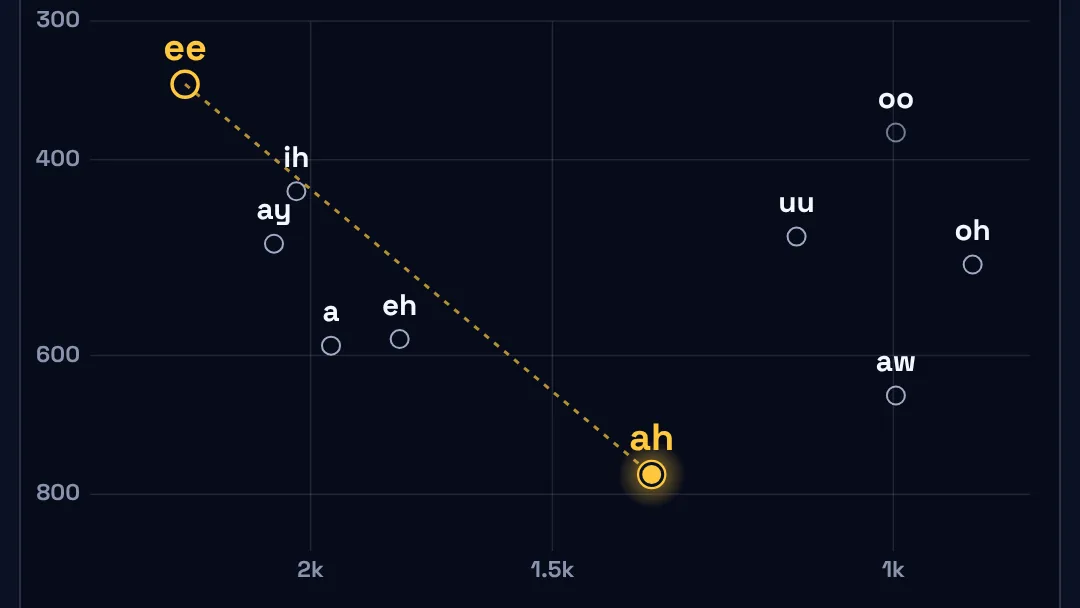
Drag the gold dot on the vowel map, pick a vowel, or change the voice. Press “Hear this vowel” to hear the buzz through the tube.
1 See
Every vowel you speak starts as the same buzz from your vocal folds. So what makes “ee” sound different from “ah”?
2 Change
3 Understand
Model notes and sources
Model. This is the source–filter model of speech (Fant, 1960). The source is the buzz of the vocal folds: a puff of air at every vibration, f0 times a second (about 110 Hz for an average man, 200 Hz for a woman). A train of puffs is a row of harmonics at f0, 2f0, 3f0 …, and for a voice they fall by roughly 12 dB an octave (the model uses 1/n² for harmonic n). The filter is the throat and mouth, a tube about 17 cm long in an adult man, which rings at its resonances, the formants F1, F2, F3 …. The model draws the tube as four second-order resonances in a row, with bandwidths of 60, 90, 150 and 200 Hz, and adds the open mouth’s +6 dB an octave. The sound you hear is each harmonic’s strength times the tube’s gain at its pitch.
The numbers. The rings on the vowel map are the measured averages of Hillenbrand, Getty, Clark & Wheeler (1995): twelve American English vowels spoken in /hVd/ words (“heed”, “hod”, “who’d” …) by 45 men, 48 women and 46 children aged 10 to 12. For an average man, “ee” (/i/) rings at 342 and 2,322 Hz and “ah” (/ɑ/) at 768 and 1,333 Hz. F4 is a fixed 3,500, 4,100 or 4,500 Hz, a typical value. The “Voice” control swaps between the three groups’ averages; you can also drag anywhere on the map, between vowels.
How the drawing moves. The side view is simplified and not to scale. Roughly, F1 rises as the jaw opens and the tongue drops, and F2 rises as the tongue moves forward; rounded back vowels like “oo” also push the lips out. The drawing follows that rule of thumb. It is the textbook simplification, not a measurement: the exact shape behind a pair of formants differs from person to person.
The sound. “Hear this vowel” plays a buzz with every harmonic at 1/n (the source and the mouth’s radiation together) through four band-pass filters at F1–F4 in parallel, a classic formant synthesizer (Klatt, 1980). It sounds robotic on purpose: real voices add breath, jitter and changing pitch.
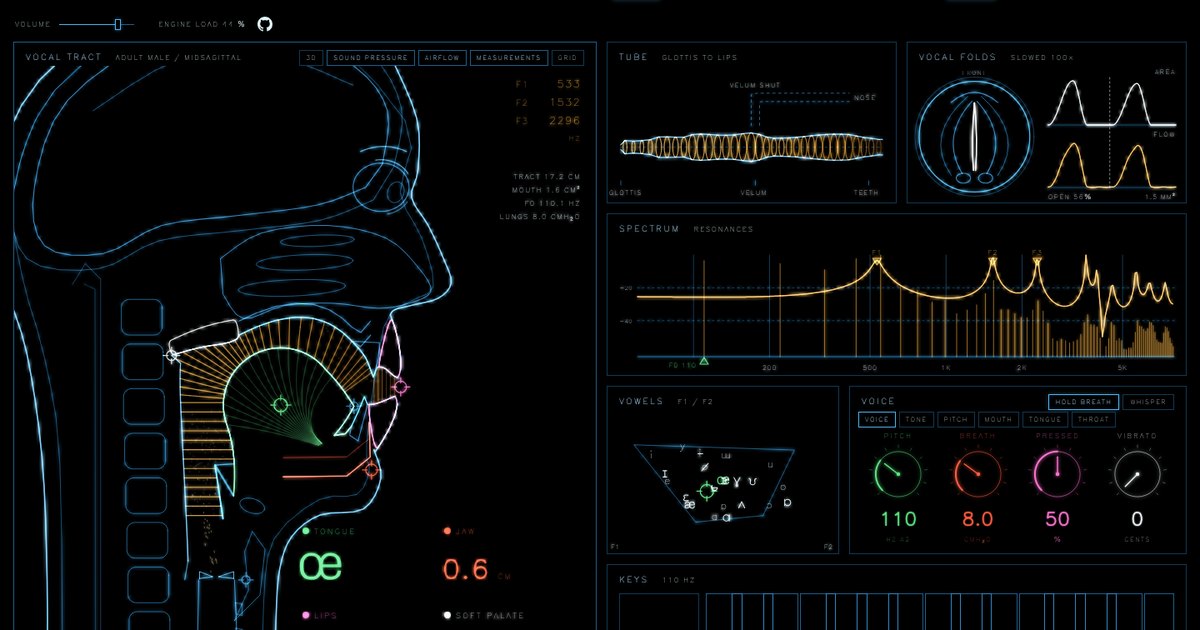
CHIMERA. The film features CHIMERA, a free, open-source (MIT) voice synthesizer by Jameson Hodge that runs in the browser. Instead of a formant model, it simulates air moving through a branched tube network, lungs to lips and nose, in the time domain. Its vowel shapes were tuned to Hillenbrand’s averages (and literature values for non-English vowels): over 22 vowels, the formants of its static shapes are within 2.0% of their targets on average for a man (2.3% woman, 2.4% child), by its own calibration file. In its own speech test, the Whisper speech recognizer gets about 37% of its words wrong, against 2.7% for 23 real speakers. In the film, the opening line and the held “ee” and “ah” are our screen recordings of CHIMERA’s live app, with its own sound (chimera-vocal-synth.vercel.app, source on GitHub). Three short clips posted on X appear picture only and credited on screen: Jameson Hodge’s duet, Klaus Brave’s Mr. Sandman quartet and @frolic’s Bohemian Rhapsody choir. The airway, spectra, vowel map and charts are drawn in code by ExplainerTools.
Limits. Real vowels are not static: they glide, and their formants depend on the sounds around them. Pitch, duration and F3 also help listeners tell vowels apart, and the averages hide wide spreads between speakers and accents. The model has no nose, no breath noise and no consonants.
Sources: G. Fant, Acoustic Theory of Speech Production (Mouton, 1960); J. Hillenbrand, L. A. Getty, M. J. Clark and K. Wheeler, “Acoustic characteristics of American English vowels”, J. Acoust. Soc. Am. 97 (5), 3099 (1995); G. E. Peterson and H. L. Barney, “Control methods used in a study of the vowels”, J. Acoust. Soc. Am. 24, 175 (1952); D. H. Klatt, “Software for a cascade/parallel formant synthesizer”, J. Acoust. Soc. Am. 67, 971 (1980); J. Hodge, CHIMERA vocal synth (README, docs/architecture.md, docs/speech-comparison.md and its vowel calibration file, November 2026).
An ExplainerTools Original. Featuring CHIMERA by Jameson Hodge (chimera-vocal-synth.vercel.app).