Topic guide · Brain and vision
How could Neuralink’s Blindsight let a blind person see?
By skipping the eyes and drawing on the brain directly. Seeing happens in the visual cortex at the back of the brain. Stimulate one spot of it and a person sees a dot of light, a phosphene, always at the same place in view. A camera can then turn each frame into a pattern of dots, one per electrode, bright where the scene is bright. The number of electrodes sets the resolution: in Phosphene Lab, 60 dots read as a scatter of stars and about 1,000 start to draw a doorway. Elon Musk said in late October 2026 that Blindsight is “ready from an engineering standpoint” and waiting on regulatory approval; no human results have been published.
- Dots per electrode
- 1 (best case)
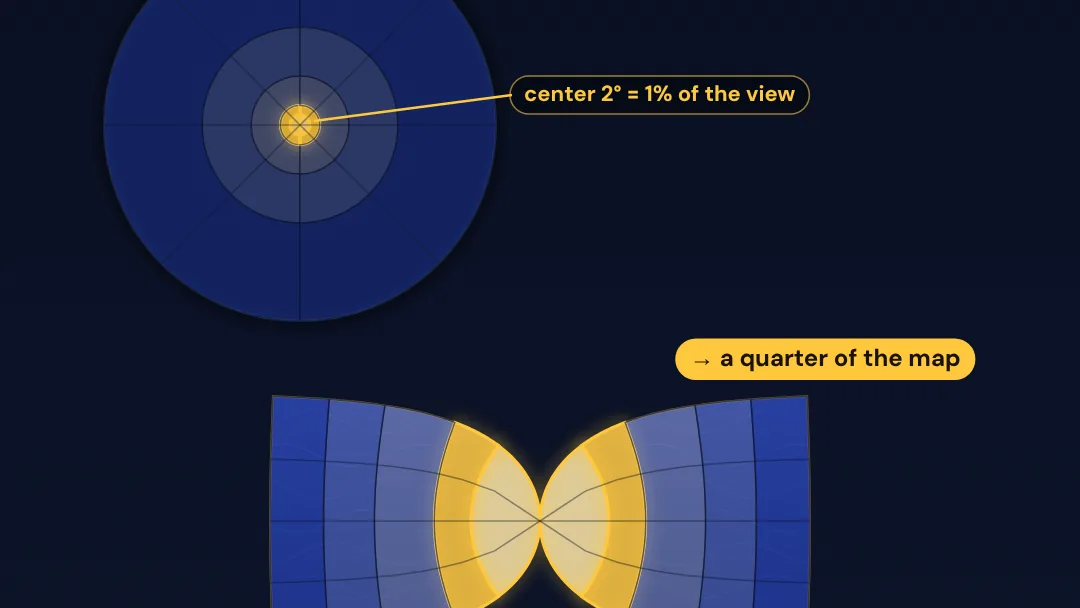
- Center 2° of a 20° view
- 1% of the view, ≈ ¼ of the map
- 1,024 dots, gap at center
- 0.09°
- 1,024 dots, gap at 20°
- 2.5°
Model · phosphene map, simplified Electrodes spread evenly over the brain’s map of the central 20° of view, with cortical magnification 17.3/(E + 0.75) mm of cortex per degree (Horton & Hoyt, 1991). Neuralink has not published Blindsight’s electrode count.
Interactive · ExplainerTools
Phosphene Lab
Add electrodes from 1 to 10,000 and watch dots of light turn from a scatter of stars into a doorway, a letter or a face. Hover to see where a point of view sits on the brain’s map; drag to look around.
Model · phosphene map, simplified
How could an implant let someone see?
In three steps, none of which uses the eyes.
- Camera
A small camera, for example on a pair of glasses, sees the scene. A computer turns each frame into a pattern: which electrodes to pulse, and how strongly.
- Electrodes
Fine electrodes in the visual cortex, at the back of the brain, deliver tiny pulses of current to the cells around them.
- Dots
Each pulse makes the person see a dot of light, a phosphene, at one fixed place in their view. Together the dots draw a rough picture of the scene.
Phosphenes are not new. Neurosurgeons have made people see them by stimulating the visual cortex for decades, and blind volunteers have tested cortical implants. In a 2021 study Eduardo Fernández and colleagues placed 96 electrodes in the visual cortex of a blind woman for six months; patterns of dots let her identify some letters and the edges of objects. The idea only works if the visual cortex is intact, which is why it suits blindness from damage to the eye or the optic nerve.
Why do the dots crowd into the middle?
Because the visual cortex is a map of what you see, and the map is out of proportion. Neighboring spots of cortex see neighboring points of view, but the center of view, where you read and recognize faces, gets far more cortex than the edges. Horton and Hoyt’s classic 1991 measurement gives about 17.3 ÷ (E + 0.75) millimeters of cortex for each degree of view at E degrees from the center: about 23 mm per degree at the center and 1.6 mm at 10°.
In Phosphene Lab, which uses that rule, the central 2° of a 20° view is 1% of its area but takes about a quarter of the cortex, and the central 5° about half. So electrodes spread evenly over the brain land densely in the middle of the view and sparsely at the edges. With 1,024 of them over the map of the central 20°, neighbors sit about 2.1 mm apart on the cortex. In the view, that is 0.09° apart at the center and 2.5° apart at the edge: sharp in the middle, coarse at the edges.
How many electrodes does a picture take?
Roughly one dot per electrode, so the electrode count is the resolution, and it has been small. Second Sight’s Orion implant, tested in six people from 2018, had 60 electrodes on the surface of the visual cortex. Fernández’s 2021 array had 96. Illinois Tech’s wireless implant, first placed in 2022, has 400. In monkeys, Xing Chen and colleagues implanted 1,024 electrodes in 2020; hundreds of them made phosphenes, and the animals recognized shapes, motion and letters drawn in dots.
In the model, 60 dots read as a scatter of stars: you could find a bright doorway but not its shape. About 1,000 start to draw it, the same count as Neuralink’s N1 chip, which has 1,024 electrodes on 64 threads. Neuralink has not published how many electrodes Blindsight will have, so the doorway is the model’s picture, not a preview of the device.
What has Neuralink said about Blindsight?
Neuralink announced on September 17, 2024, that the FDA had given Blindsight Breakthrough Device designation, which speeds up review; it is not an approval. Elon Musk wrote then that the vision will “at first be low resolution, like Atari graphics”, and that it could one day be better than natural vision and see in infrared or ultraviolet. Those are his claims.
At the end of October 2026 Musk posted that Blindsight is “ready from an engineering standpoint. Just waiting on regulatory approval.” He did not say which approval. As of early November 2026, Drug Development & Delivery reports, no Blindsight trial was listed on ClinicalTrials.gov and no human results had been published. In its June 2025 update Neuralink showed a “Calibrated Vision” simulation of letters drawn in dots; that is a company simulation, not a recording of what anyone saw.
Try it: add the electrodes
- 1 See
Open Phosphene Lab. It starts at Neuralink N1 · 1,024 with A doorway. Gap between dots reads 0.09° at the center and 2.5° at the edge, and Dots in the middle 5° reads 50%: the dots crowd into the middle.
- 2 Change
Tap Orion implant · 60. The doorway falls apart into a scatter of stars: the gap is 0.37° at the center and 10° at the edge, and Same pixel count as reads ≈ 8 × 8. Then tap Utah array, 2021 · 96 and Illinois ICVP · 400 and watch the shape come back.
- 3 Understand
Tap Neuralink N1 · 1,024 again and drag Field covered down to 8°. The same electrodes, squeezed into the middle: 76% of the dots fall within 5°, and the doorway is sharp but it is tunnel vision. Then tap Ten thousand (future) and switch to A face.
Where does this model stop?
Phosphene Lab is a best case. It spreads the electrodes evenly over the brain’s map of the central 20° of view and gives each one exactly one dot, at the place the map says. Real phosphene maps are irregular. Not every electrode makes a dot, and size, brightness and color vary with the current and the spot. Stimulating many electrodes at once can merge or fade dots.
Real arrays cover a small patch of cortex, not the whole map of the central 20°, and much of the visual cortex, especially the map of the outer view, lies deep inside a fold. Phosphenes are fixed to the brain’s map, so they move with the eyes: a head camera works best if the eyes stay still or are tracked. Whether people blind from birth would see phosphenes at all is an open question. The film uses short, credited excerpts of Neuralink’s own videos on YouTube; the dots, the brain map and the numbers come from the model.
Explore by question
A brain implant replaces the eye and the camera’s sensor with dots of light. Each card answers one part of the question.
Phosphene Lab
Model · phosphene map, simplified
 Interactive · Phosphene LabHow could a brain implant let a blind person see?Add electrodes from 1 to 10,000 and watch dots of light turn from a scatter of stars into a doorway, a letter or a face.
- Short · 43 secondsHow could a brain implant let a blind person see?One electrode, one dot; the brain’s stretched map; and 1,024 dots drawing a doorway. Narrated and captioned.
- JournalHow could a brain implant let a blind person see?Elon Musk says Neuralink’s Blindsight is ready, waiting on regulators. Zap one spot of the visual cortex and a person sees a dot of light; enough dots draw a picture.
What the eye does first
The implant skips the eye. These show what the eye’s lens and retina do with light before the brain sees anything.
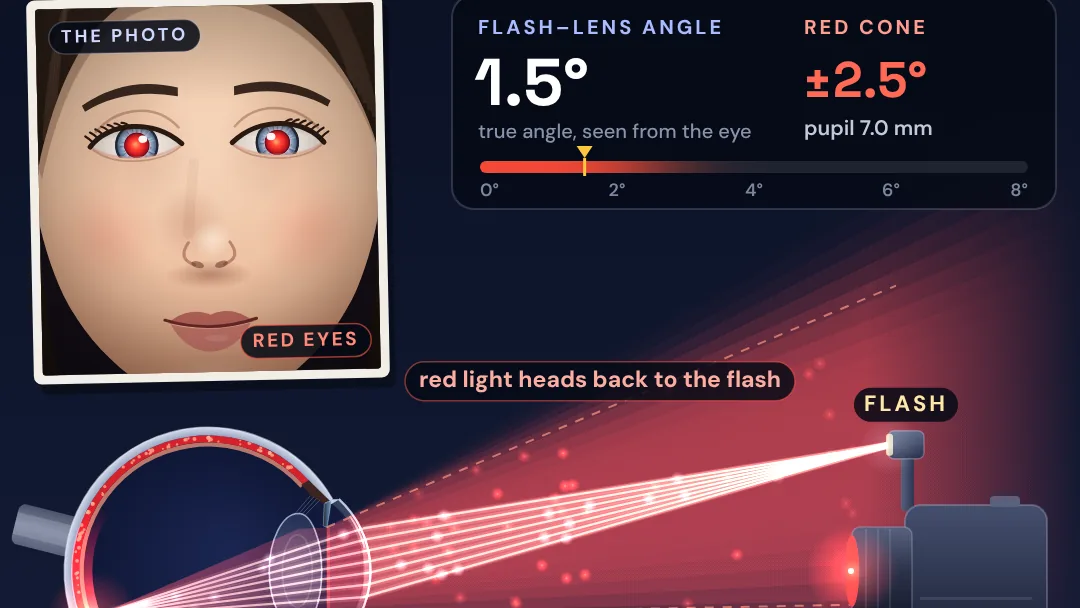 Interactive · Red-Eye LabWhy do eyes glow red in flash photos?Slide a camera’s flash away from its lens and watch light bounce off the retina at the back of the eye, or miss the lens.
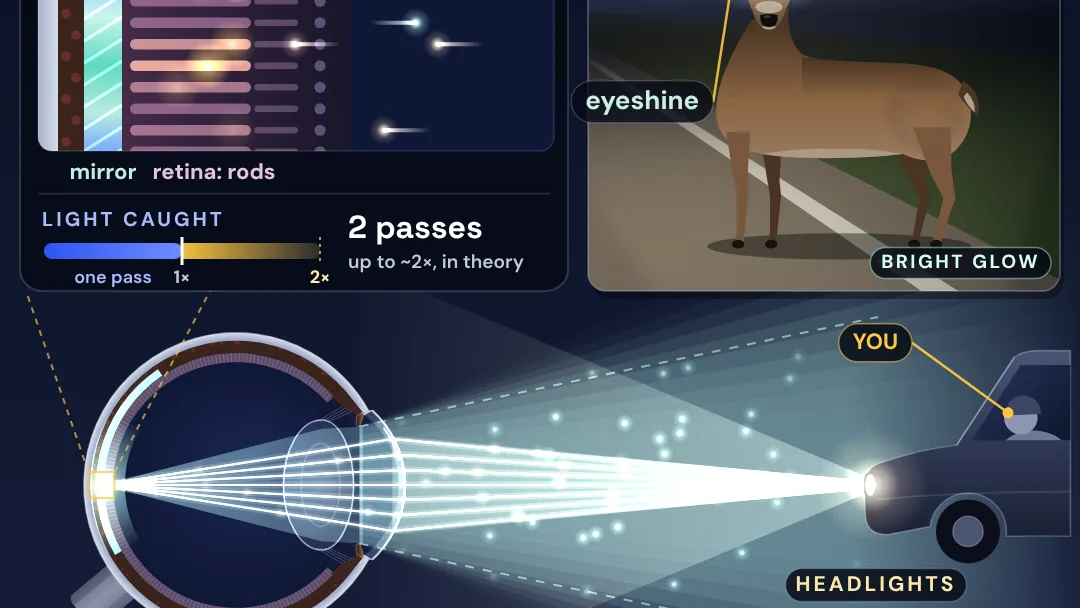 Interactive · Eyeshine LabWhy do deer freeze in your headlights?Take the mirror out of a deer’s eye, the layer that helps it see in the dark, and watch its eyeshine vanish.
How a camera makes a picture
The camera is the implant’s eye. These explain how a lens and a grid of pixels turn a scene into numbers.
- Interactive articleCameras and LensesBuild up a camera from a pinhole to a lens and a sensor, one interactive diagram at a time.by Bartosz Ciechanowski
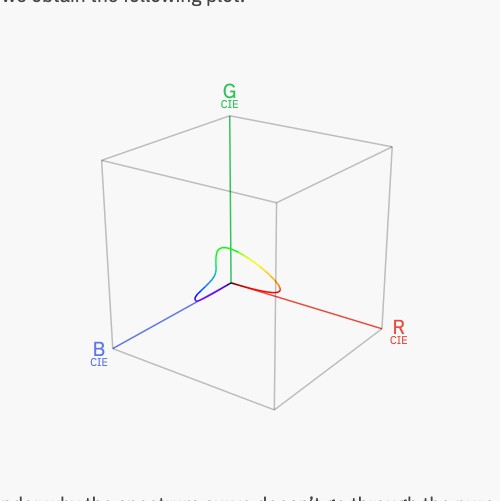 Interactive articleColor SpacesColor matching, gamuts and the coordinate systems screens use to describe the colors we see.by Bartosz Ciechanowski
Common questions
What is a phosphene?
A dot of light you see without light entering the eye. Pressing on a closed eye makes one; so does a small electrical pulse in the visual cortex. Each spot of the cortex makes its phosphene at the same place in view, which is what lets an implant draw with them.
Why would the first images be low resolution?
Because each electrode makes roughly one dot, and implants so far have had tens to hundreds of electrodes. In our model, 60 dots read as a scatter of stars and about 1,000 start to draw a doorway, sharp in the middle and coarse at the edges. Musk says Blindsight will at first look like Atari graphics.
Has anyone seen with a brain implant before?
Yes, crudely. People with Second Sight’s 60-electrode Orion implant saw spots of light, and a blind woman with a 96-electrode array in 2021 could identify some letters and the edges of objects from patterns of dots. In 2020, monkeys with a 1,024-electrode implant recognized shapes and letters.
Could it work for someone blind from birth?
Musk has said it could, provided the visual cortex is intact. Researchers call it an open question: a visual cortex that has never received signals from the eyes may not turn a pulse into a usable dot of light. No results have been published.
Is Blindsight approved?
No. The FDA gave it Breakthrough Device designation in September 2024, which speeds up review but is not an approval. In late October 2026 Musk said it was waiting on regulatory approval. As of early November 2026 no Blindsight trial was listed on ClinicalTrials.gov.
Sources and credits
- Journal of Clinical Investigation · Visual percepts evoked with an intracortical 96-channel microelectrode array inserted in human occipital cortex (Fernández et al., 2021) A 96-electrode array in the visual cortex of a blind 57-year-old for six months: patterns of phosphenes let her identify some letters and object boundaries.
- Science · Shape perception via a high-channel-count neuroprosthesis in monkey visual cortex (Chen, Wang, Fernández and Roelfsema, 2020) A 1,024-channel implant in monkey visual cortex: phosphenes on hundreds of electrodes, and the animals recognized shapes, motion and letters.
- Archives of Ophthalmology · The representation of the visual field in human striate cortex (Horton and Hoyt, 1991) The revised map of human visual cortex: far more cortex for central vision. The model’s 17.3/(E + 0.75) mm per degree.
- The Debrief · Neuralink receives FDA Breakthrough designation for Blindsight (2024) September 2024: the designation, and Musk’s “low resolution, like Atari graphics” and better-than-natural-vision claims.
- Drug Development & Delivery · Blindsight faces questions over clinical readiness (2026) November 2026: Musk’s October post, no Blindsight trial on ClinicalTrials.gov and no published human results.
- Phosphene Lab · model notesThe brain map, the even spread of electrodes, dot size, the readouts, every implant’s electrode count and what the model leaves out.
Every creator named here made the work we link to. Listing it does not imply a partnership or endorsement.