Topic guide · Sound and privacy
Can a plane’s sound give away where a video was filmed?
Sometimes, with a lot of work and the right planes overhead. As a plane passes, its hum drops in pitch: the sound waves bunch up ahead of it and stretch out behind. How quickly the pitch falls depends on how far away you are. In Flyover Doppler Lab, half the drop takes 4.8 seconds right under a turboprop 300 m up at 70 m/s, and about 25 seconds 1.5 km to the side. Planes broadcast their position once a second, so their tracks are public: one flyover puts the listener on a line either side of its track, and a second flyover crosses it. In November 2026 the YouTuber Colsto said he located a security-camera clip to within about 100 m this way, TechRadar reports. That figure is his own and has not been independently checked.
- Coming → going, 70 m/s
- 126 → 83 Hz
- Half the drop, right under
- 4.8 s
- Half the drop, 1.5 km to the side
- ≈ 25 s
- Position reports (ADS-B)
- once a second
Model · straight, level, steady flyover A 100 Hz engine tone on a plane 300 m up at 70 m/s, in still air (sound at 343 m/s), heard from flat ground. Half the drop is the time the pitch takes to fall from 75% to 25% of the way down. The ADS-B rate is the FAA’s.
Interactive · ExplainerTools
Flyover Doppler Lab
Move a listener away from a plane’s flight path, or change its speed and altitude. Watch the drop in its hum stretch out, and the lines on the map where everyone hears the same curve.
Model · straight, level, steady flyover
Why does a passing plane’s hum drop in pitch?
In three steps. The engine’s note never changes; what changes is how often its sound waves reach you.
- Coming
Each wave the plane sends starts a little closer to you than the one before, so the waves arrive bunched up. More waves a second sounds like a higher note.
- Overhead
For a moment the plane moves neither toward you nor away, and the bunching fades.
- Going
Now each wave starts a little further away, so they arrive stretched out, and the note sounds lower.
This is the Doppler effect. For a moving source in still air, the pitch you hear is the source’s pitch × c ÷ (c − v cos θ), where c is the speed of sound, v the plane’s speed and θ the angle between its heading and the line to you when it sent that sound. Take a turboprop on approach at 70 m/s whose propeller hums at 100 Hz, about what a six-blade propeller makes at 1,000 rpm. Coming, you hear about 126 Hz; going, about 83 Hz. Those two ends depend only on the plane’s speed, not on where you stand.
Why does the drop give away your distance?
Because of how fast the angle changes. Right under the plane, it swings from “coming” to “going” in a few seconds. Far to the side, the plane is never close, so the angle turns slowly and the same fall from 126 to 83 Hz is stretched out. In the model, half of the drop takes 4.8 seconds right under a plane 300 m up, 17 seconds 1 km to the side and about 25 seconds 1.5 km to the side. At its steepest the pitch falls 5.1 Hz a second right under the plane and only 1.0 Hz a second 1.5 km away.
The rule of thumb: half the drop takes about 1.15 × the closest distance ÷ the plane’s speed. So if you know the speed, the drop gives the distance. And there is a neat bonus. The halfway pitch, about 104 Hz here, arrives at the very moment the plane is closest, even though each sound takes time to reach you. Fitting this curve to estimate an aircraft’s speed and altitude from the ground is an established acoustics technique; B. G. Ferguson described it for propeller aircraft in the Journal of the Acoustical Society of America in 1992.
How does a distance become a place?
With public flight tracks. Aircraft with ADS-B broadcast their GPS position, altitude and ground speed once a second, the FAA says. The signals are not encrypted, and networks of hobbyist receivers collect and archive them. Match a drop to the plane that made it, and you know its speed, its altitude and its track.
Then the geometry does the rest. Everyone at the same distance from a straight track hears the same curve, so one flyover puts the listener somewhere on a line either side of it. A second flyover from another direction gives a second pair of lines, and the pairs cross at four spots. The time between the two drops is what picks one.
In early November 2026 the security researcher and YouTuber Colsto showed this at full scale in “I discovered a sound that leaks your exact location (and it’s everywhere)”. He says he located a security-camera clip to within about 100 m from the curves of two flyovers, 920 seconds apart, and the silence of a third flight, matched against about 50 GB of US flight data. He says the work took months and more than 5,000 lines of code, and he is not releasing any software or tools. The 100 m figure is his claim; it has not been independently checked.
What does this mean for the videos you post?
That background sound carries information, even when it sounds like silence. Colsto’s clip was a quiet security-camera recording of trees and a riverbank; the planes in it were faint enough to need a spectrogram to see. This is an open-source-intelligence technique, and it works on a recording without its maker knowing.
It is also hard to do. It needs planes loud enough to show up, flights with public tracks, a rough idea of when and where the video was made, and a lot of computing. Colsto himself calls the odds of someone doing this “pretty slim”, TechRadar reports, and he says ordinary noise reduction may not remove the clue. Flyover Doppler Lab explains the physics only: it does not analyse audio, look up flights or locate anyone.
Try it: walk away from the flight path
- 1 See
Open Flyover Doppler Lab and tap Under the approach path. Pitch: coming → going reads 126 → 83 Hz, Half the drop takes 4.8 s and Closest distance 300 m.
- 2 Change
Tap 1 km to the side, or drag the gold pin away from the track. The two ends stay at 126 and 83 Hz, but half the drop now takes 17 s and Steepest drop falls from 5.1 to 1.5 Hz/s. Two blue lines appear, 1 km either side of the track: anyone on them hears this same curve.
- 3 Understand
Watch the second flight’s gold lines cross the blue ones at four circled spots. Then tap Cruising jet overhead: 304 → 60 Hz, half the drop takes 37 s, and each sound needs about 29 s just to reach you from 10 km up.
Where does this model stop?
Flyover Doppler Lab flies a straight, level plane at a steady speed through still air, with one engine tone and a listener on flat ground. Real air has wind and temperature layers that bend sound and change its speed: it is about 300 m/s at cruising altitude, not 343. Real planes curve, climb and slow down, buildings and the ground echo, and an engine makes many tones at once. A real search fits the whole curve against many candidate flights and places, with terrain and weather, rather than reading off one number.
The 100 Hz tone is an example; the shape of the drop, and so the distance, does not depend on it. The map is stylized, not a real place, and the plane is sped up so it passes every few seconds. The film opens with a phone video of a jet over a New York street (While on my Journey on YouTube) and uses two short excerpts of Colsto’s video, all credited on screen; the pitch card over the street clip is the model, not that plane’s recording.
Explore by question
A plane’s hum, the speed of sound and a little geometry. Each card answers one part of the question, with why it belongs here.
Flyover Doppler Lab
Model · straight, level, steady flyover
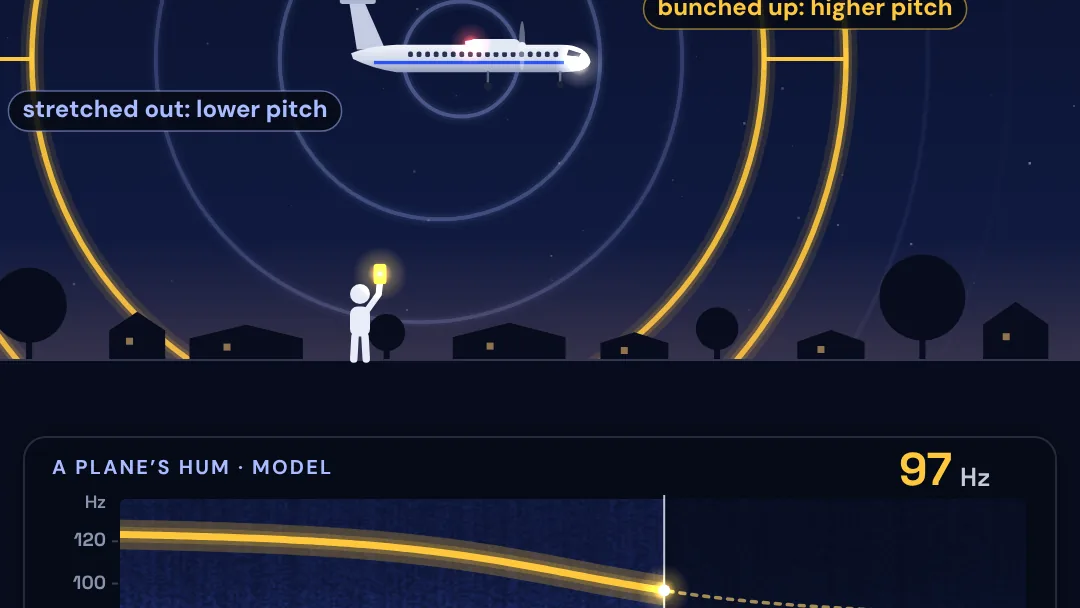 Interactive · Flyover Doppler LabCan a plane's sound give away where a video was filmed?Move a listener away from a plane’s flight path and watch the drop in its hum stretch out, and the lines where everyone hears the same curve.
- Short · 44 secondsCan a plane's sound give away where a video was filmed?The waves bunching and stretching, a 5-second drop becoming a 25-second one, and two flyovers crossing. Narrated and captioned.
- JournalCan a plane's sound give away where a video was filmed?A passing plane’s hum drops in pitch, and the drop is quick right under it and slow far to the side. With public flight tracks, Colsto says that pinned a video to about 100 m.
The same waves, faster than sound
A plane’s sound waves bunch up ahead of it. Push the plane past the speed of sound and they pile into a cone: a sonic boom.
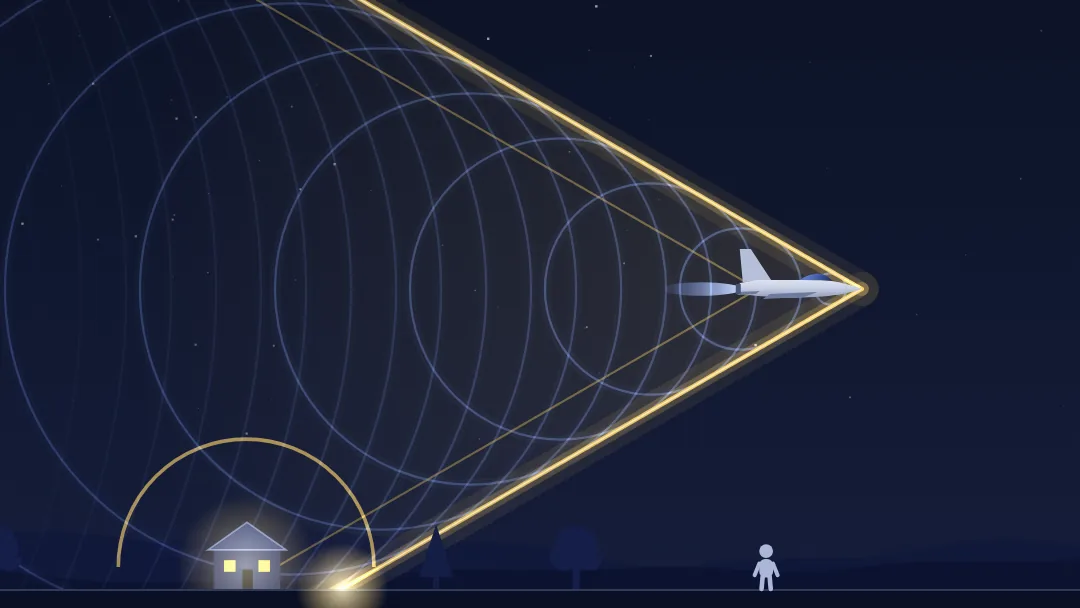 Interactive · Sonic Boom LabWhat makes a sonic boom?Drag a plane past the speed of sound and watch its sound rings pile into a cone that sweeps the ground.
- Short · 33 secondsWhat makes a sonic boom?Why a jet faster than sound drags a boom behind it. Narrated and captioned.
Sound takes time to arrive
From a plane 10 km up, each sound needs about 29 seconds to reach you. Thunder uses the same delay to tell you how far away lightning struck.
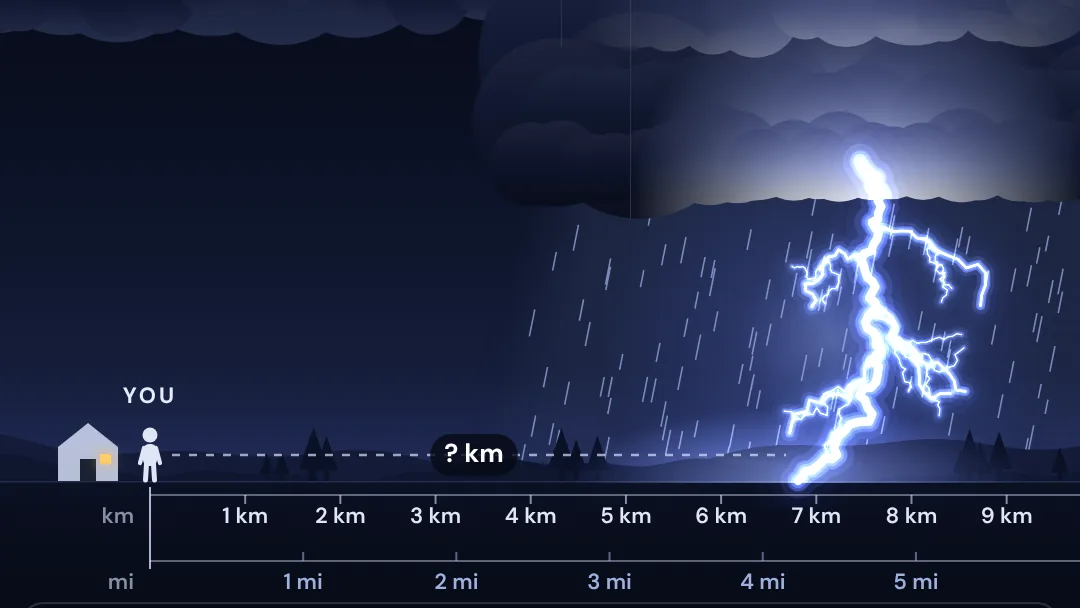 Interactive · Thunder TimerHow far away was that lightning?Drag a lightning strike closer and count the seconds until the thunder arrives: about 3 seconds per kilometer.
- Short · 34 secondsHow far away was that lightning?Count the seconds between flash and thunder. Narrated and captioned.
Crossing lines to find a place
GPS also finds a position where distance constraints cross, with timed signals from satellites instead of a plane’s hum.
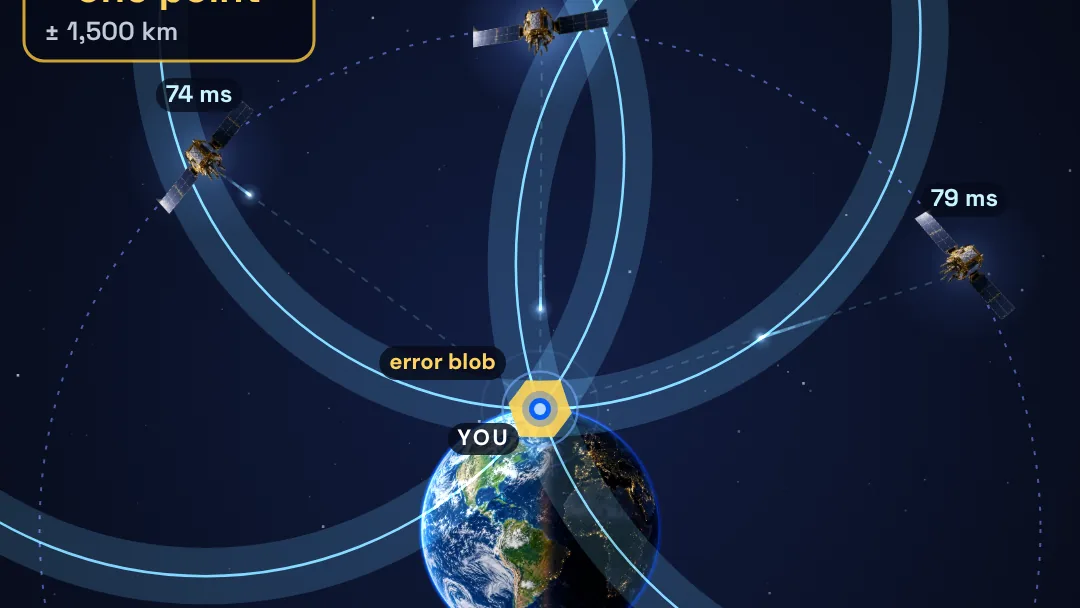 Interactive · GPS LabHow does GPS know where you are?Drag satellites into view and watch their timed signals shrink your phone’s position to a single point.
Common questions
Why does a plane sound lower after it passes?
Because of the Doppler effect. Coming toward you, the plane’s sound waves arrive bunched up, which sounds higher; going away, they arrive stretched out, which sounds lower. For a 100 Hz hum on a plane at 70 m/s, that is about 126 Hz coming and 83 Hz going. The engine’s own note never changes.
Why is the drop faster when the plane is closer?
Because the plane swings from coming to going faster. Right under it, the angle flips in a few seconds; far to the side it turns slowly. In the model, half the drop takes about 1.15 × the closest distance ÷ the plane’s speed: 4.8 s at 300 m and about 25 s at 1.5 km for a plane at 70 m/s.
Do all planes broadcast where they are?
Most do. Aircraft with ADS-B Out broadcast their position, altitude and speed once a second, and in the US it is required in most controlled airspace. The signals are unencrypted. The FAA can limit what its own displays show for some aircraft, but Wikipedia notes the data may still be available from other sources.
Can any video with a plane in it be located this way?
No. It needs planes loud enough to show up in the audio, flights with public tracks, a rough idea of when and where the video was made, and a lot of computing. Colsto says it took him months and more than 5,000 lines of code, and he calls the odds of someone doing it “pretty slim”. His 100 m result is his own claim.
Does the speed of sound or the wind change the answer?
Yes. The model uses still air at 343 m/s. Wind carries sound along with it, and temperature changes its speed, about 300 m/s at cruising altitude, so a real search has to correct for the weather. The model also assumes a straight, level flight at a steady speed.
Sources and credits
- Colsto · I discovered a sound that leaks your exact location (and it’s everywhere) (YouTube) November 2026. The original demonstration: Doppler curves of passing planes matched against ADS-B flight data, which he says located a recording to within about 100 m.
- TechRadar · YouTuber discovers aircraft noise trick that can geolocate your videos to within 100m November 3, 2026: the 100 m claim, Doppler curves matched to public flight data, no software or tools released, and his view that the odds of someone doing this are “pretty slim”.
- FAA · ADS-B: Ins and Outs ADS-B Out broadcasts an aircraft’s GPS location, altitude, ground speed and other data once per second.
- Wikipedia · Automatic Dependent Surveillance–Broadcast The 1090 MHz and 978 MHz links, unencrypted signals that anyone can receive, and crowd-sourced receiver networks.
- Wikipedia · Doppler effect The moving-source formula the model uses: heard pitch = source pitch × c ÷ (c − v cos θ).
- Flyover Doppler Lab · model notesThe retarded-time equations, the 100 Hz tone, the half-drop measure, the four-spot geometry and what the model leaves out.
Every creator named here made the work we link to. Listing it does not imply a partnership or endorsement.