Sound · interactive
Can a plane’s sound give away where a video was filmed?
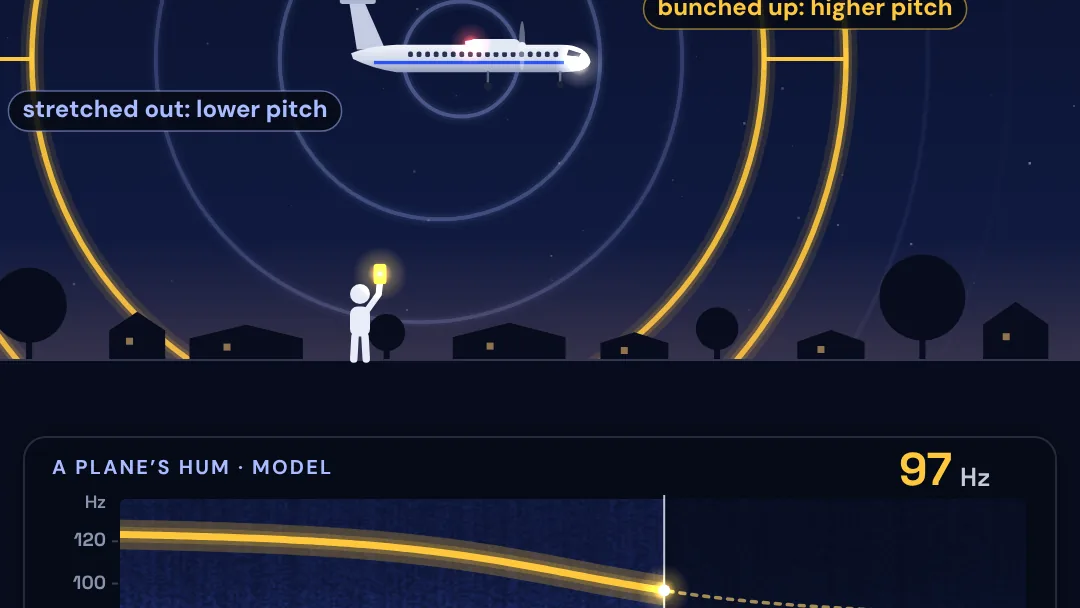
Drag the gold pin or move the listener control. The plane flies past again and again (sped up); the plot is the pitch you would hear, with 0 s the moment it is closest.
1 See
A plane’s hum always drops as it passes. But the drop is sudden right under it and slow far to the side, and flight tracks are public. Can a plane’s sound give away where a video was filmed?
2 Change
3 Understand
Model notes and sources
Model. A plane flies a straight line at constant speed v and altitude h through still air, where sound travels at c = 343 m/s (dry air at 20 °C). Its engine hums at f0 = 100 Hz, about the blade-passing tone of a six-blade turboprop propeller turning 1,000 times a minute (a Dash 8 Q400’s six-blade propeller turns at up to 1,020 rpm, so 6 × 1,020 / 60 = 102 Hz). The listener stands on flat ground y metres to the side of the plane’s ground track, so the closest the plane comes is d = √(h² + y²). With t = 0 the moment the plane is closest, sound heard at time t left the plane at te, when it was r = √(d² + v²te²) away, so t = te + r/c. The pitch heard is the moving-source Doppler formula f = f0 · c / (c − v cos θ), with θ the angle between the plane’s heading and the line from the plane to you when it sent that sound. Coming, the pitch approaches f0c/(c − v); going, f0c/(c + v). At 70 m/s that is 126 Hz and 83 Hz, whatever your distance.
Why the shape gives away your distance. The curve is exactly antisymmetric about t = 0: the halfway pitch, f0/(1 − v²/c²), is heard at the very moment the plane is closest. How long the fall takes scales with d/v: Half the drop takes is the time between the pitch passing 75% and 25% of the way down, about 1.13 d/v at 70 m/s (2/√3 ≈ 1.15 for a slow plane). Right under a plane 300 m up at 70 m/s it is 4.8 s; 1.5 km to the side it is 24.7 s. Steepest drop is the slope at the midpoint, f0v²/[c d (1 − v²/c²)3/2]: 5.1 Hz/s right under the plane, 1.0 Hz/s 1.5 km to the side. So once the plane’s speed and altitude are known, the drop’s length gives d, and d and the altitude give how far to the side you were. Everyone at that distance on either side of the track hears the same curve: two lines. Fitting a propeller tone’s Doppler curve this way to estimate an aircraft’s speed and altitude is an established passive-acoustics technique (Ferguson, 1992).
Flight tracks are public. Aircraft with ADS-B Out broadcast their GPS position, altitude and ground speed once a second, unencrypted, and hobbyist receiver networks such as ADS-B Exchange, Flightradar24 and adsb.lol collect and archive them. In early November 2026 the security researcher and YouTuber Colsto showed this idea at full scale: he says he located a security-camera clip to within about 100 metres by matching the Doppler curves of two flyovers, 920 seconds apart, and the silence of a third flight, against about 50 GB of US flight data, with more than 5,000 lines of code that he has not released. Those figures are his and press reports’; they have not been independently checked. The tool’s second flight shows the geometry only: two pairs of lines cross at four spots, and the time between the two drops is what picks one.
Privacy. This is an open-source-intelligence (OSINT) technique, and it works on a recording without its maker’s knowledge or consent. Background audio, even when it sounds silent, can carry this kind of information. The tool explains the physics; it does not analyse audio or look anything up.
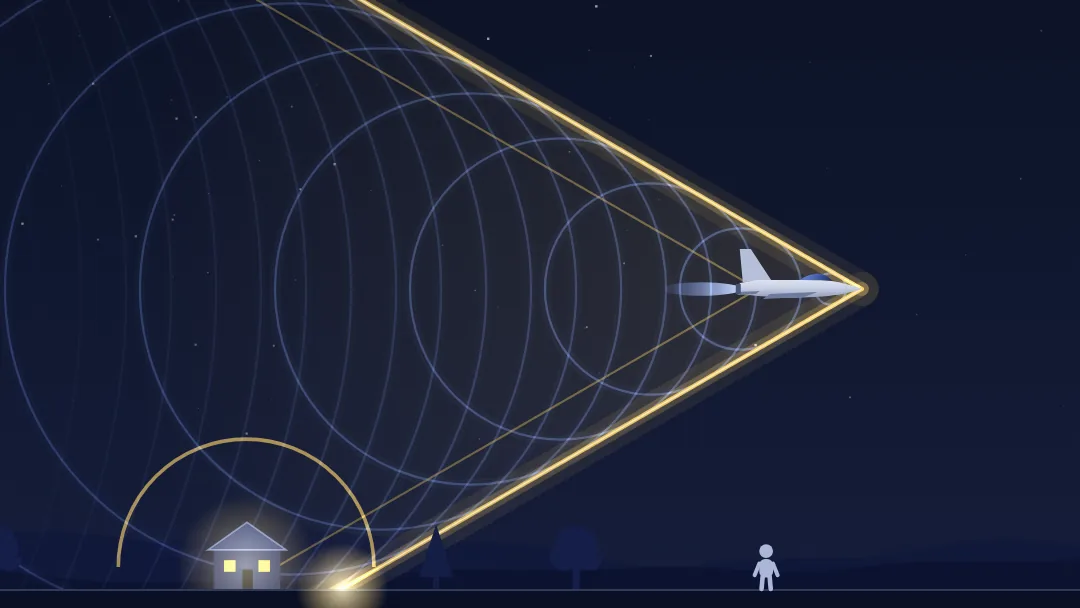
The pictures. Everything on the tool’s stage is drawn in code from the model; the map is stylized, not a real place, and the plane is sped up so it passes every few seconds. In the film, the pitch card, the side view, the map and the pinned backyard are drawn too, and sound waves are drawn one in thirty. Three short real excerpts appear in the film, picture only and credited on screen: the opening is a phone video of a jet on approach passing over a New York street (While on my Journey on YouTube); it is a jet, not the turboprop the model uses, and the pitch card over it is the model, not that plane’s recording. The spectrogram of real flyovers and the map of one flight’s track with the band that could have heard it are from Colsto’s own video (colsto on YouTube). Colsto is the original source of the technique; posts that spread it on X shared screenshots of his video.
Limits. Real air has wind and temperature layers that bend and speed up sound (it is slower, about 300 m/s, at cruise altitude), real flight paths curve, climb and change speed, ground and buildings reflect sound, and a plane makes many tones, not one. The model ignores all of that, and its listener stands on flat ground. Real geolocation needs the full curve fitted against many candidate flights and places, with terrain and weather.
Sources: Wikipedia, Doppler effect and Speed of sound; B. G. Ferguson, “A ground-based narrow-band passive acoustic technique for estimating the altitude and speed of a propeller-driven aircraft”, J. Acoust. Soc. Am. 92 (3), 1403 (1992); FAA, ADS-B: Ins and Outs; Wikipedia, Automatic Dependent Surveillance–Broadcast; Radius, Q400 propeller (Dowty R408); TechRadar, YouTuber discovers aircraft noise trick that can geolocate your videos to within 100m (3 November 2026); Colsto, I discovered a sound that leaks your exact location (and it’s everywhere) (YouTube, November 2026).
An ExplainerTools Original. Inspired by Colsto’s flyover geolocation video (November 2026).