Topic guide · Phones and satellites
How can a call hop from a cell tower to a satellite?
By treating the satellite as one more cell tower. AST SpaceMobile’s BlueBird satellites send the same LTE signal a tower does, on the carrier’s own 850 MHz band, so an ordinary phone adds the satellite to the list of cells it measures. The network moves a call to any neighbour that is clearly stronger, so past the last tower the satellite wins and the call carries on. AT&T says it completed the first such handoff in a test near Granite Falls, Washington, in October 2026. The hard part is the satellite’s: about 500 km up, a hundred times farther than a tower 5 km away, its signal is spread over ten thousand times the area, and your phone has to transmit at full power to reach it.
- Tower 5 km away
- −100 dBm
- Satellite overhead, 520 km up
- −112 dBm
- Network switches when a neighbour is
- 3 dB stronger
- Phone transmit power to the satellite
- 0.2 W, its maximum
Model · illustrative signals and handover Tower signal falls with the Okumura–Hata distance slope from −76 dBm at 1 km. One satellite at 850 MHz passes straight overhead. AST’s test phone showed about −110 dBm and 23–24 dBm transmit power.
Interactive · ExplainerTools
Tower-to-Satellite Lab
Walk a phone from town past the last cell tower into the mountains, move the satellite across the sky and change the handover margin. Watch which cell serves your call, and when it switches.
Model · illustrative signals and handover
How does a call move from a tower to a satellite?
The same way it moves from one tower to the next. Nothing about the phone changes.
- Measure
A phone on a call keeps measuring every cell it can hear: how strong each one arrives, in dBm.
- Report
It reports those numbers to the network. A satellite cell is simply one more line in the list.
- Switch
When a neighbour is stronger than the serving cell by a set margin, the network tells the phone to switch. In the 3GPP standards that report is event A3.
Past the last tower, the strongest cell in the list is the satellite, so the same rule hands the call to space. In Tower-to-Satellite Lab, with a 3 dB margin, Tower A hands you to Tower B about 5 km out of town, and Tower B hands you to the satellite at about 23 km, where the satellite’s −112 dBm is 3 dB stronger than the fading tower.
Why does the phone accept a satellite at all? AST SpaceMobile’s BlueBirds broadcast on their partners’ own low-band spectrum, the 850 MHz band for AT&T, with the same LTE signal a tower sends. In AST’s film of the test, the phone’s debug screen reads “LTE(SAT)” on band 5, which is 850 MHz. The network does the hard part out of sight: it corrects the satellite’s extra delay and Doppler shift so the phone sees a normal cell, UT Austin’s Todd Humphreys explains.
Why does the satellite need such a big antenna?
Because it is so far away. A tower might be 5 km from you; AST’s first BlueBirds fly about 520 km up. A signal spreads out as it travels, so its power per square metre falls with the square of distance. A hundred times the distance spreads the same signal over ten thousand times the area.
The satellite makes up for it with size. Its first five BlueBirds carry arrays of 693 square feet, about 64 m², Space.com reported at their launch in 2024. AST says BlueBird 6 unfolded one of about 2,400 square feet, roughly 223 m², nearly a doubles tennis court’s 261 m². A bigger antenna gathers more of a faint signal and focuses its own.
Speed is the other problem. At about 7.6 km/s the satellite shifts its signal’s frequency by up to about 18 kHz while it is usable in the model, more than the 15 kHz between LTE subcarriers, and the signal takes 1.7 to 3.4 ms each way instead of a few hundredths of a millisecond from a nearby tower. The network corrects both, and steers the satellite’s beams onto fixed cells on the ground as it passes.
Does a satellite call use more battery?
Very likely, because your phone has to shout. A phone sets its own transmit power from how weak the cell sounds, up to 23 dBm, 0.2 W, for an ordinary LTE phone. Near towers it rarely needs much: in Ericsson’s measurements of about 7,000 phones on Swedish LTE networks, average output stayed under 1% of the maximum everywhere, and under 2.2% even for the busiest 5% of rural phones.
To reach a satellite, it runs at or near the maximum: the debug screen in AST’s film of the test shows 23 to 24 dBm. Transmitting harder drains the battery faster. In a measured LTE phone, the transmitter drew about 100 mW more for every extra decibel above roughly 16 dBm. No carrier has published how much battery a satellite call costs, so the tool shows the transmit power, not a battery percentage. Airplane Mode shows the same climb to full power as towers fall out of range.
What did AT&T and AST SpaceMobile actually do?
On 21 October 2026, outside Granite Falls, Washington, AT&T says it moved a phone’s connection from its ground network to AST SpaceMobile’s BlueBird satellites, which the companies call the industry’s first handoff between a cellular network and a direct-to-device satellite network. Ericsson supplied radio and core equipment and Nokia the radio and mobility software for the satellite side, and the phones were standard and unmodified, AT&T says. Ericsson says its automation cuts transition times from seconds to milliseconds.
The release does not say which satellite was used, whether a voice call was carried, or how long the switch took. The call in our film and tool is the model’s, not a replay of the test.
Try it: walk the phone out of range
- 1 See
Open Tower-to-Satellite Lab and tap Downtown. Strongest tower reads −68 dBm from Tower A and Serving cell reads Tower A. The satellite is already in the list at −112 dBm.
- 2 Change
Tap Edge of coverage. Tower B has faded to −112 dBm, level with the satellite, and still serves you: the network waits for a 3 dB lead. Now tap Deep wilderness. The tower is down to −123 dBm and Serving cell reads Satellite.
- 3 Understand
Tap Satellite low in the sky. The satellite drops to −120 dBm, 29° up, the weakest usable signal, and Satellite delay · Doppler reads 3.2 ms and +17 kHz. Raise Handover margin to see the network hold on to a fading tower longer.
Where does this model stop?
Every signal level in Tower-to-Satellite Lab is illustrative. Tower signals fade with the Okumura–Hata distance slope from a level we chose for open country. The satellite’s power per beam is not public, so it is set to −112 dBm straight overhead, close to the −109 to −112 dBm on the test phone’s screen. Real signals swing by 10 to 20 dB with terrain, trees, buildings and your body.
The model has one satellite on one pass straight overhead, usable for about four minutes, and no Earth rotation. A real network flies many satellites and hands calls between them. It also uses timers, thresholds and priorities, not just a margin, and the carriers have not said how they tune the satellite layer. The uplink, from your phone up to the satellite, is usually the harder direction; the tool shows its transmit power but does not model the link.
The film uses two short pieces of AST SpaceMobile’s own footage, credited on screen: the test phone’s debug screen (@AST_SpaceMobile on X) and the array of BlueWalker 3, its 64 m² test satellite (AST SpaceMobile on YouTube). The towers, satellite, signals and numbers come from the model.
Explore by question
A satellite posing as a tower, a long way up. Each card answers one part of the question, with why it belongs here.
Tower-to-Satellite Lab
Model · illustrative signals and handover
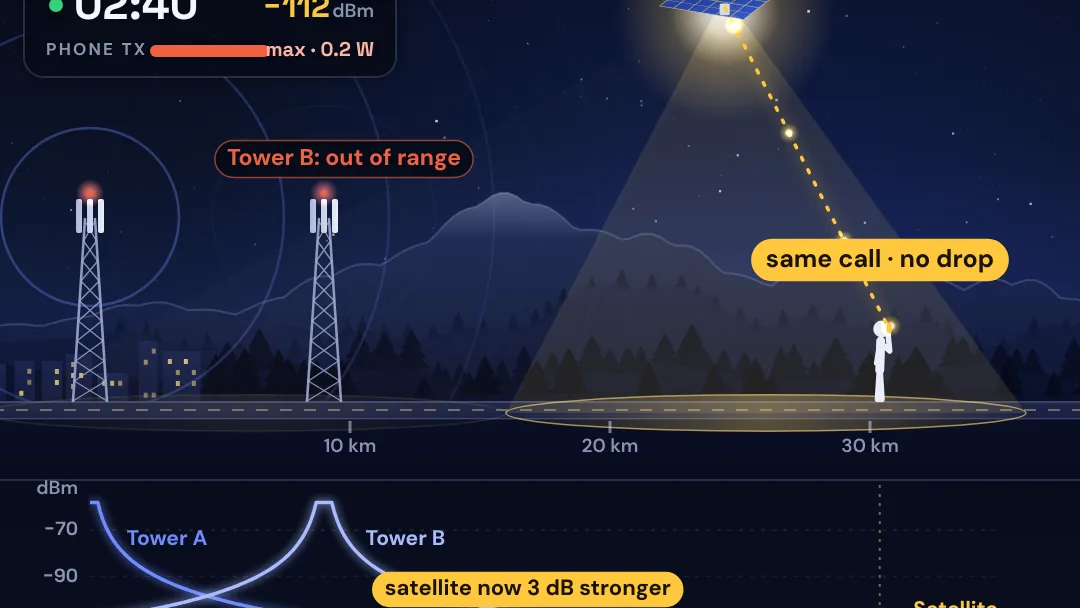 Interactive · Tower-to-Satellite LabHow can your phone hop from a cell tower to a satellite mid-call?Walk a phone past the last cell tower and watch the network hand the call to a satellite that poses as one more tower.
- Short · 46 secondsHow can your phone hop from a cell tower to a satellite mid-call?The walk past the last tower, a hundred times the distance and the phone at full power. Narrated and captioned.
- JournalHow can your phone hop from a cell tower to a satellite mid-call?AT&T and AST SpaceMobile say they handed a phone from a tower to a satellite in October. The satellite pretends to be just another tower; the hard part is that it’s 100 times farther away.
Why low orbit, and why it keeps moving
A satellite 500 km up is close enough to hear a phone, but it is overhead for only minutes, so a network needs many of them.
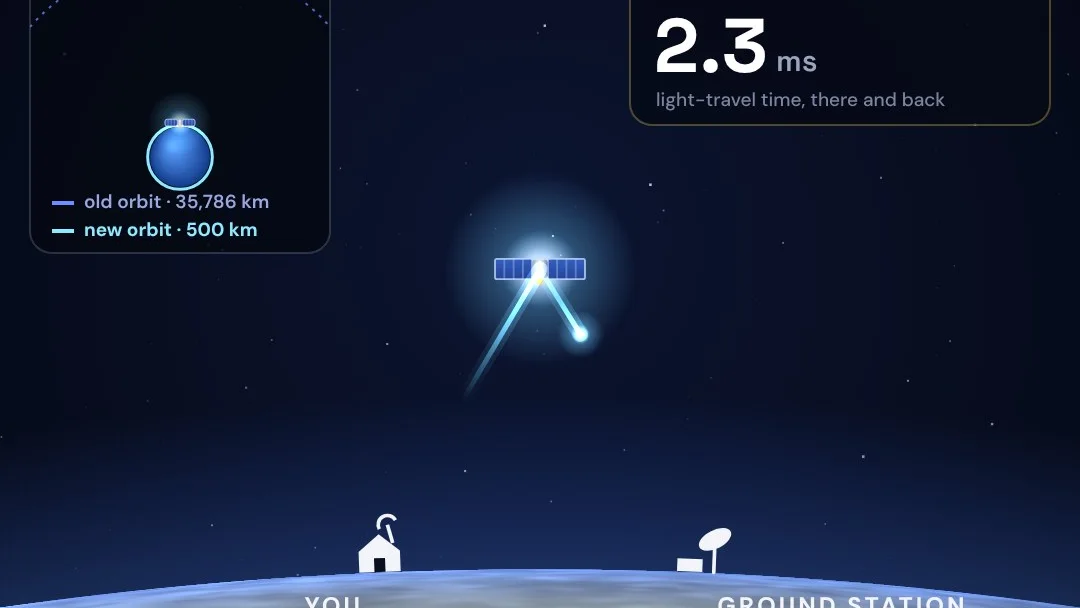 Interactive · Low Orbit InternetWhy does Starlink feel so fast?Drop a satellite from 36,000 km to about 500 km and watch the round trip shrink, and why you then need thousands.
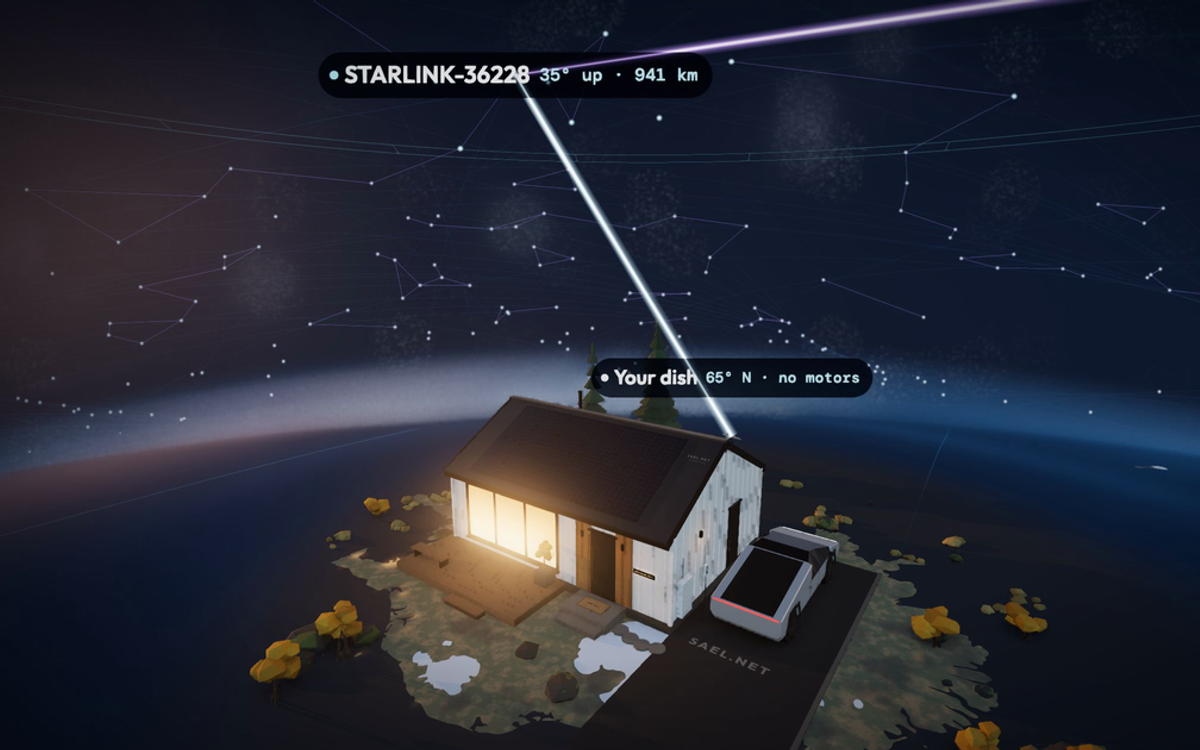 Interactive demoHome internet from space: StarlinkFollow a dish as it hands its link between low satellites and laser relays.by Ryan Sael · Best on a larger screen
Your phone’s radio, near and far
The handover runs on signal strength, and a weak cell makes your phone transmit harder.
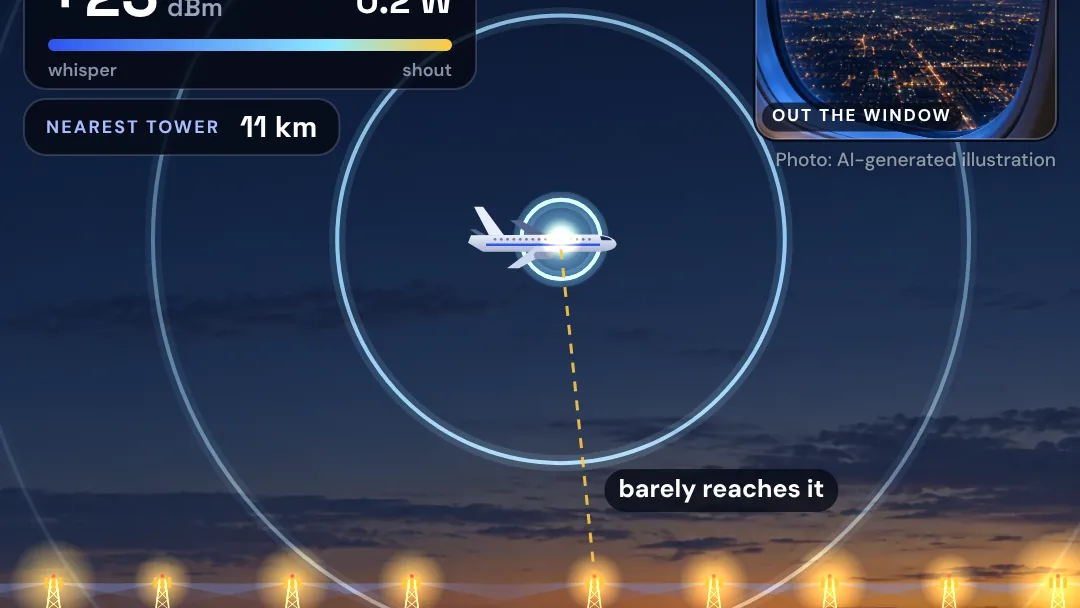 Interactive · Airplane ModeWhy does airplane mode matter?Drag a phone up to cruising altitude and watch its radio climb to full power as the towers it can reach fall out of range.
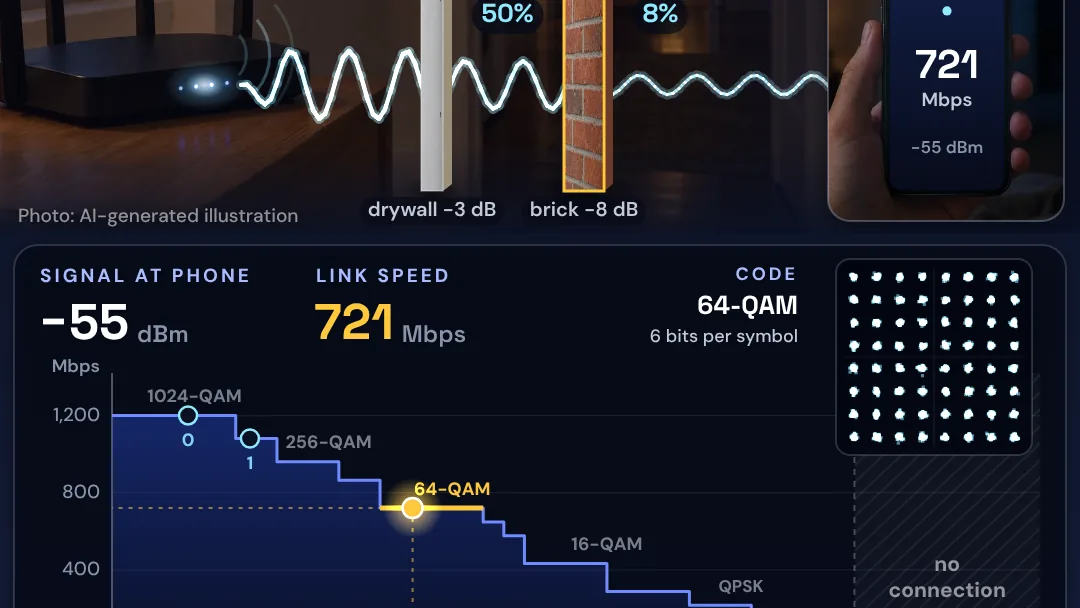 Interactive · Wi-Fi WallsWhy does Wi-Fi slow down through walls?Add walls between a router and a phone and watch the signal fade, wall by wall.
Common questions
Do I need a special phone?
No. AT&T says the test used standard, unmodified phones. The satellite sends the same LTE signal a tower does on the carrier’s own band, so the phone treats it as one more cell. In AST’s film of the test, the phone simply reports an LTE cell on band 5, marked “SAT”.
Does a satellite connection drain my battery faster?
Very likely. To reach a satellite hundreds of kilometres up, your phone transmits at or near its 0.2 W maximum; the test phone showed 23 to 24 dBm. Near towers, phones measured by Ericsson averaged under 1% of their maximum, and a phone’s transmitter draws much more power as its output rises. No carrier has published a figure for satellite calls.
How can a satellite moving at 7.6 km/s keep a call?
It steers its beams onto fixed cells on the ground as it passes, and the network corrects its delay and Doppler shift. In the model one satellite is usable for about four minutes of each pass, so a real network needs many satellites and hands calls from one to the next.
Is the satellite’s signal really ten thousand times weaker?
From spreading alone, yes: a hundred times the distance spreads a signal over ten thousand times the area. The satellite makes up much of that with a huge antenna and more power, so in the model it reaches −112 dBm overhead, against −100 dBm from a tower 5 km away.
Why does the network wait for a margin before switching?
So the call doesn’t flip back and forth between two cells that are about as strong as each other. In the tool the margin is 3 dB: at Edge of coverage, Tower B and the satellite are level and the call stays on the tower until the satellite pulls 3 dB ahead.
Sources and credits
- AT&T · AT&T and AST SpaceMobile: engineering the connected world, one handoff at a time November 2, 2026. The 21 October test near Granite Falls, Washington: the first handoff between a ground cellular network and a direct-to-device satellite network, AT&T says, with Ericsson and Nokia equipment and unmodified phones.
- AST SpaceMobile via Business Wire · BlueBird 6 unfolding February 10, 2026. AST says BlueBird 6’s array spans about 2,400 square feet, about 223 m².
- Space.com · SpaceX launches 5 giant BlueBird smartphone satellites for AST SpaceMobile September 2024. Each of the first five BlueBirds unfolds a 693-square-foot (64 m²) array.
- UT Austin Radionavigation Laboratory · AST SpaceMobile in cellphone satellite communication Todd Humphreys on how the network makes a satellite act like a base station, pre-compensating delay and Doppler.
- Joshi et al. · Output power levels of 4G user equipment and implications on realistic RF EMF exposure assessments (IEEE Access, 2017) About 7,000 phones on 41 Swedish LTE base stations: average output under 1% of maximum in every environment; 95th percentile 2.2% in rural areas.
- Lauridsen et al. · An empirical LTE smartphone power model with a view to energy efficiency evolution (Intel Technology Journal, 2014) A measured LTE phone’s transmitter power draw rises steeply at high output, about 103 mW for each extra dB above 15.6 dBm.
Every creator named here made the work we link to. Listing it does not imply a partnership or endorsement.