Phones · interactive
How can your phone hop from a cell tower to a satellite mid-call?
Side view, not to scale. The glowing line joins the phone to its serving cell; the tag on each tower and on the satellite is what the phone measures. The chart shows each cell's signal along the road, and the bar above it which cell serves you as you walk out of town. Drag the walker or the satellite.
1 See
Out of range of the last cell tower, a phone mid-call should drop. AT&T and AST SpaceMobile say they handed one to a satellite instead, in a test in October 2026. How can your phone hop from a cell tower to a satellite mid-call?
2 Change
3 Understand
Model notes and sources
Model. A road runs from a town (Tower A, at 0 km) past Tower B, the last tower (9 km), into the mountains (to 35 km). Each tower's signal at the phone (its reference signal received power, RSRP) falls with distance d as RSRP = −76 dBm − 34.4 · log10(d / 1 km), the distance slope of the Okumura–Hata model for a 40 m mast at 850 MHz, with the level at 1 km chosen for open country (illustrative). The satellite flies a circular orbit 520 km up (AST SpaceMobile's first BlueBirds fly at about 507 × 523 km), at v = √(μ/r) = 7.6 km/s, and passes straight overhead. Its distance d comes from the geometry, and its signal is RSRP = EIRP − FSPL − 3 dB + 10 · log10(cos η): free-space loss FSPL = 32.45 + 20 · log10(d / km) + 20 · log10(850 MHz), 145.4 dB at 520 km; a 3 dB loss at the phone; and the scan loss of a flat array pointing η away from straight down. The satellite's power per beam is not public, so its EIRP, 36.4 dBm per 15 kHz resource element, is chosen to give −112 dBm straight overhead: weak but usable (illustrative). Below −120 dBm the phone is taken to have no usable signal (a typical edge-of-coverage value, assumed).
The handover rule. A phone on a call keeps measuring the cells it hears and reports them, and the network moves the call to a neighbour once that neighbour is stronger than the serving cell by the Handover margin: 3GPP's measurement event A3, “neighbour becomes offset better than serving”. If the serving cell falls below −120 dBm, the call moves to the strongest usable cell, or drops if there is none. With the film's 3 dB margin, Tower A hands you to Tower B 4.95 km out of town, and Tower B hands you to the satellite at about 23 km, where the satellite's −112 dBm is 3 dB stronger than Tower B. The bar above the chart replays that walk out of town. Real networks add a time-to-trigger, other report types (for example “serving cell worse than one threshold and neighbour better than another”, which lets an operator keep phones on the ground network until it is weak) and priorities between layers; the carriers have not published how they tune the satellite layer.
Why a satellite can pass for a tower. AST SpaceMobile's BlueBirds broadcast on their partner carriers' own low-band spectrum (the FCC grant covers 700–900 MHz; the AT&T and Verizon leases, the 850 MHz band) with the same LTE and 5G signals a tower uses, so an unmodified phone sees one more cell; AST describes its network as “akin to cell towers in space”. The hard work is on the network's side: it pre-compensates the satellite's extra delay and Doppler shift so the phone sees a normal cell (Todd Humphreys, UT Austin), steers beams onto fixed cells on the ground as the satellite moves, and has to hear a phone's 0.2 W (23 dBm, LTE's standard handset power) from hundreds of kilometres away.
A hundred times farther, ten thousand times weaker. A signal spreads out as it travels, so its power per square metre falls with the square of distance: 100 times farther (5 km to a tower, about 500 km to the satellite) spreads it over 100 × 100 = 10,000 times the area, 40 dB. The model's levels differ by less than that, about 12 dB at 5 km, because ground signals fade faster than free space (34.4 dB per tenfold distance instead of 20) and because the satellite makes up the rest with a huge antenna. An antenna's gain grows with its area, G = 4πA / λ²: at 850 MHz (λ = 0.35 m) that is about 38 dBi for BlueBird Block 1's 64 m² and 43.5 dBi for Block 2's 223 m², against roughly 15 dBi for a tower's panel antenna (upper estimates, assuming every square metre works perfectly).
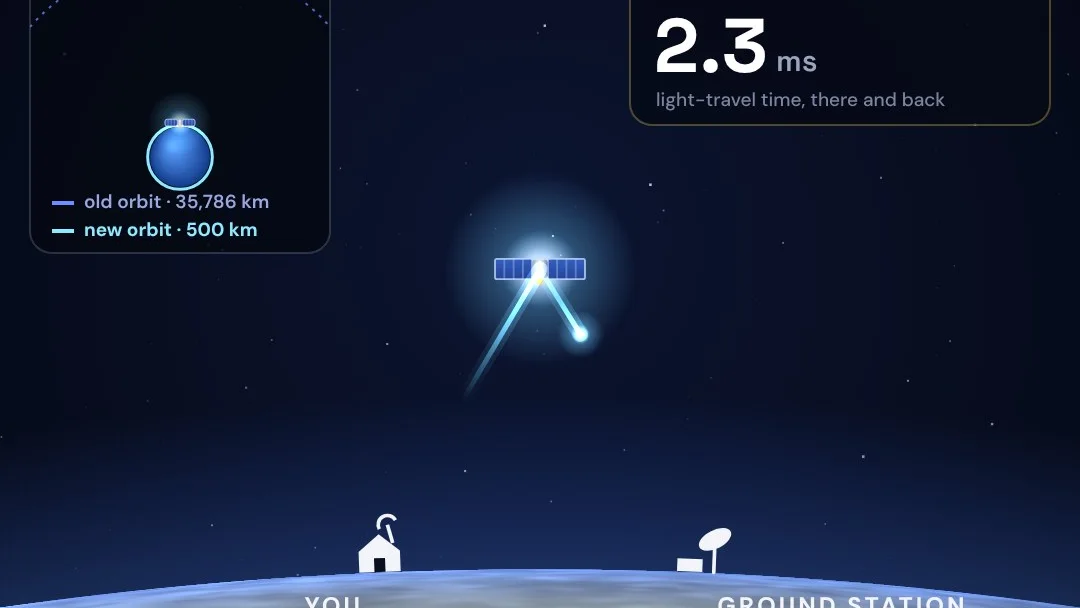
Delay and Doppler. One-way delay is d / c: 1.7 ms straight overhead and 3.4 ms when the satellite is 27° above the horizon, against 0.03 ms from a tower 10 km away (radio path only). The Doppler shift before the network corrects it is −f · (dd/dt) / c at 850 MHz: zero overhead and up to about 18 kHz while the satellite is usable in this model, more than the 15 kHz between LTE subcarriers. The satellite is usable (above −120 dBm) for about 4 minutes of each pass, down to about 27° above the horizon on either side. A real constellation hands the call from one satellite to the next; this model has one, so a satellite low in the sky means no service far from the towers.
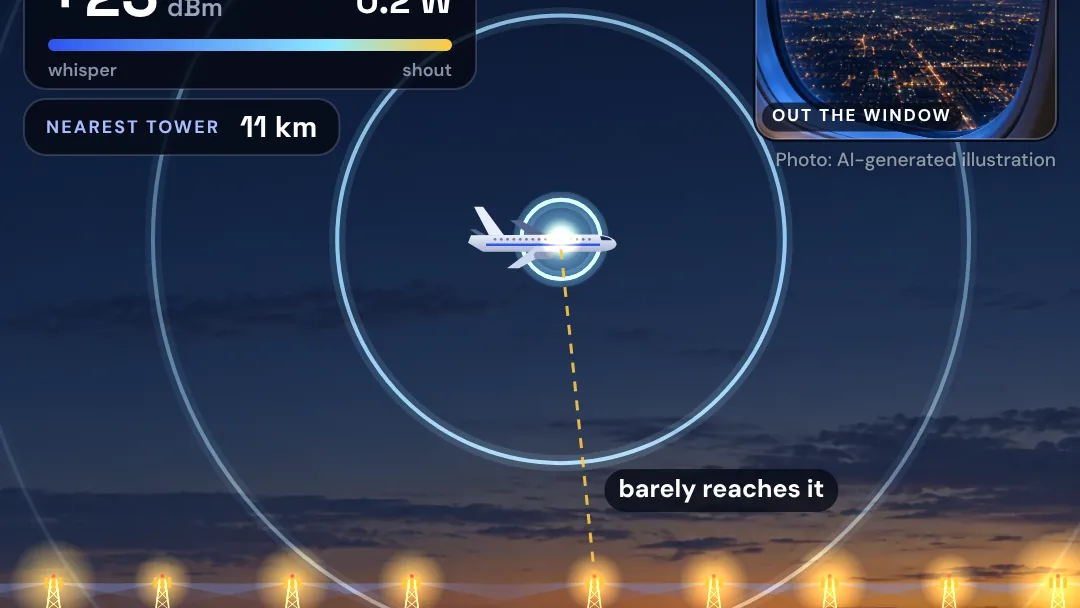
Battery. A phone sets its own transmit power from how weak the cell sounds (uplink power control, 3GPP TS 36.213), up to 23 dBm, 0.2 W, for an ordinary LTE phone (power class 3, TS 36.101). Near towers it rarely needs much: in Ericsson's measurements of about 7,000 phones on Swedish LTE networks, average output was under 1% of the maximum everywhere, and under 2.2% even for the busiest 5% of rural phones (Joshi et al., 2017). To reach a satellite it runs at or near the maximum: AST's test phone showed 23–24 dBm. The model's version is simplified: 1 dB more power for every dB of extra path loss, reaching 23 dBm when the downlink is at −110 dBm (assumed), which gives about 20 mW to a tower 5 km away. Transmitting harder costs battery: in a measured LTE phone the transmitter drew about 100 mW more for every extra dB above about 16 dBm (Lauridsen et al., 2014). The battery in the film is a picture of that, not a measured drain.
The test. AT&T says that on 21 October 2026, outside Granite Falls, Washington, it completed the industry's first handoff between a ground cellular network and a direct-to-device satellite network, with AST SpaceMobile's BlueBird satellites, Ericsson's radio and core automation, Nokia's radio and mobility software, and standard, unmodified phones. The release does not name the satellite or say whether a voice call was carried or how long the switch took; Ericsson says its automation cuts transition times from seconds to milliseconds. The call in the film and the tool is the model's.
The antenna. AST says BlueBird 6, its first larger Block 2 satellite, unfolded an array of about 2,400 square feet (about 223 m²); its first five BlueBirds (Block 1, launched September 2024) carry 693 sq ft (64 m²) arrays. A doubles tennis court is 23.77 × 10.97 m, 261 m². The film draws the Block 2 array as a square of the same area.
The pictures. Everything on the stage is drawn in code from the model. It is a side view, not to scale: the road is to scale (26 px per km), but the satellite's height, the towers and the beams are not. The satellite's two ground cells are about 20 km across, a rough estimate from the beam width (λ / 8 m ≈ 2.5°) at 520 km. The phone screen in the film is a generic drawing, not any real phone's interface. The film's zoom-out draws distances to scale (airliners cruise at about 11 km, the edge of space is at 100 km, the space station at about 420 km); the icons are not. The film also uses two short pieces of real footage, picture only, each credited on screen. On “AT&T and AST SpaceMobile say they did it in October” is AST SpaceMobile's own film of the Granite Falls test (@AST_SpaceMobile on X, 2 Nov 2026): the test phone's debug screen reads “Serving PLMN(313-210)-LTE(SAT)” and “LTE RRC:CONN BAND:5”, so it is connected to the satellite's cell on band 5 (850 MHz), at an RSRP of about −109 to −112 dBm and a transmit power of 23–24 dBm, close to the model's −112 dBm and 0.2 W. On the antenna beat, a crane shot over the array of BlueWalker 3, AST's 693 sq ft (64 m²) test satellite, during assembly in Texas, with its staff for scale (AST SpaceMobile on YouTube, 2022); it is not one of the larger Block 2 BlueBirds, and the clip is labelled so. The drawn array next to it shows the 64 m² and 223 m² sizes to scale.
Limits. All signal levels are illustrative: real ones swing by 10–20 dB with terrain, trees, buildings, your body and the weather, and the satellite's power and beam patterns are not public. One satellite, one pass straight overhead, the walker's distance along the road ignored for the satellite, no Earth rotation. The uplink, from the phone up to the satellite, is usually the harder direction; it is described here but not modelled.
Sources: AT&T, AT&T and AST SpaceMobile: engineering the connected world, one handoff at a time (2 Nov 2026); AST SpaceMobile via Business Wire, BlueBird 6 unfolding (10 Feb 2026, about 2,400 sq ft); Space.com, SpaceX launches 5 giant BlueBird smartphone satellites (693 sq ft, 64 m²); Gunter's Space Page, BlueBird Block 1 (507 × 523 km orbit); AST SpaceMobile, film of the handoff test (X, 2 Nov 2026) and presentation to BEREC (2024: unmodified phones, 500–700 km, partners' low-band spectrum); SDxCentral, FCC grants AST SpaceMobile access to AT&T, Verizon spectrum (700–900 MHz, 850 MHz leases); UT Austin Radionavigation Laboratory, AST SpaceMobile in cellphone satellite communication (delay and Doppler pre-compensation); 3GPP, TS 36.331 (measurement event A3), TS 36.213 (uplink power control) and TS 36.101 (23 dBm handset power); P. Joshi et al., Output power levels of 4G user equipment and implications on realistic RF EMF exposure assessments (IEEE Access, 2017); M. Lauridsen et al., An empirical LTE smartphone power model with a view to energy efficiency evolution (Aalborg University and Nokia, 2014); Wikipedia, Hata model, Free-space path loss, Inverse-square law, LTE (15 kHz subcarriers), Tennis court, International Space Station, Kármán line.
An ExplainerTools Original. The handoff test is AT&T and AST SpaceMobile's, as they describe it; the signals are this model's.