Topic guide · Heat and phones
How does a vapor chamber cool a phone?
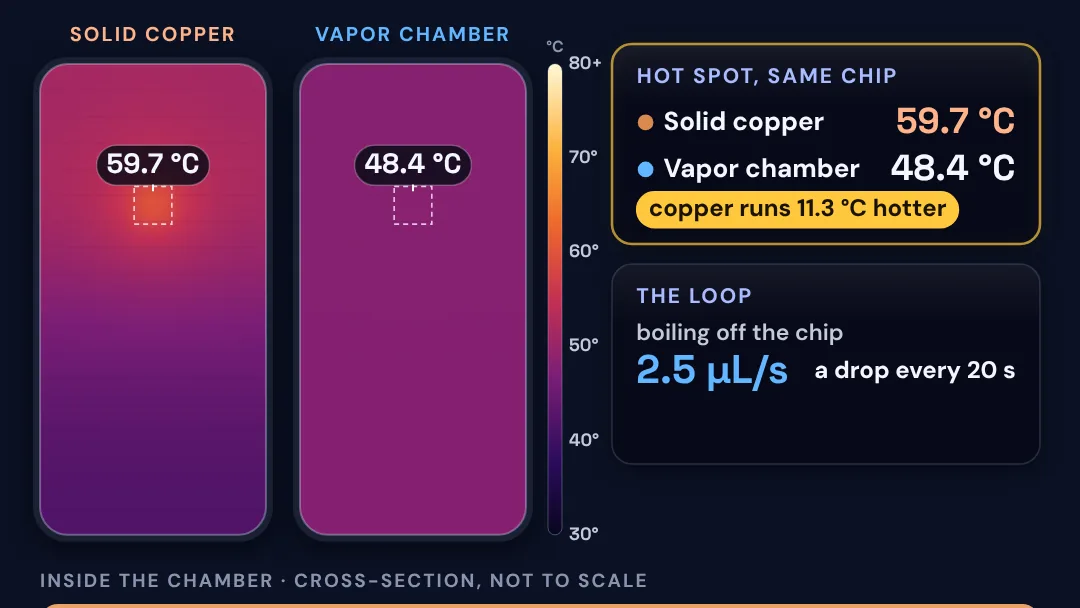
By boiling a few drops of water and letting the vapor carry the heat. A vapor chamber is a thin sealed metal pocket with a little water inside and almost no air, so the water boils at the temperature of a warm phone instead of at 100 °C. It boils off the chip, the vapor rushes to cooler parts of the plate and condenses there, and a wick pulls the liquid back. In Vapor Chamber Lab, a 6 W chip under a phone-size plate makes a 59.7 °C hot spot in solid copper and only 48.4 °C in a vapor chamber, which boils about one drop of water every 20 seconds. The catch is the wick: past what it can return, 7.58 W for the lab chamber the model uses, the patch over the chip dries out.
- Solid copper, 6 W
- 59.7 °C
- Vapor chamber, 6 W
- 48.4 °C
- Water boiled, 6 W
- 2.5 µL/s
- Wick limit
- 7.58 W
Model · bare plate in still air Hot spots on a 72 × 150 × 0.5 mm plate with a 12 mm chip, in still air at 25 °C. The chamber’s conductivity and wick limit are one 0.5 mm lab chamber’s, lying flat.
Interactive · ExplainerTools
Vapor Chamber Lab
Turn a phone chip from idle up to a 13 W burst. Watch solid copper and a vapor chamber side by side, seen like a thermal camera, and the loop inside the chamber.
Model · bare plate in still air
What happens inside a vapor chamber?
A loop that runs on its own. A vapor chamber is a flat, sealed metal pocket. Before it is sealed, a little liquid goes in, usually water, and nearly all the air is pumped out. A wick lines the inside: a thin layer of porous metal or fine mesh.
Heat from the chip boils the water right above it. The vapor rushes to wherever the plate is cooler and condenses there, giving its heat to the metal. The wick pulls the liquid back toward the chip, the way a paper towel drinks up a spill, and the water boils again. NASA Spinoff, describing a titanium vapor chamber, puts it the same way: the liquid evaporates at the heat source, the vapor gives up its energy somewhere cooler, and “a porous metal structure” brings the liquid back. Nothing moves but the water.
Why does water boil in a phone nowhere near 100 °C? Water boils when its vapor pressure matches the pressure around it. With the air pumped out, the only gas left inside is the water’s own vapor. At 48 °C that is about 11 kPa, 11% of the air outside, Vapor Chamber Lab’s notes show, so the water boils at 48 °C. The chamber starts working as soon as the phone warms up.
Why does boiling carry more heat than copper?
Because boiling soaks up a lot of heat without getting any hotter. Turning water into vapor takes about 2,390 kJ for every kilogram at a warm phone’s 45–50 °C. Even at 100 °C, where it is a little lower, it is more than five times the energy it takes to heat the same water from 0 to 100 °C. The vapor gives all of it back when it condenses.
So very little water has to move. At 6 W the chip boils off about 2.5 µL a second: one drop every 20 seconds, going round and round.
Copper has no such trick. Heat flows through metal only from hotter to cooler, and the thinner the sheet, the steeper the slope it needs. In the model, a 0.5 mm copper plate with a 6 W chip is 59.7 °C at the hot spot and about 42 °C at the far corners. A vapor chamber of the same size and thickness stays within half a degree of 48 °C everywhere. One 0.5 mm test chamber measured an effective conductivity of about 20,900 W/m·K, Applied Thermal Engineering reports, about 52 times copper’s 400. Long heat pipes can approach 100,000 W/m·K.
What happens when the wick can’t keep up?
The patch over the chip dries out. A wick can only pull so hard. The 0.5 mm test chamber could carry at most 7.58 W lying flat, at its best fill. Past that, the chip boils water faster than the wick brings it back. The liquid front retreats, and a dry patch opens over the chip where nothing boils. Under it, the chamber is just its two thin metal walls.
In the model, at 13 W, about the A19 Pro chip’s reported peak, the dry patch is about 33 mm across. The chamber’s hot spot reaches 108.3 °C, hotter than solid copper’s 100.2 °C, because the dry walls are thinner than the copper plate. The model dries the whole patch at once; real chambers dry out over a narrow range of power.
Which way the chamber faces matters too. The same chamber carried 9.06 W when gravity helped the liquid back to the hot spot and 6.33 W when gravity worked against it.
What do phones actually ship with?
Apple’s iPhone 17 Pro has one, and Apple has said what is inside it. “Deionized water is sealed inside the vapor chamber, which is laser-welded into the aluminum chassis,” Apple’s Greg Joswiak said at the phone’s launch event, as 9to5Mac reported. The foldable iPhone Duo has one too. Its engineers told PCMag that heat goes from the A20 Pro chip into a vapor chamber, 9to5Mac relays. A flexible graphite pipe through the hinge then carries heat to the other half, which gives the phone more surface to shed it from.
It seems to help. Testers at Geekerwan measured an iPhone 17 Pro shedding about 6.1 W while gaming, against at best 5.3 W for the A18 Pro in the iPhone 16 Pro Max. Notebookcheck reads that as cooling that handles about 15% more heat. The A19 Pro chip can also draw up to 13 W in short bursts.
How thin is a phone’s chamber? Apple has not published the thickness, fill or wick of either one, so the tool does not claim them. The lab chamber it uses is 0.5 mm thick. Thinner gets harder: Yadavalli, Weibel and Garimella found that at ultra-thin sizes and low power, the vapor itself starts to resist the flow, and a heat pipe can do no better than a solid spreader.
Try it: turn the chip up until the wick runs dry
- 1 See
Open Vapor Chamber Lab. It starts at Gaming · 6 W: Hot spot, solid copper reads 59.7 °C and Hot spot, vapor chamber 48.4 °C. Boiling off the chip reads 2.5 µL/s, a drop every 20 s.
- 2 Change
Tap Idle · 1 W. Copper reads 30.8 °C and the chamber 28.9 °C: with little heat to move, the gap almost closes. Then tap Near the limit · 7.5 W. Copper reads 68.4 °C, the chamber 54.2 °C, and Load on the wick 99%.
- 3 Understand
Now tap Peak burst · 13 W. The load on the wick reads 172%. A dry patch about 33 mm across opens over the chip, and the chamber’s hot spot, 108.3 °C, is 8.0 °C hotter than solid copper.
Where does this model stop?
Vapor Chamber Lab is a bare plate in still air, not a phone. A real phone also has a battery, a screen, a case and other paths for heat, and it slows its chip down long before the model’s hottest numbers. Air takes heat from both faces at an assumed 12 W/m²·K, for natural convection plus radiation.
The chamber is one lab chamber’s measured conductivity and wick limit, lying flat. Real chambers vary with size, wick, fill and orientation, and very thin ones can do worse than solid metal at low power. The color scale runs from 30 to 80 °C, like a thermal camera’s range, so anything hotter reads white. The cross-section is not to scale: its bubbles, vapor and droplets are drawn to show the loop, not to measure it.
The film’s thermal-camera footage and real iPhone vapor chambers are by @iphonedo on TikTok, credited on screen. The plates, the chamber and every number come from the model, not from the clips.
Explore by question
A few drops of water, a wick and a sealed pocket. Each card answers one part of the question, with why it belongs here.
Vapor Chamber Lab
Model · bare plate in still air
 Interactive · Vapor Chamber LabHow can a few drops of liquid cool a phone?Turn a phone chip from idle to a 13 W burst and watch solid copper and a vapor chamber side by side, until the wick runs dry.
- Short · 43 secondsHow can a few drops of liquid cool a phone?Real iPhones in infrared, the loop inside the chamber, then solid copper at the same 6 W. Narrated and captioned.
- JournalHow does a vapor chamber cool a phone?A vapor chamber is a sealed copper pocket with a little liquid and almost no air, so the liquid boils at phone temperatures and carries the chip’s heat away. The catch is the wick.
The same loop, pushed uphill
A heat pump’s refrigerant also boils in one place and condenses in another. A compressor lets it carry heat from cold air into a warm house, which a vapor chamber never has to do.
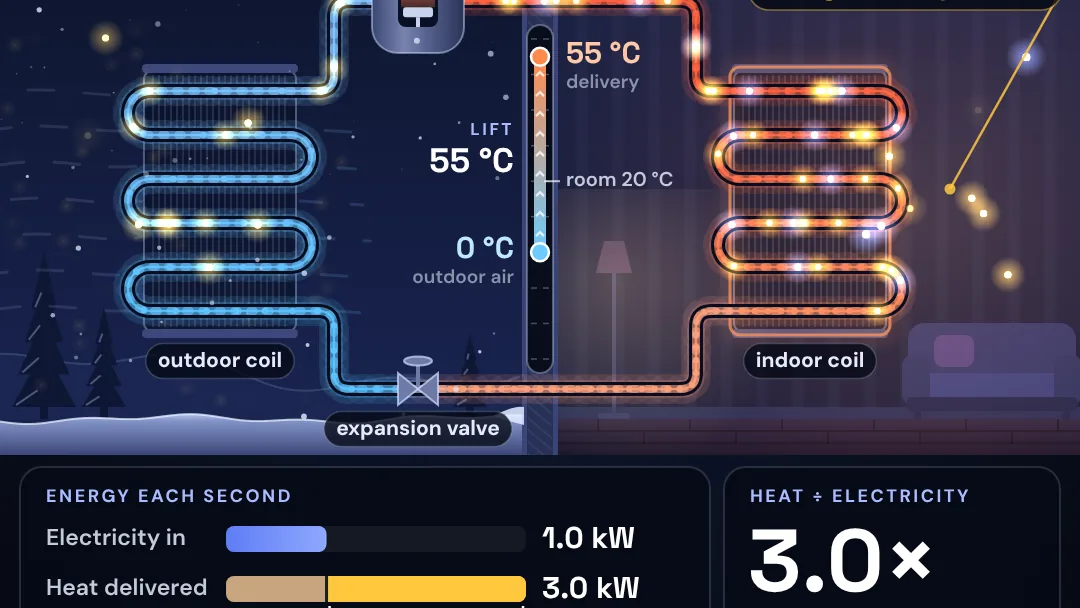 Interactive · Heat Pump LabHow can a heat pump give more heat than it uses?Drag the outdoor temperature down and watch a refrigerant carry heat in from freezing air, and why a bigger lift takes more electricity.
- Short · 35 secondsHow can a heat pump give more heat than it uses?A heat pump moves heat instead of making it. Narrated and captioned.
Each change of phase on its own
A vapor chamber runs on two changes of phase: water to vapor at the chip, and vapor back to water where the plate is cooler.
 Interactive demoThe Water LabChange the temperature and switch to a molecular view to watch water freeze, melt and evaporate.by Marble · Opens on the creator’s site
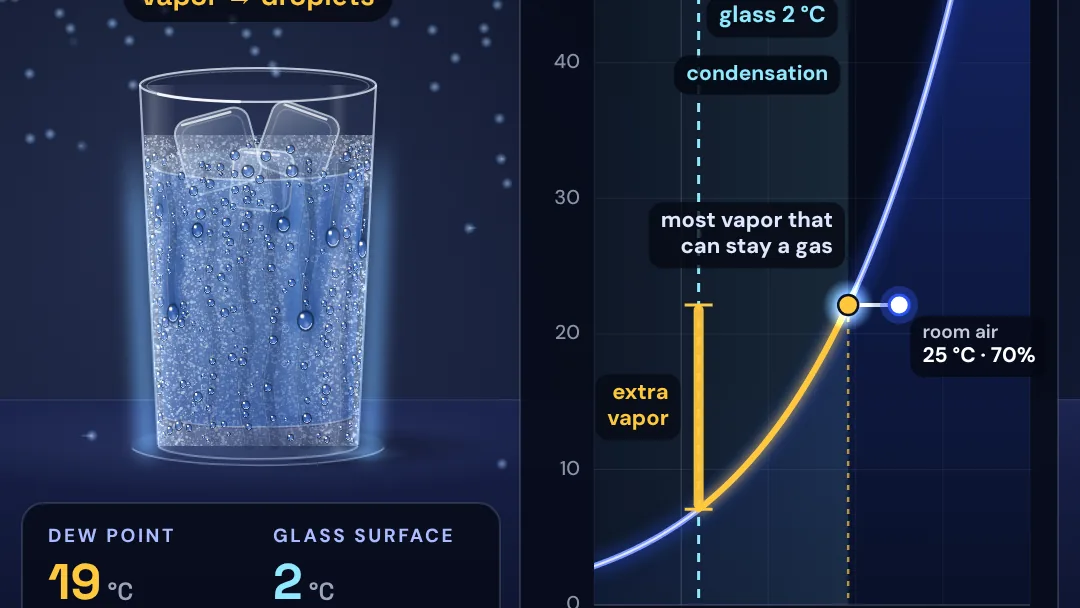 Interactive · Dew Point LabWhy does a cold glass sweat?Drag the humidity and the drink temperature, and watch water vapor condense on a cold glass or stay in the air.
Where the heat comes from
A phone’s chip turns its work into heat in a spot about the size of a fingernail. This film zooms into a processor.
Common questions
Is a vapor chamber the same as a heat pipe?
It is a flat one. Both are sealed, with a wick and a little liquid, and both run the same boil-and-condense loop. A heat pipe is a tube that carries heat from one end to the other. A vapor chamber is a thin plate that spreads heat across its whole face, which suits a flat phone. Wikipedia’s heat pipe article calls flat pipes and vapor chambers thin planar pipes with the same primary components.
Is there really water in my phone?
If it has a vapor chamber, probably a few drops, sealed in. Copper and water is the usual pairing in computer heat pipes, Wikipedia’s heat pipe article notes, and Apple says the iPhone 17 Pro’s chamber holds deionized water. Apple has not said how much. Very little is needed: in the model, a 6 W chip boils about one drop every 20 seconds, and the same water goes round and round.
Does a vapor chamber wear out?
It has no moving parts and typically needs no maintenance, Wikipedia’s heat pipe article notes. Over time, though, gases that cannot condense can build up inside, from impurities or the fluid breaking down, and slowly make it less effective. Neither Apple nor the tool gives a lifetime for a phone’s chamber.
If phones have vapor chambers, why do they still slow down?
Because a vapor chamber spreads heat; it does not get rid of it. The heat still has to leave through the phone’s surface. In the model, both plates shed the same 6 W from the same area, so both average about 48 °C; the chamber only removes the hot spot. Once the whole phone is warm, the only fix is to make less heat, so the chip slows down. In a 20-minute 3DMark test by The Tech Chap, the iPhone 17 Pro lost 38.7% of its performance, Notebookcheck reports.
Does it matter how I hold the phone?
For some chambers, a little. The 0.5 mm lab chamber in the model carried 7.58 W lying flat, 9.06 W when gravity helped the liquid back to the hot spot and 6.33 W when gravity worked against it. Upside down it still carried 7.58 W, because the wick, not gravity, does most of the work.
Concepts in this guide
Each one has a plain one-line definition in Concepts A–Z, with every model, film and post where it comes up.
Sources and credits
- 9to5Mac · Here’s how the iPhone 17 Pro vapor chamber actually works September 17, 2025. Apple’s Greg Joswiak: “Deionized water is sealed inside the vapor chamber, which is laser-welded into the aluminum chassis.”
- 9to5Mac · The iPhone Duo’s cooling system hides a clever trick inside its hinge October 12, 2026, relaying PCMag’s interview with Apple engineers: the A20 Pro’s heat goes into a vapor chamber, and a flexible graphite pipe through the hinge carries it to the other half.
- Notebookcheck · iPhone 17 Pro: Apple A19 Pro drosselt fast 40% (in German) September 18, 2025. Geekerwan: about 6.1 W while gaming, against at best 5.3 W for the A18 Pro, about 15% more heat handled, and bursts up to 13 W. The Tech Chap: a 38.7% drop over 20 minutes of 3DMark Solar Bay Extreme.
- Huang, Liu, Luo and Li · A novel ultra-thin vapor chamber for heat dissipation in ultra-thin portable electronic devices (Applied Thermal Engineering, 2020) A 0.5 mm chamber: 7.58 W lying flat at its best fill, about 20,900 W/m·K (about 52 times copper), 9.06 W with gravity, 6.33 W against it and 7.58 W inverted.
- Yadavalli, Weibel and Garimella · Performance-governing transport mechanisms for heat pipes at ultra-thin form factors (2015) At ultra-thin sizes and low power, the vapor’s own resistance can leave a heat pipe no better than a solid spreader.
- NASA Spinoff · Compact Vapor Chamber Cools Critical Components The loop in a titanium vapor chamber: the liquid evaporates at the heat source, the vapor releases its energy somewhere cooler, and a porous metal structure returns the liquid.
- Wikipedia · Heat pipe Flat pipes and vapor chambers, copper and water for electronics, an effective conductivity approaching 100 kW/(m·K) against about 0.4 for copper, no moving parts, and non-condensable gases.
- Wikipedia · Enthalpy of vaporization Water: 2,257 kJ/kg at 100 °C, more than five times the energy needed to heat it from 0 to 100 °C.
- Vapor Chamber Lab · model notesThe plate, the air, the chamber’s measured conductivity and wick limit, the vapor pressure and boiling rate, the dry-patch estimate and what the model leaves out.
Every creator named here made the work we link to. Listing it does not imply a partnership or endorsement.