Topic guide · Quiet supersonic flight
How can NASA’s X-59 fly faster than sound without a boom?
By shaping, not by flying slower. Every supersonic jet makes shock waves, one from each place it pushes air aside: the nose, the canopy, the inlet, the wings, the tail. On an ordinary jet the stronger parts of the wave catch up with the weaker ones on the long way down and merge into two big shocks, the sharp double boom. NASA’s X-59 is shaped so its shocks stay apart: a long, thin nose, the engine on top, lift spread from nose to tail. They arrive one by one as a soft thump. NASA’s target is about 75 perceived decibels on the ground; Concorde’s boom was about 105.
- Ordinary jet, at the ground
- 2 shocks · ≈ 0.8 psf
- X-59 shape, at the ground
- 5 small steps
- Pressure builds over
- ≈ 1 ms vs ≈ 15 ms
- Loudness
- ≈ 92 vs 75 PLdB
Model · simplified shock merging Mach 1.4 at 55,000 ft, both jets an assumed 24,000 lb. The loudness scale is set so the X-59 shape reads NASA’s 75 PLdB target; NASA gives Concorde’s boom as about 105 PLdB.
Interactive · ExplainerTools
Quiet Boom Lab
Stretch a jet’s nose from an ordinary short one to the X-59’s, and change its speed and height. Watch its shock waves merge into a double boom or stay apart as a thump, and see the pressure a person on the ground feels.
Model · simplified shock merging
Why does an ordinary supersonic jet boom twice?
In three steps. The boom is not one event at the moment a jet passes Mach 1; it is the shock pattern the jet drags along the whole time it flies faster than sound.
- Shocks
A jet faster than sound can’t warn the air ahead. Each place where it pushes air aside, the nose, canopy, inlet, wings and tail, starts its own shock wave, and all of them trail behind it in a cone.
- Catch up
The stronger part of a pressure wave travels a little faster than the weaker part. Over the 17 km from 55,000 feet down to the ground, the shocks at the front overtake each other and merge, and so do the ones at the back.
- Two jumps
What reaches the ground is an N-wave: a sudden jump in pressure, a steady fall below normal, and a sudden jump back. You hear the two jumps as a sharp double boom.
Sonic Boom Lab shows the first step: how the sound rings of a speeding jet pile into a cone that sweeps the ground. Quiet Boom Lab picks up from there and follows the shocks on their way down.
What do 75 PLdB and 0.8 psf mean?
A sonic boom is a pressure change, measured in pounds per square foot (psf). In the tool’s model, an ordinary jet the size of the X-59 at Mach 1.4 and 55,000 feet reaches the ground as an N-wave of about 0.8 psf. That is a tiny change, less than a thousandth of the air’s own pressure, but it comes in about a millisecond, and a sudden jump is what the ear hears as a bang.
So loudness depends on how fast the pressure rises, not just how far. NASA rates booms in perceived decibels (PLdB), a scale built for short, sharp sounds. Concorde’s boom was about 105 PLdB, NASA says. Its target for the X-59 is about 75 PLdB, which it has compared to a car door closing. In the model, the X-59 shape’s pressure builds in five small steps over about 15 milliseconds instead of one: a thump, not a bang.
How is the X-59 shaped to stay quiet?
The X-59 is 99.7 feet long, and almost a third of that is nose. A long, slender nose spreads the front of the pressure wave over many meters, so it starts as a ramp of small compressions instead of one strong shock. The single engine sits on top of the jet, which, NASA says, directs its noise away from people below, and the underside is kept smooth. Lift, which also pushes air down, is spread along the jet from the small canard to the T-tail instead of piling up in one place.
The result is a jet whose shocks start weaker and farther apart, too far apart to catch up before they reach the ground. Designers worked backwards: they picked the gentle signature they wanted on the ground and shaped the aircraft to make it. The long nose has a cost. It blocks the view ahead, so the pilot looks forward through a camera and screen instead of a windshield.
Where is the X-59 now, and what happens next?
NASA and Lockheed Martin Skunk Works built the X-59 for NASA’s Quesst mission. It first flew on October 28, 2025, went supersonic in June 2026 and reached Mach 1.53, about 1,010 mph, during a record six flights in one week in September 2026, NASA says. A year after its first flight, after more than 40 flights, it flew across the country via El Paso and Fort Worth to Kennedy Space Center.
Next come acoustic tests, measuring the thump the jet actually makes, and then flights over US communities to ask people what they hear. That matters because civil supersonic flight over US land has been banned since 1973, after public complaints about booms. In July 2026 the FAA proposed replacing the ban with a limit of 0.11 psf on a boom’s pressure at the ground. The rule is not final, and Quesst’s data is meant to help regulators decide what people will accept.
Try it: stretch the nose
- 1 See
Open Quiet Boom Lab and tap Ordinary jet, same speed. The shock lines merge into two before the ground. Biggest pressure jump reads 0.79 psf, Rise time 1.3 ms and Loudness (model) 92 PLdB.
- 2 Change
Drag the jet’s nose, or the Nose slider, all the way out, or tap X-59 design point: Mach 1.4, 55,000 ft. Five small shocks reach the ground. The biggest jump falls to 0.074 psf, the rise time grows to 15 ms, and the loudness reads 75 PLdB.
- 3 Understand
Keep the X-59 shape and drag Speed to Mach 2: the wave has longer to age on the way down and the shocks merge again, about 86 PLdB. Then tap Just past Mach 1: the shocks bend back up before they reach the ground, and no boom lands at all.
Where does this model stop?
Quiet Boom Lab uses G. B. Whitham’s theory of supersonic flow: each jet is summed up by how its cross-section and lift grow along its length, and the pressure wave ages on its way down through the standard atmosphere. Both jets weigh an assumed 24,000 lb; Lockheed Martin gives the X-59’s take-off weight as about 25,000 lb, and other sources say up to about 32,300 lb. The ordinary jet is built from its parts. The X-59 end is a designed low-boom shape in the same spirit as NASA’s, not NASA’s own numbers.
The loudness reading is a simpler stand-in for NASA’s PLdB scale, set so the X-59 shape at its design point reads 75. The picture is not to scale: the ground is 17 km below a 30 m jet. The model leaves out wind, turbulence, the exhaust plume and the three-dimensional flow near the jet; NASA designed the real X-59 with computer simulations and wind tunnels. The film uses short, credited clips of the X-59 at Fort Worth by spotter @LensOfMae and NASA’s schlieren image of two T-38s and their shock waves (NASA Armstrong); the jets, shock waves and numbers come from the model.
Explore by question
A quiet boom is still a boom, rearranged. Each card answers one part of the question.
Quiet Boom Lab
Model · simplified shock merging
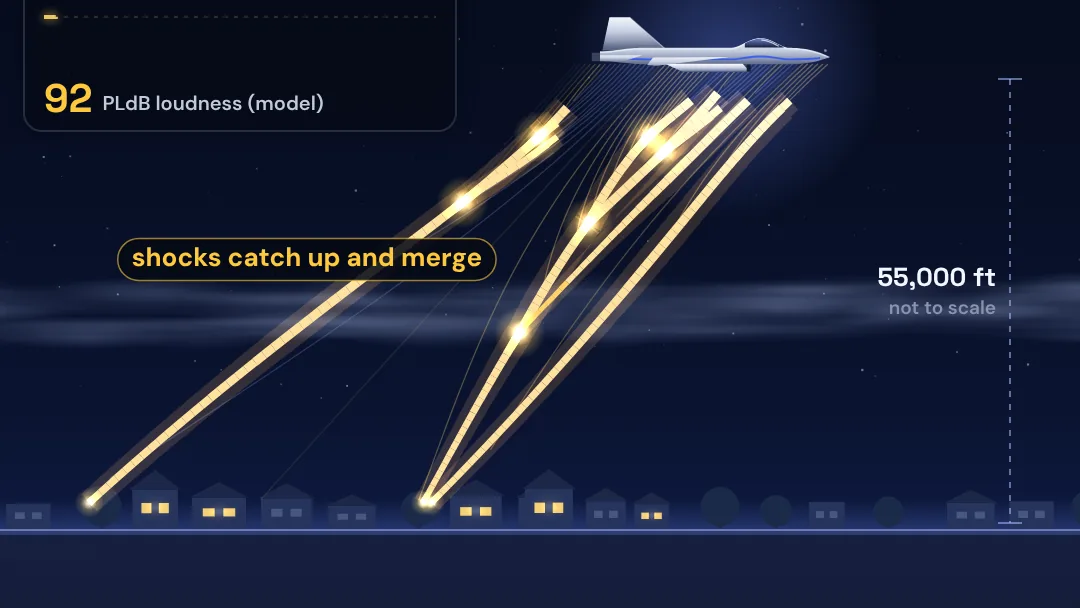 Interactive · Quiet Boom LabHow do you fly faster than sound without a sonic boom?Stretch a jet’s nose into the X-59’s shape and watch its shock waves stop merging, from a double boom to a soft thump.
- Short · 45 secondsHow do you fly faster than sound without a sonic boom?The X-59 at Fort Worth, shocks merging into a double boom, then the nose stretched until they stay apart. Narrated and captioned.
- JournalHow do you fly faster than sound without a sonic boom?Every supersonic jet makes shock waves. On an ordinary jet they merge on the way down into a double boom; NASA’s X-59 is shaped so they stay apart and arrive as a soft thump.
How a sonic boom forms
Before the shocks can merge, the jet has to outrun its own sound. This model shows the cone that sweeps the ground.
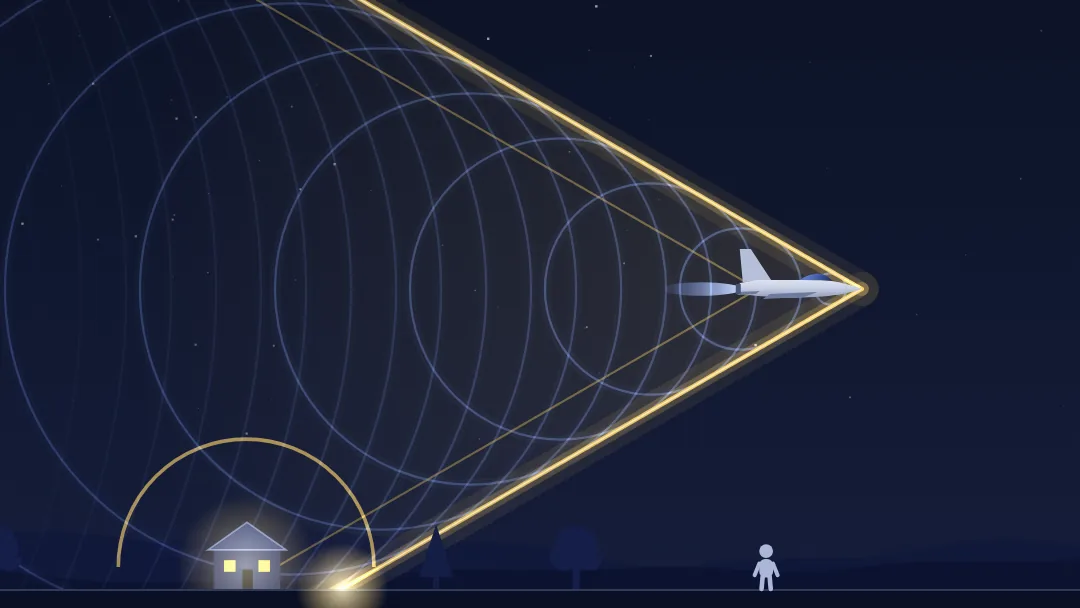 Interactive · Sonic Boom LabWhat makes a sonic boom?Drag a plane past the speed of sound and watch its sound rings pile into a cone that sweeps the ground.
- Short · 33 secondsWhat makes a sonic boom?What makes a sonic boom, and why it isn’t a one-time bang.
A tiny sonic boom
A whip crack is a sonic boom you can make by hand: the tip outruns sound.
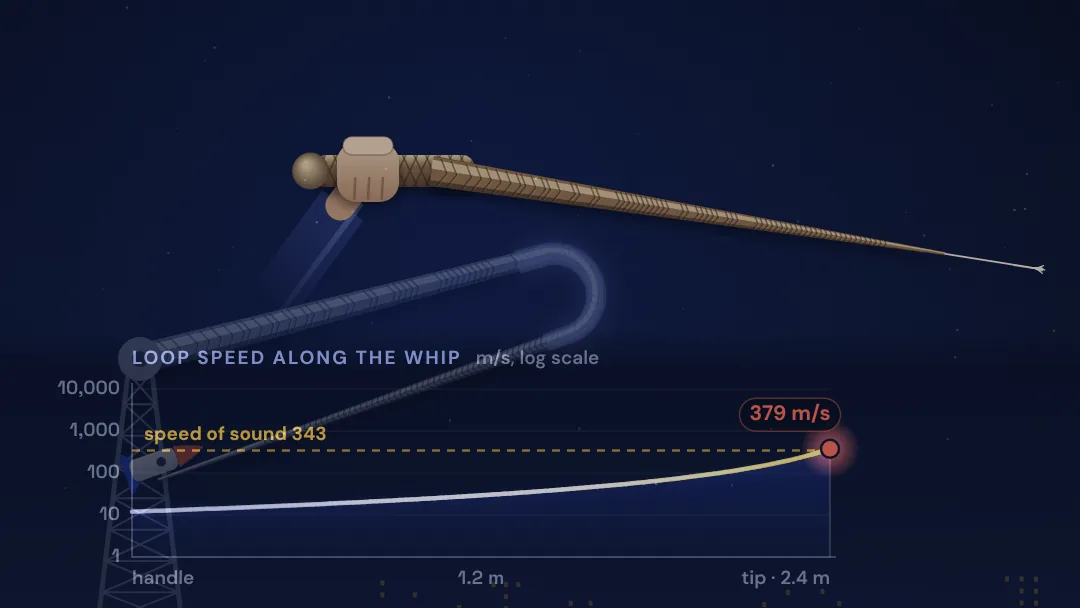 Interactive · Whip Crack LabWhy does a whip crack?Thin a whip’s tip and watch a rolling loop speed up until the end outruns sound.
Lift and sound
Lift is half of what shapes the boom, and a boom is a pressure wave like any sound. These two explain the pieces.
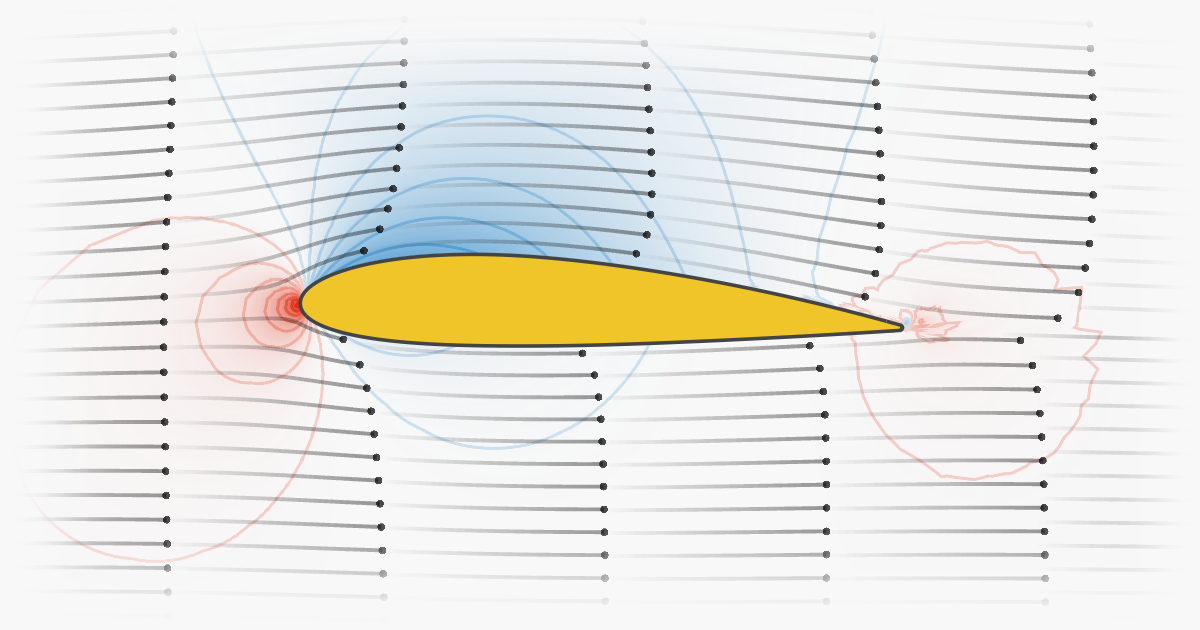 Interactive articleAirfoilExperiment with moving air and wing shapes to build an intuition for lift.by Bartosz Ciechanowski
 Interactive articleSoundPlay tones and visual models to see how a vibration travels through air as a pressure wave.by Bartosz Ciechanowski
Common questions
Is the X-59 silent?
No. It still makes shock waves, and NASA expects people below to hear a soft thump of about 75 perceived decibels, which it has compared to a car door closing. Concorde’s boom was about 105 PLdB. The shaping changes how the pressure arrives, not whether it arrives.
What is an N-wave?
The pressure signature of an ordinary sonic boom at the ground: a sudden jump up, a steady fall below normal, and a sudden jump back, shaped like the letter N. Its two jumps are the “boom-boom”. It forms because the shocks from a jet’s parts merge into one at the front and one at the back on the way down.
Why does a longer nose make a quieter boom?
A long, slender nose spreads the front of the pressure wave over a longer distance, so it starts as many small compressions instead of one strong shock. Small shocks that start far apart can’t catch up with each other before they reach the ground, so they arrive one by one as a gentle rise.
Why is the X-59’s engine on top?
NASA says the top-mounted engine directs its noise away from people below. With the engine above the wing, the wing sits between the inlet and the ground and the underside stays smooth, so fewer shocks head down from that part of the jet.
Can supersonic airliners fly over the US now?
Not yet. Civil supersonic flight over US land has been banned since 1973. In July 2026 the FAA proposed replacing the ban with a limit of 0.11 psf on a boom’s pressure at the ground, but the rule is not final. NASA’s community tests with the X-59 are meant to show regulators what people will accept.
Sources and credits
- NASA · How is the X-59 designed to quiet the boom? The shape scatters the shock waves so they reach the ground as a soft thump; the engine on top directs its noise away from people below; 99.7 ft long.
- NASA · Low-Boom Flight Demonstrator lithograph Mach 1.4 at 55,000 ft; ordinary jets’ shock waves merge into booms, the X-59’s shape keeps them apart.
- NASA Armstrong · Sonic boom heads for a thump Concorde’s boom about 105 PLdB; 75 PLdB considered acceptable for flight over land.
- NASA · NASA awards contract to build quieter supersonic aircraft (2018) The 75 PLdB target, compared to a car door closing; data for new sound-based rules on flight over land.
- NASA Quesst blog · X-59 completes record six flights in one week September 2026: Mach 1.53, about 1,010 mph, the X-59’s fastest so far.
- DLA Piper · Proposed FAA rule would allow civil supersonic flight The 1973 ban and the July 2, 2026 proposal to replace it with a 0.11 psf limit on a boom’s pressure at the ground; not final.
- Quiet Boom Lab · model notesWhitham’s F-function, aging in the standard atmosphere, the two shapes, the loudness stand-in and its calibration, and what the model leaves out.
Every creator named here made the work we link to. Listing it does not imply a partnership or endorsement.