A startup in California, Reflect Orbital, wants to sell sunlight after dark: mirrors in orbit that catch the Sun after it has set for you and aim it at a solar farm, a disaster zone or a night shift. The US Federal Communications Commission approved its first test satellite, Eärendil-1, in July 2026: an 18 × 18 m mirror of thin film, meant to fly about 600 km up. So can a mirror in orbit really light up the night, and how much?
Try it yourself in Space Mirror Lab: grow the mirror, raise the orbit or aim thousands of mirrors at one spot, and watch how wide and how bright the spot gets.
Still sunny up there
After sunset your ground is in Earth’s shadow, but 600 km up a satellite overhead stays in sunshine until the Sun is about 24° below your horizon, which is why satellites shine after dusk (see Satellite Dusk). Tilt a flat mirror there and it can send that sunlight down. Reflect says it would light places for a few minutes within two hours of sunset.
The Sun is not a point
Sunlight arrives from a disc about 0.53° wide, so a flat mirror doesn’t send down a thin beam: like a pinhole, it makes an image of the Sun, and that image spreads at 0.53° on the way down. From 600 km it lands as a spot 600 km × tan 0.53° ≈ 5.6 km across, plus the width of the mirror itself, a few dozen metres at most. Reflect describes its sites as about 6,000 acres, a circle of about that size.
A bigger mirror, the same spot
Grow the mirror and the spot doesn’t shrink; it only gets brighter, because more sunlight goes into the same 25 km². In the tool, direct sunlight of 100,000 lux, a 90% reflective film and a mirror turned 45° to the sideways dusk sunlight give about 0.84 lux for the 18 m test mirror: about 3 full moons (a full moon high in a clear sky gives about 0.26 lux). Reflect says about one full moon; astronomers Kocifaj, Bakos and Kundracík estimate about four. The 54 m mirrors Reflect plans give about 7.4 lux, like a lit residential street. Matching sunlight would take about 13,500 of them on one spot.
Minutes, not a night
At 600 km a satellite moves at 7.6 km/s and laps Earth every 96.5 minutes. It stays more than 30° up in your sky for only about 4 minutes, and lower than that it is farther away and its light spreads thinner. Light without gaps needs a new mirror every 4 minutes: about 24 around one orbit, and Earth turns under that orbit, so lighting a place for hours takes many more. Reflect talks of thousands of satellites, and eventually up to 50,000.
The sky around the spot
Air scatters part of every beam, so the glow spreads beyond the spot. For a single 54 m mirror, Kocifaj and colleagues estimate a sky brighter than a full-moon night out to about 14 km, and for 400 mirrors on one spot a glow visible from 80 km. The American Astronomical Society and dark-sky groups also warn of eye damage through telescopes and of bright moving points across the sky. Reflect says it will keep light away from observatories and protected habitats, switch it off quickly and turn its mirrors edge-on when idle, and disputes some of the study’s assumptions.
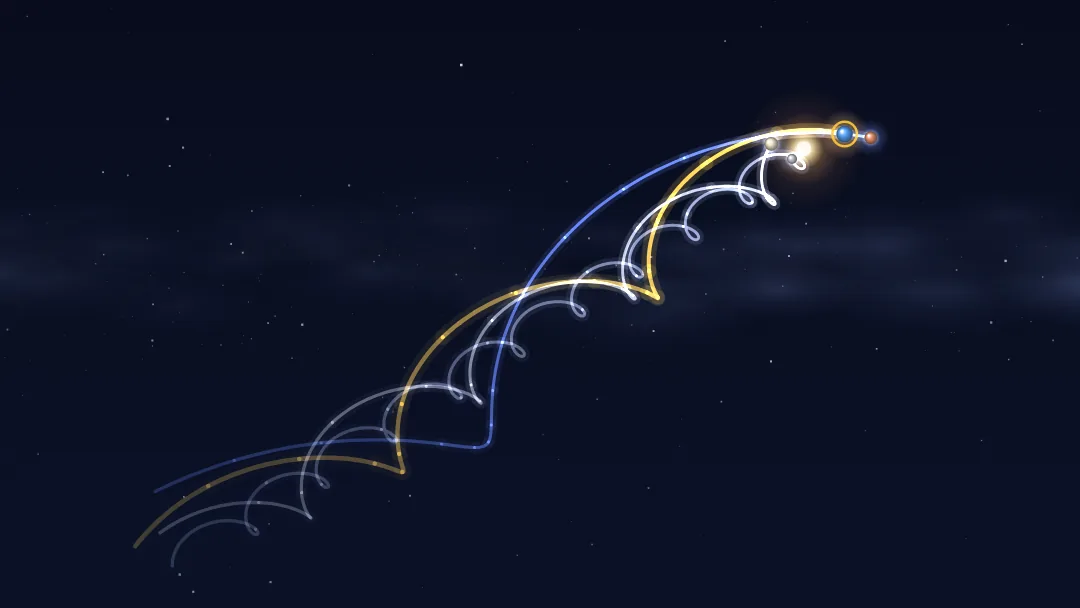
The tool is a model of a flat mirror straight overhead under a clear sky; a wrinkled film, haze or a satellite low in the sky would make the spot dimmer. The film uses short excerpts of Reflect Orbital’s hot-air-balloon mirror test (@bennbuilds on X; a daytime test, not from orbit) and satellite trails over Mt Taranaki stacked from two hours of photos (@blarsenphoto on TikTok), credited on screen; the valley, Earth, mirrors and numbers are drawn from the model.
Sources: Reflect Orbital, Reflect Orbital seeks collaboration with dark skies (2026); M. Kocifaj, G. Á. Bakos and F. Kundracík, Atmospheric light pollution by proposed Reflect Orbital space mirrors (2026); Space.com, Reflect Orbital just got permission to launch its 1st space mirror; MIT Technology Review, Space mirrors and the night sky; Payload, Reflect Orbital responds to its critics.
Sources & further reading
- Reflect Orbital: Reflect Orbital seeks collaboration with dark skies (2026)
- Kocifaj, Bakos & Kundracík, Atmospheric light pollution by proposed Reflect Orbital space mirrors (2026)
- Space.com, Reflect Orbital just got permission to launch its 1st space mirror
- MIT Technology Review, Space mirrors and the night sky (2026)
- Payload, Reflect Orbital responds to its critics (2026)
Make the next question an experiment.
Browse independent creators who make big ideas visible.
Find an explainer