Short · Space
Can a mirror in orbit light up the night?
A startup, Reflect Orbital, wants to sell sunlight after dark: after sunset, a satellite 600 km up is still in sunshine, and a tilted mirror can bounce that light down. But the Sun is a disc 0.53° wide, so the beam spreads into a spot nearly 6 km across, whatever the mirror’s size. A bigger mirror only makes the spot brighter: about 3 full moons for Reflect’s 18 m test mirror in this model, about a lit street for its planned 54 m mirrors. The catch: each mirror races past in about 4 minutes, so a spot needs a stream of them, and astronomers warn the glow would spread for kilometres.
Opens Space Mirror Lab. Change the same thing yourself.

Transcript
A startup wants to sell sunlight after dark. After sunset, six hundred kilometres up, it's still sunny. A tilted mirror can bounce that sunlight down. But the Sun isn't a point. It's a disc, half a degree wide, so the beam spreads into a spot nearly six kilometres across. Now grow the mirror. The spot doesn't shrink. It just gets brighter. Their eighteen-metre test mirror: about three full moons. Fifty-four metres: streetlight bright. The catch: each mirror races past in about four minutes, so you'd need a stream of them, and astronomers warn the glow would spread for kilometres. Follow for more explainers like this.
Learn more
Learn more about space mirrors
This model shows why the spot is about 5.6 km wide whatever the mirror’s size. The guide adds how bright and how brief it is, what Reflect Orbital plans, and why astronomers object.
- Topic guideCan a mirror in space light up the night?The Sun’s half-degree disc, brightness against the Moon and streetlights, minutes per pass, and the glow beyond the spot.
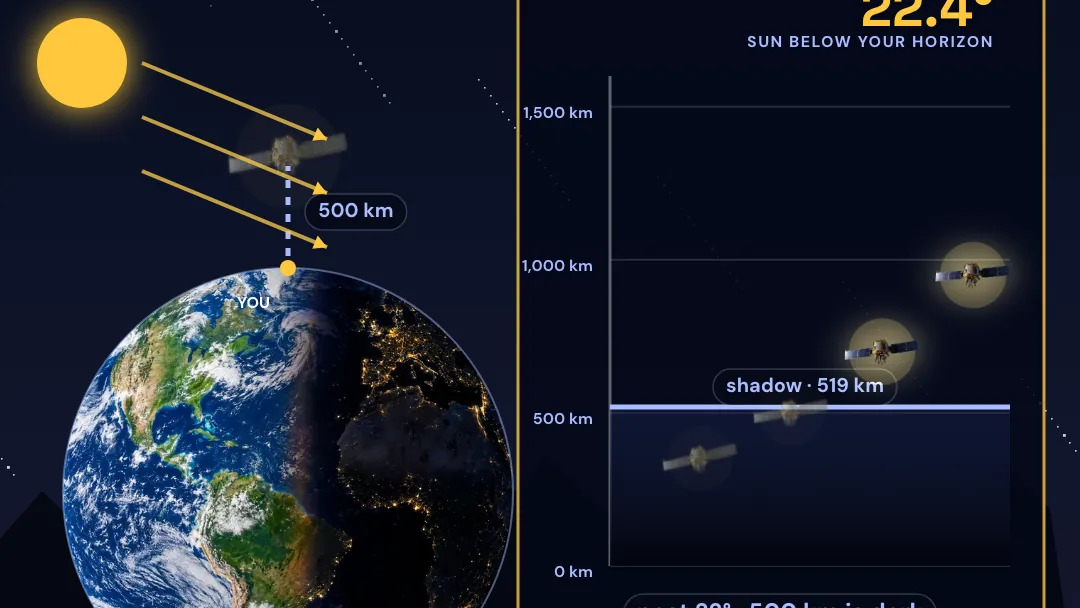 Interactive · Satellite DuskWhy do you mostly see satellites just after sunset?Why a satellite 600 km up is still in sunshine after your sunset: watch Earth’s shadow climb.
- Interactive articleCameras and LensesHow a pinhole makes an image, the same way a flat mirror makes its spot an image of the Sun.by Bartosz Ciechanowski
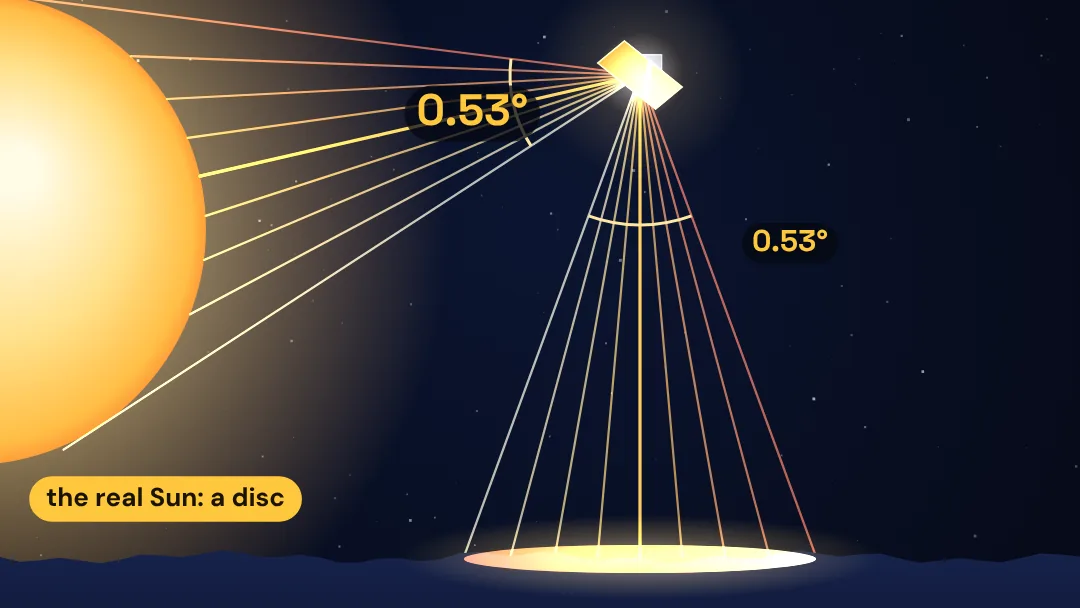 JournalCan a mirror in orbit light up the night?A startup wants to beam sunlight down after dark. The Sun’s half-degree disc spreads each mirror’s light into a spot nearly 6 km wide, so a bigger mirror only makes it brighter.