Skip to the interactive
ExplainerTools Watch the 45-second film

Space · interactive

Can a mirror in orbit light up the night?

Model · flat mirror, 0.53° Sun, no clouds

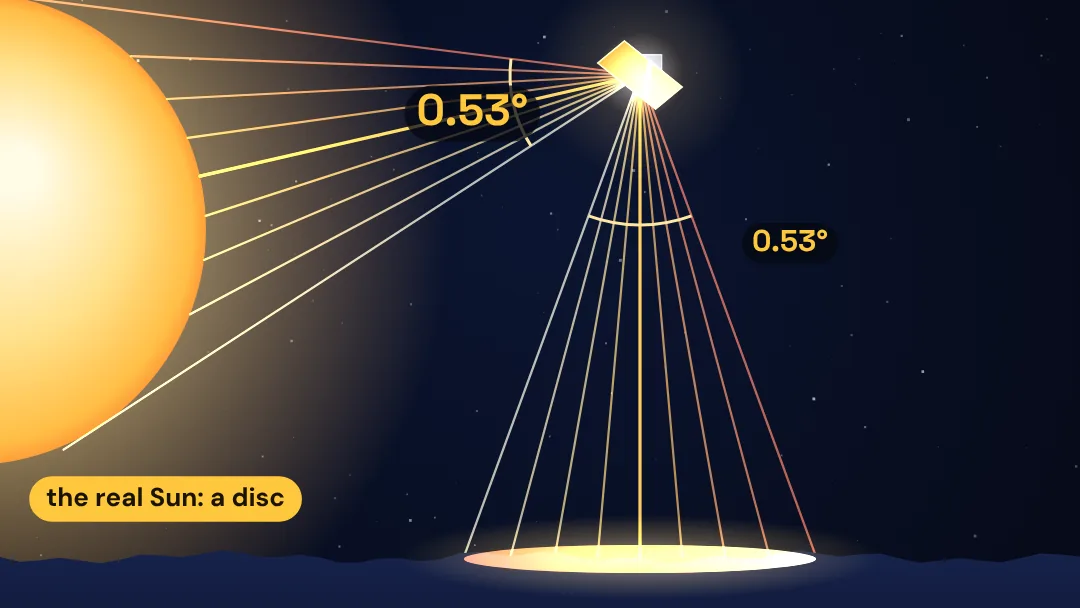
Left: a mirror in orbit and its cone of reflected sunlight (angle drawn 40× wider). Right: the spot from above, to scale. Below: how bright it is. Drag the satellite up or down to change its altitude.

1 See

A startup wants to sell sunlight after dark: mirrors in orbit, still in sunshine after sunset, aimed at a spot on the ground. How big is that spot, and how bright? Can a mirror in orbit light up the night?

2 Change

3 Understand

The 45-second film · Watch with transcript
Watch the 45-second film
Model notes and sources

Model. A flat square mirror of side s sits at altitude h, straight above the spot, under a clear sky. Sunlight comes from the Sun’s disc, 0.533° across, so every point of a flat mirror sends out a cone 0.533° wide and the spot is D = s + h · tan 0.533°: 5.6 km from 600 km whatever the mirror’s size (the mirror adds only its own 18 or 54 m). The light at the spot is E = n · E☉ · R · cos 45° · s² / (πD²/4), with E☉ = 100,000 lux (direct sunlight at the ground), reflectivity R = 0.9 (aluminised film) and cos 45° because at dusk the sunlight arrives sideways, so a mirror that sends it straight down is turned 45° to it. For Reflect Orbital’s 18 m test mirror at 600 km that is 0.84 lux; for its planned 54 m mirrors, 7.4 lux. A full moon high in a clear sky gives about 0.26 lux, a lit residential street about 7.5 lux (European road-lighting class P3), a cloudy day about 1,000 lux.

Passes. A mirror can light a spot while it is high in that spot’s sky; the tool counts the time it is more than 30° above the horizon. At 600 km the satellite moves at 7.6 km/s and laps Earth in 96.5 minutes, and it stays above 30° for 4.1 minutes, so light without gaps needs a new mirror every 4.1 minutes: 24 spaced around one orbit. Earth turns under the orbit, so lighting a place for hours takes many such orbits.

Why the spot doesn’t shrink. A flat mirror makes an image of the Sun, as a pinhole does. The Sun is not a point but a disc half a degree wide, so its reflected image spreads at half a degree on the way down. A bigger mirror sends more light into the same image. Only a lower orbit could make the spot much smaller: from 600 km no mirror can beat about 5.6 km, and a curved one can trim no more than its own width.

The company and its critics. Reflect Orbital, a startup in Hawthorne, California, says it wants to sell sunlight after dark, for example to solar farms, rescue crews and events. The US Federal Communications Commission approved its demonstration satellite, Eärendil-1, an 18 × 18 m mylar reflector at about 600–650 km, in July 2026; as of late October 2026 it had not launched. Reflect says each pass lasts up to about five minutes within two hours of sunset, about as bright as a full moon, that it will avoid observatories and other protected sites and can switch the light off quickly; it plans thousands of satellites and eventually up to 50,000 of 54 × 54 m. Astronomers and dark-sky groups object. Kocifaj, Bakos and Kundracík (2026) estimate about 4 full moons for the 18 m mirror and 9.5 lux for a 54 m one, a sky brighter than a full-moon night out to about 14 km from one 54 m beam, and a glow visible from 80 km for 400 mirrors on one spot; the American Astronomical Society warned of eye damage through telescopes and brighter skies far from the target. The model here gives 0.84 lux (3.2 full moons) for 18 m: between the company’s figure and the astronomers’.

The pictures. Everything on the stage is drawn in code from the model; the valley is an invented desert map, and the cone is drawn 40 times wider than 0.53° so it shows. In the film the angles in the Sun-disc diagram are exaggerated too; the Earth cross-section and the orbit are to scale. Three short real clips appear only in the film, credited on screen, picture only: Reflect Orbital’s hot-air-balloon mirror test, flashing sunlight into a camera on the ground and seen from a drone with the mirror hanging under the basket (video by founder Ben Nowack, @bennbuilds on X, posted March 2024; a low-altitude test from a balloon at twilight, not from orbit), and satellite trails over Mt Taranaki, New Zealand, a two-hour stack of 578 photos of ordinary satellites (@blarsenphoto on TikTok). Only one mirror has lit the ground from orbit so far: Russia’s Znamya 2, a 20 m film mirror unfurled near the Mir space station in February 1993, which swept a spot about 5 km wide across Europe (Znamya).

Limits. No clouds, haze or atmospheric loss beyond what direct sunlight at the ground already includes; a perfectly flat mirror (a film that wrinkles or sags spreads the light wider and dimmer); the Sun on the horizon (deeper after sunset the mirror turns further and sends a little less); the satellite straight overhead (lower in the sky it is farther away and the spot stretches and dims, to about a sixth at 30°). Real passes, pointing errors and scattered light are left out.

See also Satellite Dusk: why satellites still shine after sunset.

Sources: Reflect Orbital, Reflect Orbital seeks collaboration with dark skies (Oct 31, 2026); M. Kocifaj, G. Á. Bakos and F. Kundracík, Atmospheric light pollution by proposed Reflect Orbital space mirrors (2026); Space.com, Reflect Orbital just got permission to launch its 1st space mirror; Astronomy, FCC approves Reflect Orbital filing for mirror in space; MIT Technology Review, Space mirrors and the night sky; Payload, Reflect Orbital responds to its critics; Wikipedia, Reflect Orbital, Angular diameter and Lux; EN 13201-2 road lighting classes, summary.

An ExplainerTools Original. Plans and figures for Eärendil-1 from Reflect Orbital and its FCC filing; sky-glow estimates from Kocifaj, Bakos & Kundracík (2026).
Learn more

Learn more about space mirrors

This model shows why the spot is about 5.6 km wide whatever the mirror’s size. The guide adds how bright and how brief it is, what Reflect Orbital plans, and why astronomers object.

Keep exploring

Up next

  1. Interactive · ScienceIf space is so cold, why is cooling a spacecraft so hard?
  2. Interactive · ScienceDoes Earth really corkscrew through space?
  3. Interactive · ScienceCan a plane's sound give away where a video was filmed?

Behind the film

Concepts in this film

The ideas the film moves through, with this model’s numbers, the research behind each one and where else it comes up.

All concepts, A to Z

Angular diameter

Angular diameter is how wide something looks, measured as an angle. The Sun is 1.39 million km across and 150 million km away, so it spans about 0.53°, half a degree, a little more in January and a little less in July; the Moon looks almost the same size. Light from opposite edges of the Sun’s disc arrives 0.53° apart, so even a perfectly flat mirror sends out a cone that wide, and 600 km down it has spread to h × tan 0.533° = 5.6 km. Russia’s Znamya 2, a 20 m mirror unfurled near the Mir space station in 1993, cast a spot about 5 km wide that swept across Europe.

Related research Angular diameter (Wikipedia)Znamya (satellite) (Wikipedia)

See also Lens Lab: why a point of light lands as a discCameras and Lenses by Bartosz Ciechanowski

Pinhole image

A small hole or a small flat mirror doesn’t make a dot of sunlight: it makes a small picture of the Sun’s disc, which is why sunlight through leaves lands in round spots, and in crescents during an eclipse. Every patch of a flat mirror in orbit paints its own 5.6 km picture of the Sun on the same patch of ground, so a bigger mirror only stacks more pictures on top of each other: the spot gets brighter, not smaller. No mirror can do much better from 600 km, because a curved one can only trim its own width off the spot; a smaller spot needs a lower orbit.

Related research Pinhole camera (Wikipedia)Etendue (Wikipedia)

See also Cameras and Lenses by Bartosz Ciechanowski: the pinhole cameraLens Lab: cones of light and blur discs

Illuminance (lux)

Illuminance is how much light lands on each square metre of ground, measured in lux. Direct sunlight gives about 100,000 lux, an overcast day about 1,000, a lit residential street about 7.5 (European road-lighting class P3), a full moon high in a clear sky about 0.26 and a moonless night about 0.002. The model spreads the mirror’s share of sunlight over the spot, 100,000 lux × 90% reflectivity × cos 45° × mirror area ÷ spot area: 0.84 lux, about three full moons, for Reflect Orbital’s 18 m test mirror, and 7.4 lux, street-light level, for its planned 54 m mirrors. Kocifaj, Bakos and Kundracík estimate a little more, 1.05 and 9.5 lux; Reflect says its demonstration will be about as bright as a full moon.

Related research Lux (Wikipedia)EN 13201-2 road lighting classes, summary (Performance in Lighting)

See also Lights and Shadows by Bartosz CiechanowskiMoon Phase Lab: moonlight is sunlight too

Satellite pass

A satellite 600 km up circles Earth at 7.6 km/s, once every 96.5 minutes, so it is high in any one place’s sky for only a few minutes: the tool counts 4.1 minutes more than 30° above the horizon, close enough to light the spot well, and Reflect Orbital says each pass would last up to about five. Steady light needs a new mirror that often, 24 of them spaced around one orbit. Because Earth turns under the orbit, lighting one place for hours takes many such orbits.

Related research Reflect Orbital seeks collaboration with dark skies (Reflect Orbital, 31 Oct 2026)Low Earth orbit (Wikipedia)

See also Newton’s Cannon: why satellites don’t fall downLow Orbit Internet: why low orbits need thousands of satellites

Earth’s shadow

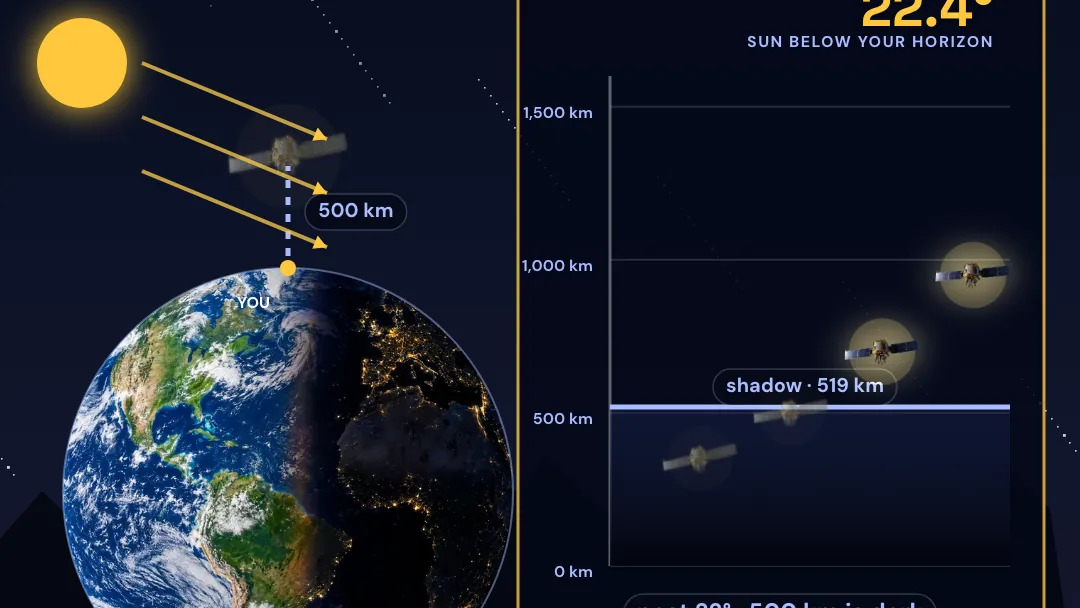
When the Sun sets for you, it hasn’t set for anything high above you. A satellite 600 km straight overhead stays in sunlight until Earth’s shadow climbs past its height, about an hour and a half after sunset at the equator around the equinoxes and longer farther from it, which is why satellites show up as moving stars in the first hours of the night. That window is what Reflect Orbital wants to sell: passes of up to five minutes within two hours of local sunset.

Related research Earth’s shadow (Wikipedia)Reflect Orbital seeks collaboration with dark skies (Reflect Orbital, 31 Oct 2026)

See also Satellite Dusk: watch Earth’s shadow rise through low orbitJournal: Why do you mostly see satellites just after sunset?Orbit Chip Lab: an orbit in near-constant sunlight

Skyglow

Skyglow is light scattered back down by the air, like the orange dome over a city seen from the countryside. A beam from orbit lights the air it passes through as well as the ground, so its glow spreads well beyond the 5.6 km spot. Kocifaj, Bakos and Kundracík (2026) estimate that one 54 m mirror would make most of the sky brighter than on a full-moon night out to about 14 km, and that 400 mirrors on one spot would be obvious from 80 km. The American Astronomical Society has warned of risks to research telescopes and, citing the company’s own filing, of eye damage for anyone looking through a mid-sized telescope.

Related research Kocifaj, Bakos & Kundracík, Atmospheric light pollution by proposed Reflect Orbital space mirrors (arXiv, 2026)Astronomy, FCC approves Reflect Orbital filing for mirror in space (2026)

See also Sunset Lab: how the air scatters lightSatellite Dusk: satellites lit after sunset

About this tool

Can a mirror in orbit light up the night?

Grow a mirror in orbit and watch its spot of sunlight on the ground: the spot stays nearly 6 km wide and only gets brighter.

Subject
Science
Topics
space · satellites · sunlight · mirrors · light pollution
Published
In the catalog
Can a mirror in orbit light up the night?

The same idea, by other creators