Engineering · Interactive demo
What’s the fastest way to board a plane?
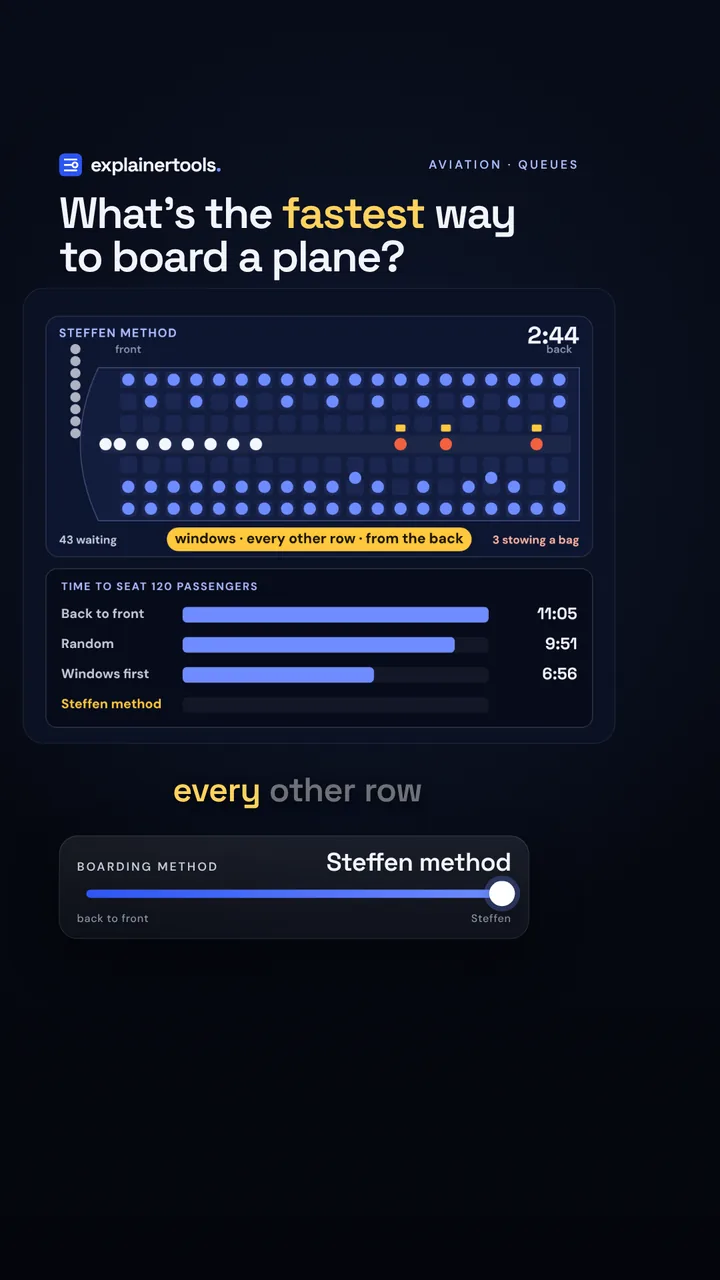
The fastest way to board a plane: the aisle is the bottleneck, so back-to-front zones are slow, random is faster, windows first faster still and the Steffen method fastest.
Created by ExplainerTools.
About this explainer
- Made by
- ExplainerTools
- Format
- Interactive demo
- Subject
- Engineering
- Where it runs
- Plays here
- Full tool
- Open the tool page
- Published
- Added to collection
- aviation
- queues
- airplane boarding
- simulation
- operations research
- travel
How the model works
Most airlines call rows from the back of the plane first. It feels orderly. Tests say it is one of the slowest ways to fill a cabin. What is the holdup, and what is faster?
- Boarding methodback to front → Steffen
- Carry-on bags0.5× light → 2× packed bins
- Boarding clockdoors open → all seated
A teaching simulation with illustrative times: one aisle, 20 rows of six, 120 passengers; a passenger blocks the aisle while stowing a bag (3 to 12 seconds) and for each seated neighbour who has to stand. No families, late arrivals or full bins.
Model notes and sources
Where this comes from. In 2008 the physicist Jason Steffen simulated boarding orders and found that the usual back-to-front blocks were among the slowest and that an order sending window passengers to every other row from the back was fastest (“Optimal boarding method for airline passengers”, Journal of Air Transport Management). In 2011 he and television producer Jon Hotchkiss tested five methods with 72 volunteers and their luggage in a mock Boeing 757 cabin (“Experimental test of airplane boarding methods”, published 2012). The Steffen method took 3 minutes 36 seconds, window-middle-aisle 4:13, random boarding 4:44, strict back to front 6:11 and boarding in blocks from the back 6:54.
The idea. The aisle is the bottleneck. A passenger who stops to lift a bag into the bin blocks everyone behind them, and so does a seated passenger who has to stand up to let someone into the window seat. Boarding is fast when many people can stow bags at the same moment, which means spreading them along the aisle, and when nobody has to climb over anybody. Calling a block of rows at the back does the opposite: it sends a crowd to the same few rows, where only two or three can stow at once while the rest of the aisle stands idle. Random boarding spreads people out by accident. Window seats first removes the seat shuffling. Steffen’s order does both on purpose.
The model. This is a teaching simulation with illustrative times, not an airline’s. The cabin has one aisle and 20 rows of six seats, 120 passengers, one passenger per aisle spot. A step forward takes one tick of 1.5 seconds. At their row a passenger blocks the aisle while stowing a bag for 2 to 8 ticks (the same passenger takes the same time in every method) plus 4 ticks for each seated neighbour who has to stand up. Back to front uses four zones of five rows, rear zone first, in random order inside a zone. Windows first seats all the window passengers, then the middles, then the aisles. Steffen’s order sends window passengers to every other row from the back on one side, then the other side, then the skipped rows, then repeats for middles and aisles. In this cabin that gives about 11 minutes for back to front, just under 10 for random, about 7 for windows first and under 5 for Steffen. The ranking matches the 2011 test; the times do not, because the test cabin was smaller. Real boarding also has families who sit together, late arrivals, full bins and people in the wrong seat, none of which is modelled, and they are the main reason airlines do not use Steffen’s order.
The film. The mechanism is drawn in code by ExplainerTools, with no AI-generated pictures. The Short also uses short real excerpts, picture only, a few seconds each and credited on screen: Delta (TikTok), a gate screen calling a boarding zone; United (TikTok), bags going into overhead bins; and Jon Hotchkiss, This vs That (YouTube), footage of the 2011 cabin test. The times in the film come from the simulation, not from the footage.
Sources: J. H. Steffen, “Optimal boarding method for airline passengers”, Journal of Air Transport Management 14 (2008); J. H. Steffen and J. Hotchkiss, “Experimental test of airplane boarding methods”, Journal of Air Transport Management 18 (2012); Jon Hotchkiss, This vs That, video of the test; Wikipedia, “Airplane boarding”.
An ExplainerTools Original. Research: J. H. Steffen (2008); Steffen and Hotchkiss (2012). Footage: Delta; United; Jon Hotchkiss, This vs That.
Watch it move
- What’s the fastest way to board a plane?45-second Short
Go deeper
Explore interactive ideas in space, science, math, and more. Try a demo, read an interactive article, watch a short video, and follow what makes you curious.
New Originals
Change one thing and see why.
The three newest models, each with a short film. Watch the question, then play with the answer.
Follow your curiosity
A collection of small doors into big ideas.
Format
Swipe or scroll for more formats →
Subject
Swipe or scroll for more subjects →
Topic
Swipe or scroll for more topics →
Sort by
Rankings count activity here on ExplainerTools. Newest means added to this collection.
Loading collection…
Make something click.
Made an explainer, or found one you love? Give it a place in the collection.