Aviation · queues
What’s the fastest way to board a plane?
Pick a boarding method and watch where the queue forms. Then turn “Carry-on bags” up and see which method suffers most.
1 See
Most airlines call rows from the back of the plane first. It feels orderly. Tests say it is one of the slowest ways to fill a cabin. What is the holdup, and what is faster?
2 Change
3 Understand
Model notes and sources
Where this comes from. In 2008 the physicist Jason Steffen simulated boarding orders and found that the usual back-to-front blocks were among the slowest and that an order sending window passengers to every other row from the back was fastest (“Optimal boarding method for airline passengers”, Journal of Air Transport Management). In 2011 he and television producer Jon Hotchkiss tested five methods with 72 volunteers and their luggage in a mock Boeing 757 cabin (“Experimental test of airplane boarding methods”, published 2012). The Steffen method took 3 minutes 36 seconds, window-middle-aisle 4:13, random boarding 4:44, strict back to front 6:11 and boarding in blocks from the back 6:54.
The idea. The aisle is the bottleneck. A passenger who stops to lift a bag into the bin blocks everyone behind them, and so does a seated passenger who has to stand up to let someone into the window seat. Boarding is fast when many people can stow bags at the same moment, which means spreading them along the aisle, and when nobody has to climb over anybody. Calling a block of rows at the back does the opposite: it sends a crowd to the same few rows, where only two or three can stow at once while the rest of the aisle stands idle. Random boarding spreads people out by accident. Window seats first removes the seat shuffling. Steffen’s order does both on purpose.
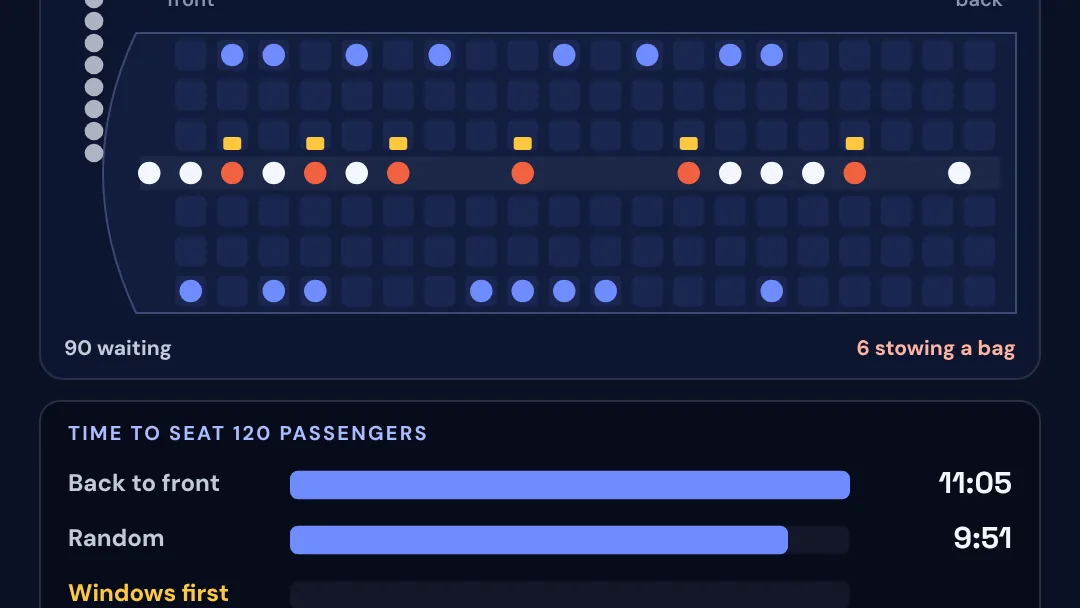
The model. This is a teaching simulation with illustrative times, not an airline’s. The cabin has one aisle and 20 rows of six seats, 120 passengers, one passenger per aisle spot. A step forward takes one tick of 1.5 seconds. At their row a passenger blocks the aisle while stowing a bag for 2 to 8 ticks (the same passenger takes the same time in every method) plus 4 ticks for each seated neighbour who has to stand up. Back to front uses four zones of five rows, rear zone first, in random order inside a zone. Windows first seats all the window passengers, then the middles, then the aisles. Steffen’s order sends window passengers to every other row from the back on one side, then the other side, then the skipped rows, then repeats for middles and aisles. In this cabin that gives about 11 minutes for back to front, just under 10 for random, about 7 for windows first and under 5 for Steffen. The ranking matches the 2011 test; the times do not, because the test cabin was smaller. Real boarding also has families who sit together, late arrivals, full bins and people in the wrong seat, none of which is modelled, and they are the main reason airlines do not use Steffen’s order.
The film. The mechanism is drawn in code by ExplainerTools, with no AI-generated pictures. The Short also uses short real excerpts, picture only, a few seconds each and credited on screen: Delta (TikTok), a gate screen calling a boarding zone; United (TikTok), bags going into overhead bins; and Jon Hotchkiss, This vs That (YouTube), footage of the 2011 cabin test. The times in the film come from the simulation, not from the footage.
Sources: J. H. Steffen, “Optimal boarding method for airline passengers”, Journal of Air Transport Management 14 (2008); J. H. Steffen and J. Hotchkiss, “Experimental test of airplane boarding methods”, Journal of Air Transport Management 18 (2012); Jon Hotchkiss, This vs That, video of the test; Wikipedia, “Airplane boarding”.
An ExplainerTools Original. Research: J. H. Steffen (2008); Steffen and Hotchkiss (2012). Footage: Delta; United; Jon Hotchkiss, This vs That.