Space · launch cost
Why does reusing a rocket make orbit cheaper?
Turn “Flights per rocket” up and watch the rocket’s share of each launch shrink. Then raise “Refurbishment between flights” and see the saving disappear.
1 See
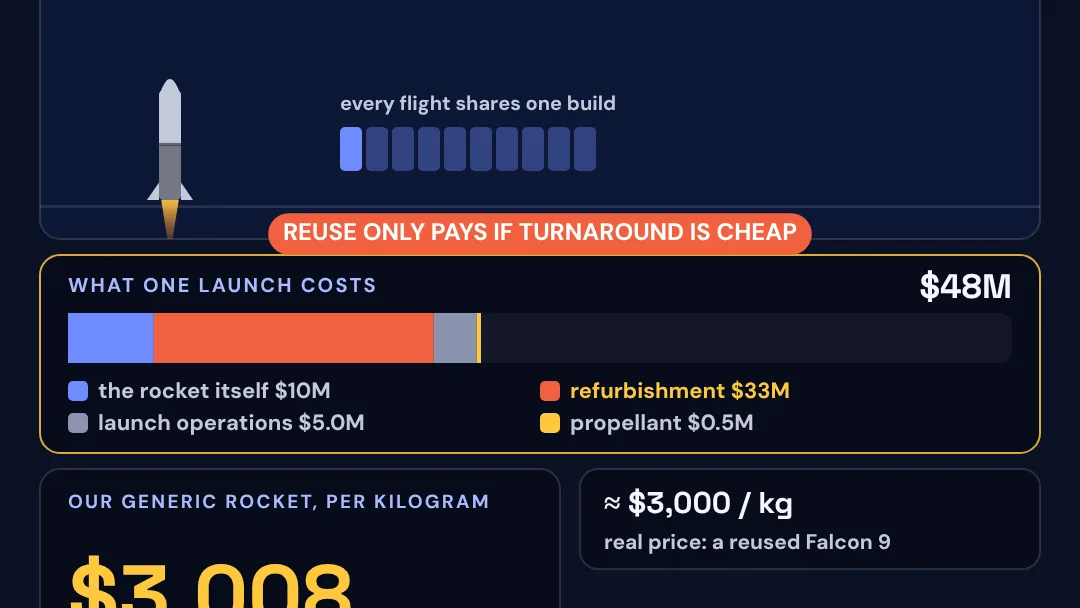
Propellant is less than one percent of what a launch costs. So where does the money go, and why does landing the rocket change the price of a kilogram in orbit so much?
2 Change
3 Understand
Model notes and sources
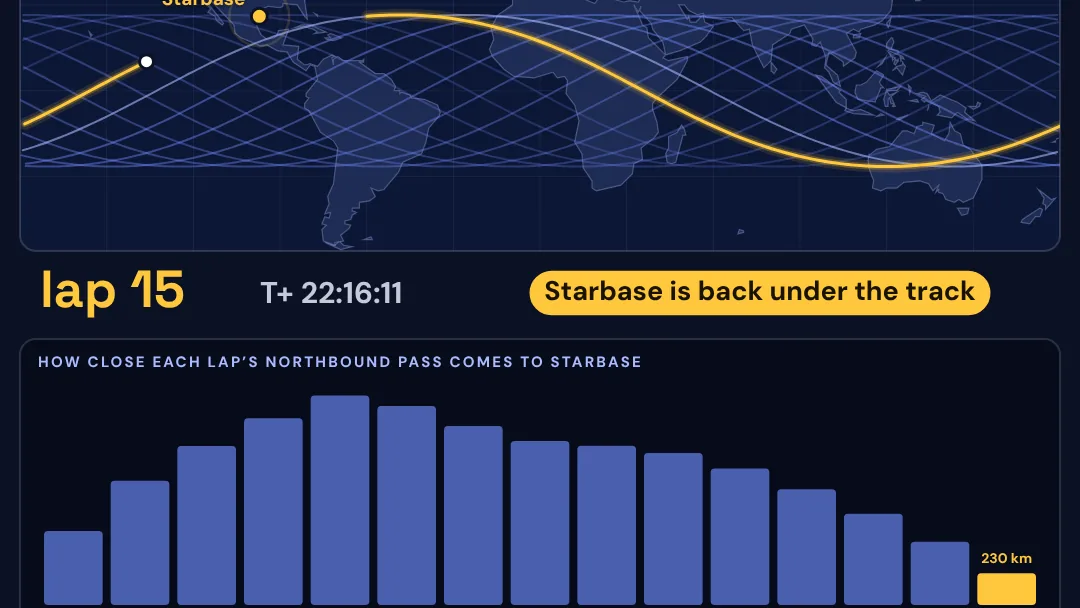
Where this comes from. Commonly cited launch prices to low Earth orbit are about $54,500 a kilogram for the Space Shuttle and about $2,700 a kilogram for a Falcon 9, figures from Harry Jones’s 2018 NASA paper “The Recent Large Reduction in Space Launch Cost”; the film rounds the Falcon 9 figure to about $3,000. On Starship’s fifteenth flight SpaceX caught the upper stage with the launch tower for the first time on November 14, 2026 (SpaceX); the Super Heavy booster aborted its catch and splashed down (SpaceX). No recovered Starship upper stage has flown again yet. “Under $100 a kilogram” is SpaceX’s stated goal for full and rapid reuse. It is a target, not a price anyone has paid.
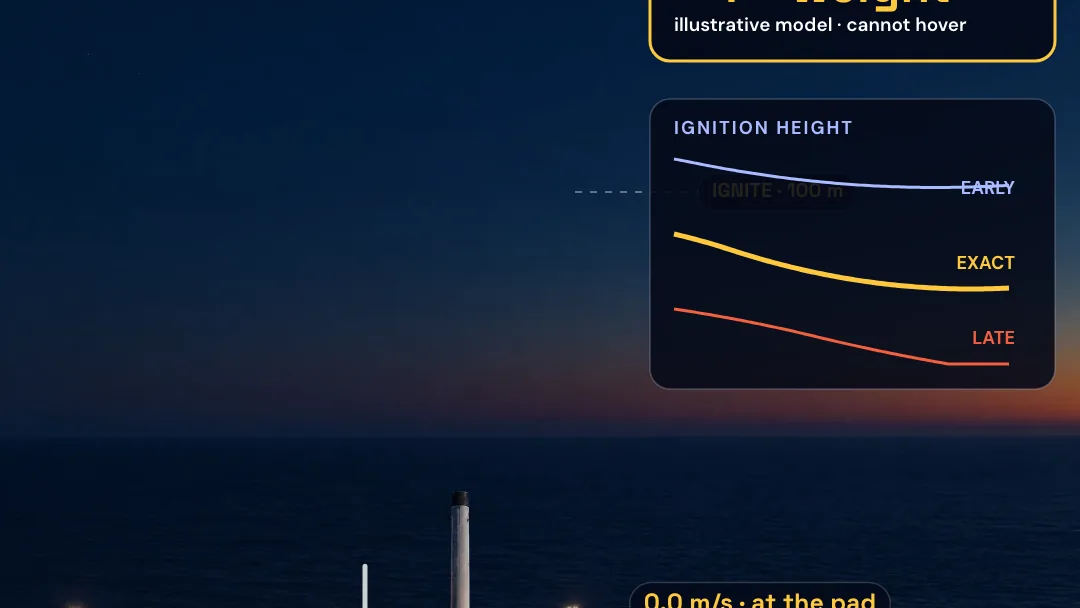
The idea. A launch bill has four parts: the rocket, any refurbishment since its last flight, the people and facilities that run the launch, and propellant. Propellant is the smallest by far, well under 1%. If the rocket is thrown away, every launch pays for a whole new one. If it flies n times, each launch pays 1/n of it. That is the whole trick, and it has two catches. Landing costs performance: fuel, legs and fins that could have been payload. And turnaround has to be cheap. The Space Shuttle was reusable, but each orbiter needed months of inspection and rebuilding between flights, and its cost per kilogram ended up higher than the expendable rockets of its day.
The model. The rocket here is generic and the dollars are illustrative, not any company’s. A new rocket costs $100 million and lifts 20 tonnes; propellant is $0.5 million and launch operations $5 million a flight. Thrown away, a launch costs $105.5 million, or $5,275 a kilogram. Flown n times, each launch carries build ÷ n, plus refurbishment at a share r of a new rocket’s price on every reflight, r × build × (n − 1) ÷ n. Landing gives up a share of payload: 20 t × (1 − penalty). So ten flights with 10% refurbishment and a 20% payload penalty cost $24.5 million a launch for 16 tonnes: $1,531 a kilogram. Thirty flights with 90% refurbishment cost $5,324 a kilogram, slightly worse than throwing the rocket away. A hundred flights with 1% refurbishment and a 30% penalty reach $535 a kilogram, where operations are most of the bill. Real prices also include development costs, profit, insurance and how full the rocket is, none of which is modelled.
The film. The mechanism is drawn in code by ExplainerTools, with no AI-generated pictures. The Short also uses short real excerpts, picture only, a few seconds each and credited on screen, all from SpaceX: the Starship Flight 15 tower catch (X) and a Falcon 9 booster landing on a droneship (X). The real prices in the film are labelled as real; the large figure is the model’s generic rocket.
Sources: Harry W. Jones, “The Recent Large Reduction in Space Launch Cost” (NASA Ames, ICES 2018); SpaceX, the Flight 15 upper-stage catch (November 14, 2026), and SpaceX on the booster; Wikipedia, “Reusable launch vehicle” and “Space Shuttle program”.
An ExplainerTools Original. Prices: H. W. Jones, NASA (2018). Starship Flight 15: SpaceX. Footage: SpaceX.