Science · Interactive demo
How could a brain implant let a blind person see?
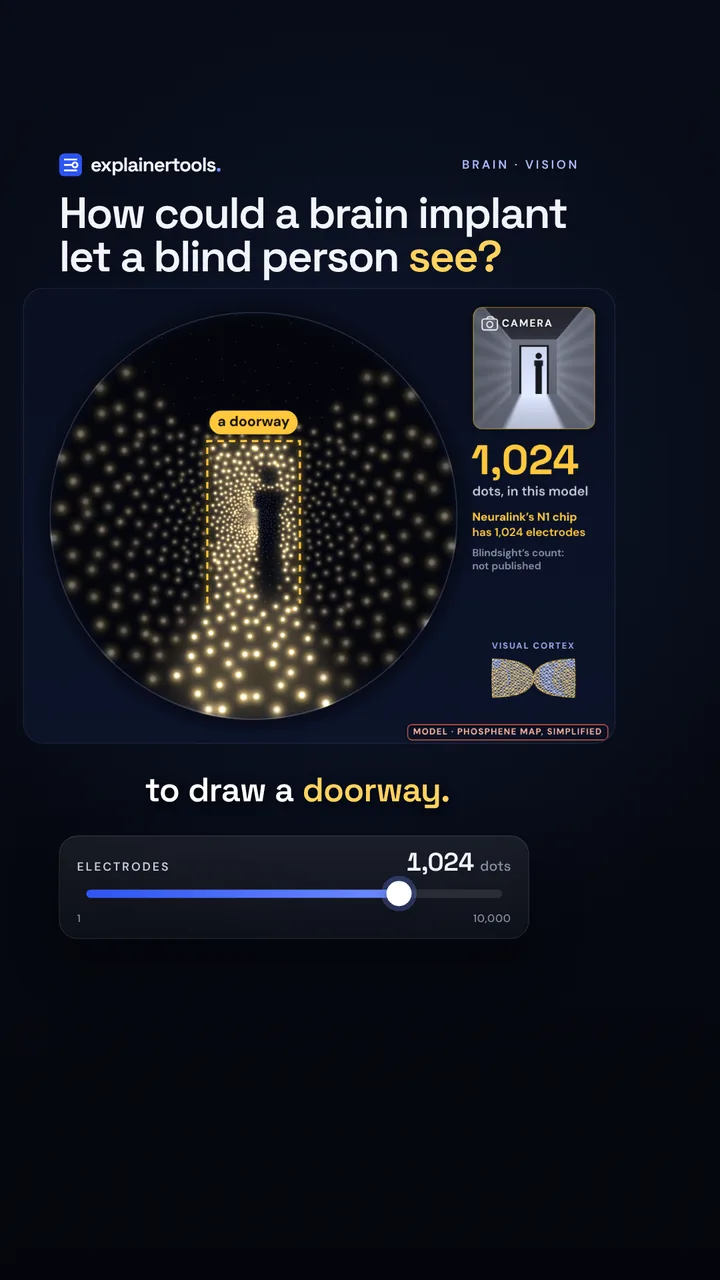
Add electrodes to a visual-cortex implant and watch dots of light turn from a scatter of stars into a doorway: sharp in the middle, coarse at the edges.
Created by ExplainerTools.
About this explainer
- Made by
- ExplainerTools
- Format
- Interactive demo
- Subject
- Science
- Where it runs
- Plays here
- Full tool
- Open the tool page
- Published
- Added to collection
- brain implants
- vision
- visual cortex
- phosphenes
- Neuralink
How the model works
Elon Musk says Neuralink's Blindsight implant is ready and waiting on regulators. It would skip the eyes and draw with dots of light on the brain itself. How could a brain implant let a blind person see?
- Electrodes1 → 10,000
- Dot sizesharp points → fuzzy blobs
- Field coverednarrow → wide
Presets Orion implant · 60Utah array, 2021 · 96Illinois ICVP · 400Neuralink N1 · 1,024Ten thousand (future)
Electrodes spread evenly over the brain’s map of the central 20° of view (cortical magnification 17.3/(E + 0.75) mm per degree, Horton & Hoyt 1991), one dot of light each. A best case: real phosphene maps are irregular and not every electrode makes a dot. Blindsight’s electrode count and results are unpublished; Neuralink’s N1 chip has 1,024 electrodes.
Model notes and sources
Model. A point of view is measured in degrees from the center of gaze; its eccentricity is E. The primary visual cortex (V1) is drawn with the complex-log map w = K·ln((z + a)/a), with K = 17.3 mm and a = 0.75°, whose stretch along a ray is the cortical magnification M(E) = 17.3/(E + 0.75) mm of cortex per degree of view (Horton & Hoyt, 1991): about 23 mm per degree at the center and 1.6 mm at 10°. Electrodes are spread evenly over the map of the central Emax degrees (the Field covered control, 20° by default) on both sides of the brain, in a fixed quasi-random order, so adding electrodes never moves the ones already there. Each electrode makes one phosphene, a dot of light, at the point of view its spot maps to. A dot's radius is ρ/M(E), where ρ (the Dot size control, 0.75 mm by default) is the radius of cortex one electrode excites. Its brightness is the camera's brightness at that point, in three levels: off, dim and bright. Where dots overlap, each is dimmed so that the sum glows instead of burning white.
Why the dots crowd into the middle. Because M falls with eccentricity, the center of view gets far more cortex. In this map the central 2° of a 20° view (1% of its area) takes about a quarter of the cortex, and the central 5° about half; over the whole field, the central 10° takes about 46%. So electrodes spread evenly on the brain land densely near the center of view. The map of the central 20° covers about 2,200 mm² on each side; 1,024 electrodes over it sit about 2.1 mm apart, which is 0.09° of view at the center and 2.5° at the edge; 60 electrodes sit about 8.6 mm apart. Gap between dots = √(2A/N)·(E + a)/K, with A = πK²[ln((Emax + a)/a) + a/(Emax + a) − 1] per side. Dots in the middle 5° is the share of the map's area within 5°. As many pixels as a screen of is √N × √N: the same number of dots, though a screen spreads them evenly.
The numbers. 60 is the electrode count of Second Sight's Orion implant on the surface of the visual cortex, implanted in six people from 2018. 96 is the Utah array that Fernández and colleagues placed in the visual cortex of a 57-year-old woman who had been blind for 16 years: over six months, patterns of phosphenes let her identify some letters and the edges of objects. 400 is the Illinois Tech intracortical visual prosthesis (25 wireless stimulators), first implanted in 2022. 1,024 is the electrode count of Neuralink's N1 chip (64 threads), the implant of its Telepathy trials; Neuralink has not published Blindsight's electrode count. In monkeys, Chen and colleagues (2020) evoked phosphenes on hundreds of the 1,024 electrodes of an implant in visual cortex, and the animals recognized shapes, motion and letters drawn with them. The Ten thousand preset is a hypothetical future. “Sixty make a scatter of stars” and “about a thousand start to draw a doorway” describe this model's pictures.
Blindsight. Neuralink announced on 17 September 2024 that the FDA had given Blindsight Breakthrough Device designation, which speeds review and is not an approval. Elon Musk wrote then that the vision “will at first be low resolution, like Atari graphics” and might one day be better than natural vision; those are his claims. At the end of October 2026 he posted that Blindsight is “ready from an engineering standpoint. Just waiting on regulatory approval.” As of early November 2026 no Blindsight trial is listed on ClinicalTrials.gov and no human results have been published.
Limits. This is a picture of the idea, not a prediction of what any implant will show. Real phosphene maps are irregular; not every electrode makes a dot, and size, brightness and color vary with the current and the spot. Stimulating many electrodes at once can merge or fade dots. Phosphenes are fixed to the brain's map, so they move with the eyes: a head camera works best if the eyes stay still or are tracked. Real arrays cover square millimeters to a few square centimeters of cortex, not the whole map of the central 20°, and much of V1, especially the map of the outer view, lies deep in a fold (the calcarine sulcus). The map here is the same in every direction and drawn upright, and each half of the view is drawn on its own side, though it lands on the opposite side of the brain and upside down. Whether people blind from birth would see phosphenes is an open question. With all of this ignored, the model flatters the implant, most of all at the very center of view.
The pictures. The dots, the camera's scenes, the head and the brain map are drawn in code from the model. The film adds three short excerpts of Neuralink's own videos, picture only and credited on screen. The opening is Neuralink's “Calibrated Vision” simulation of letters drawn in phosphene dots, from the Blindsight section of its Summer 2025 Update (YouTube, 27 June 2025), cropped to a square around the dot grid; it is a company simulation, not a recording of what a person saw, and is labeled as such. The animation of the visual cortex mapped onto the visual field is from the same update, played about 1.4 times faster. The close-up of the R1 surgical robot is from Our First Transdural Procedure (Neuralink, YouTube, 30 June 2026).
Sources: J. C. Horton and W. F. Hoyt, “The representation of the visual field in human striate cortex”, Archives of Ophthalmology 109, 816–824 (1991), doi; E. Fernández et al., “Visual percepts evoked with an intracortical 96-channel microelectrode array inserted in human occipital cortex”, Journal of Clinical Investigation 131, e151331 (2021), doi; X. Chen, F. Wang, E. Fernández and P. R. Roelfsema, “Shape perception via a high-channel-count neuroprosthesis in monkey visual cortex”, Science 370, 1191–1196 (2020), doi; Second Sight Medical Products, Orion feasibility study update (SEC filing, February 2019); Illinois Institute of Technology, A brain was just successfully implanted with a wireless artificial vision system (2022); The Register, Neuralink's N1: 64 threads, 1,024 electrodes (2024); The Debrief, Neuralink receives FDA Breakthrough designation for Blindsight (September 2024); Elon Musk on X, Blindsight is ready from an engineering standpoint (October 2026), as reported by Tesla North and Malay Mail; Drug Development & Delivery, Blindsight faces questions over clinical readiness (November 2026); Wikipedia, Phosphene and Retinotopy.
An ExplainerTools Original. Brain map after Horton & Hoyt (1991).
Watch it move
- How could a brain implant let a blind person see?43-second Short
Go deeper
Explore interactive ideas in space, science, math, and more. Try a demo, read an interactive article, watch a short video, and follow what makes you curious.
New Originals
Change one thing and see why.
The three newest models, each with a short film. Watch the question, then play with the answer.


Follow your curiosity
A collection of small doors into big ideas.
Format
Swipe or scroll for more formats →
Subject
Swipe or scroll for more subjects →
Topic
Swipe or scroll for more topics →
Sort by
Rankings count activity here on ExplainerTools. Newest means added to this collection.
Loading collection…
Make something click.
Made an explainer, or found one you love? Give it a place in the collection.