Engineering · Interactive demo
Why does reusing a rocket make orbit so much cheaper?
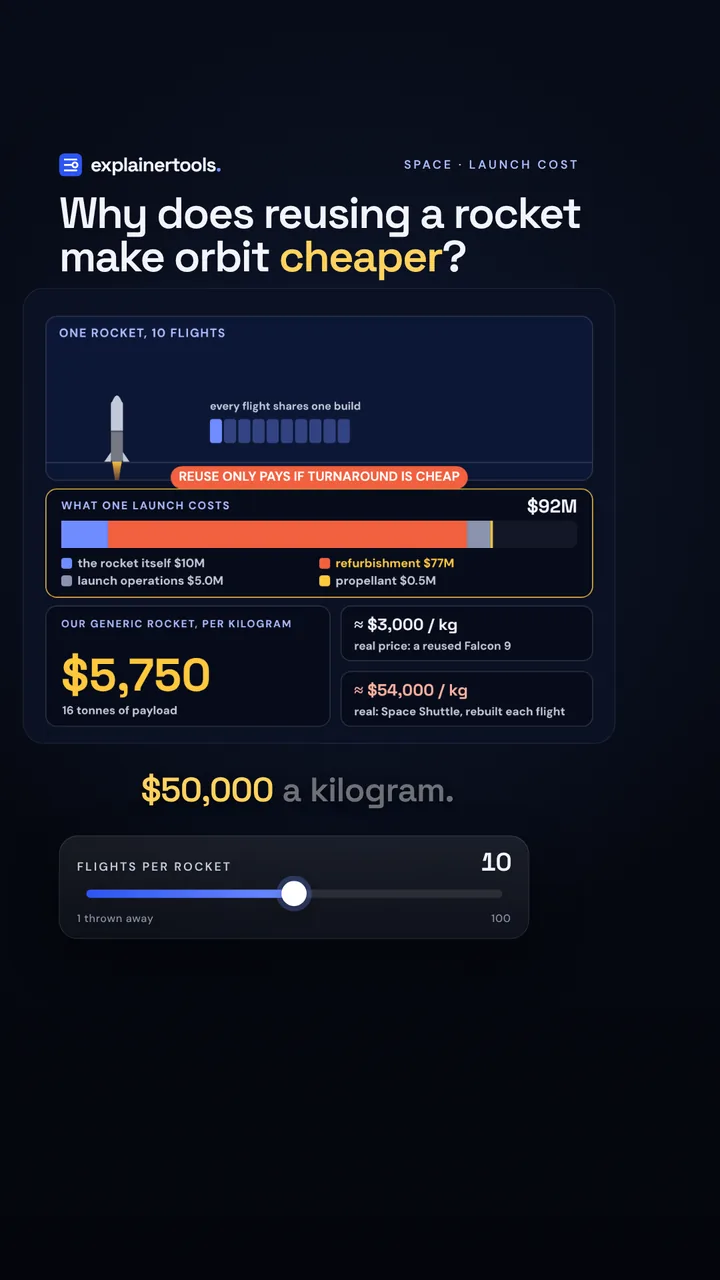
Why reusing a rocket makes orbit cheaper: propellant is under 1% of a launch, so flying one rocket many times spreads its cost, as long as refurbishment stays cheap.
Created by ExplainerTools.
About this explainer
- Made by
- ExplainerTools
- Format
- Interactive demo
- Subject
- Engineering
- Where it runs
- Plays here
- Full tool
- Open the tool page
- Published
- Added to collection
- space
- rockets
- reusable rockets
- launch cost
- Starship
- Falcon 9
How the model works
Propellant is less than one percent of what a launch costs. So where does the money go, and why does landing the rocket change the price of a kilogram in orbit so much?
- Flights per rocket1 thrown away → 100
- Refurbishment between flights0% refuel and go → 100% rebuilt
- Payload given up to land0% → 40%
A generic rocket with illustrative dollars: $100 million to build, 20 tonnes to orbit, $5 million of operations and $0.5 million of propellant a flight; refurbishment is a share of the build cost on each reflight and landing gives up some payload. Not any company’s prices.
Model notes and sources
Where this comes from. Commonly cited launch prices to low Earth orbit are about $54,500 a kilogram for the Space Shuttle and about $2,700 a kilogram for a Falcon 9, figures from Harry Jones’s 2018 NASA paper “The Recent Large Reduction in Space Launch Cost”; the film rounds the Falcon 9 figure to about $3,000. On Starship’s fifteenth flight SpaceX caught the upper stage with the launch tower for the first time on November 14, 2026 (SpaceX); the Super Heavy booster aborted its catch and splashed down (SpaceX). No recovered Starship upper stage has flown again yet. “Under $100 a kilogram” is SpaceX’s stated goal for full and rapid reuse. It is a target, not a price anyone has paid.
The idea. A launch bill has four parts: the rocket, any refurbishment since its last flight, the people and facilities that run the launch, and propellant. Propellant is the smallest by far, well under 1%. If the rocket is thrown away, every launch pays for a whole new one. If it flies n times, each launch pays 1/n of it. That is the whole trick, and it has two catches. Landing costs performance: fuel, legs and fins that could have been payload. And turnaround has to be cheap. The Space Shuttle was reusable, but each orbiter needed months of inspection and rebuilding between flights, and its cost per kilogram ended up higher than the expendable rockets of its day.
The model. The rocket here is generic and the dollars are illustrative, not any company’s. A new rocket costs $100 million and lifts 20 tonnes; propellant is $0.5 million and launch operations $5 million a flight. Thrown away, a launch costs $105.5 million, or $5,275 a kilogram. Flown n times, each launch carries build ÷ n, plus refurbishment at a share r of a new rocket’s price on every reflight, r × build × (n − 1) ÷ n. Landing gives up a share of payload: 20 t × (1 − penalty). So ten flights with 10% refurbishment and a 20% payload penalty cost $24.5 million a launch for 16 tonnes: $1,531 a kilogram. Thirty flights with 90% refurbishment cost $5,324 a kilogram, slightly worse than throwing the rocket away. A hundred flights with 1% refurbishment and a 30% penalty reach $535 a kilogram, where operations are most of the bill. Real prices also include development costs, profit, insurance and how full the rocket is, none of which is modelled.
The film. The mechanism is drawn in code by ExplainerTools, with no AI-generated pictures. The Short also uses short real excerpts, picture only, a few seconds each and credited on screen, all from SpaceX: the Starship Flight 15 tower catch (X) and a Falcon 9 booster landing on a droneship (X). The real prices in the film are labelled as real; the large figure is the model’s generic rocket.
Sources: Harry W. Jones, “The Recent Large Reduction in Space Launch Cost” (NASA Ames, ICES 2018); SpaceX, the Flight 15 upper-stage catch (November 14, 2026), and SpaceX on the booster; Wikipedia, “Reusable launch vehicle” and “Space Shuttle program”.
An ExplainerTools Original. Prices: H. W. Jones, NASA (2018). Starship Flight 15: SpaceX. Footage: SpaceX.
Watch it move
- Why does reusing a rocket make orbit so much cheaper?50-second Short
Go deeper
Explore interactive ideas in space, science, math, and more. Try a demo, read an interactive article, watch a short video, and follow what makes you curious.
New Originals
Change one thing and see why.
The three newest models, each with a short film. Watch the question, then play with the answer.
Follow your curiosity
A collection of small doors into big ideas.
Format
Swipe or scroll for more formats →
Subject
Swipe or scroll for more subjects →
Topic
Swipe or scroll for more topics →
Sort by
Rankings count activity here on ExplainerTools. Newest means added to this collection.
Loading collection…
Make something click.
Made an explainer, or found one you love? Give it a place in the collection.