Topic guide · Rocket reuse and the cost of orbit
Why does reusing a rocket make orbit cheaper?
Because a rocket is an expensive machine wrapped around cheap fuel. Propellant is less than one percent of what a launch costs; almost all the rest is the vehicle. Throw it away and every launch buys a new one. Fly it n times and each launch pays 1/n of it. That is how a Falcon 9 reached about $2,700 a kilogram to low Earth orbit, against about $54,500 for the Space Shuttle. The catch is turnaround: the Shuttle was reusable too, but rebuilding it between flights cost so much that the saving vanished. In Reuse Ledger you can change the flights and the refurbishment bill yourself.
- Space Shuttle, to low Earth orbit
- ≈ $54,500 / kg
- Falcon 9
- ≈ $2,700 / kg
- Model: thrown away → flown 10 times
- $5,275 → $1,531 / kg
- Starship goal (not a price)
- under $100 / kg
Prices · H. W. Jones, NASA (2018) Real prices are Harry Jones’s widely cited NASA estimates. The model’s rocket is generic and its dollars are illustrative. No recovered Starship upper stage has flown again yet.
Interactive · ExplainerTools
Reuse Ledger
Turn “Flights per rocket” up and watch the rocket’s share of each launch shrink. Then raise “Refurbishment between flights” and see the saving disappear.
Model · a generic rocket, illustrative dollars
What does a launch actually pay for?
Four things: the rocket, any refurbishment since its last flight, the people and facilities that run the launch, and propellant. Propellant is the smallest by far. Filling a Falcon 9 costs a few hundred thousand dollars against a launch price in the tens of millions. The usual yardstick is dollars per kilogram to low Earth orbit: by Harry Jones’s NASA estimate, about $54,500 for the Space Shuttle and about $2,700 for a Falcon 9.
What do you give up to land a rocket?
Payload. Landing needs fuel held back for the burns, plus legs or catch fittings, fins and heat protection, and every kilogram of that is a kilogram not delivered to orbit. The tool’s “payload given up to land” control takes a share off the 20 tonnes. The trade is worth it when the rocket costs far more than the lost payload, which it almost always does.
Why didn’t the reusable Space Shuttle get cheap?
Because reuse only pays if getting the vehicle ready again is cheap. Each orbiter needed months of work between flights: thousands of heat-shield tiles inspected by hand, main engines removed and overhauled, and a new external tank every time. In the tool, set refurbishment to 90% of a new rocket’s price and thirty flights come out at $5,324 a kilogram, slightly worse than throwing the rocket away.
What did the November 2026 Starship catch change?
On November 14, 2026, during Starship’s fifteenth flight, SpaceX caught the upper stage with the launch tower for the first time (SpaceX). The booster aborted its own catch and splashed down. Recovering an upper stage is the missing half of full reuse, but recovery is not reuse: no caught upper stage has flown again. “Under $100 a kilogram” is SpaceX’s goal for full, rapid reuse at high flight rates. It is not a price. The Starship Flight 15 guide covers the catch itself.
Try it: keep the ledger yourself
- 1 See
Open Reuse Ledger with the rocket thrown away after one flight.
- 2 Change
Press Land it, fly 10 times, then Reusable but rebuilt, then Rapid full reuse.
- 3 Understand
More flights shrink the rocket’s share; refurbishment decides whether that saving survives.
Where does this model stop?
Reuse Ledger uses a generic rocket with illustrative dollars, not any company’s costs. It leaves out development spending, profit, insurance, launch-site fees and how full the rocket is, and it treats refurbishment as a fixed share of the build price. Real prices are also set by what customers will pay, not only by what a launch costs.
Explore by question
Rockets, landings and orbit. Each card answers one part of the question.
Reuse Ledger
Model · a generic rocket, illustrative dollars
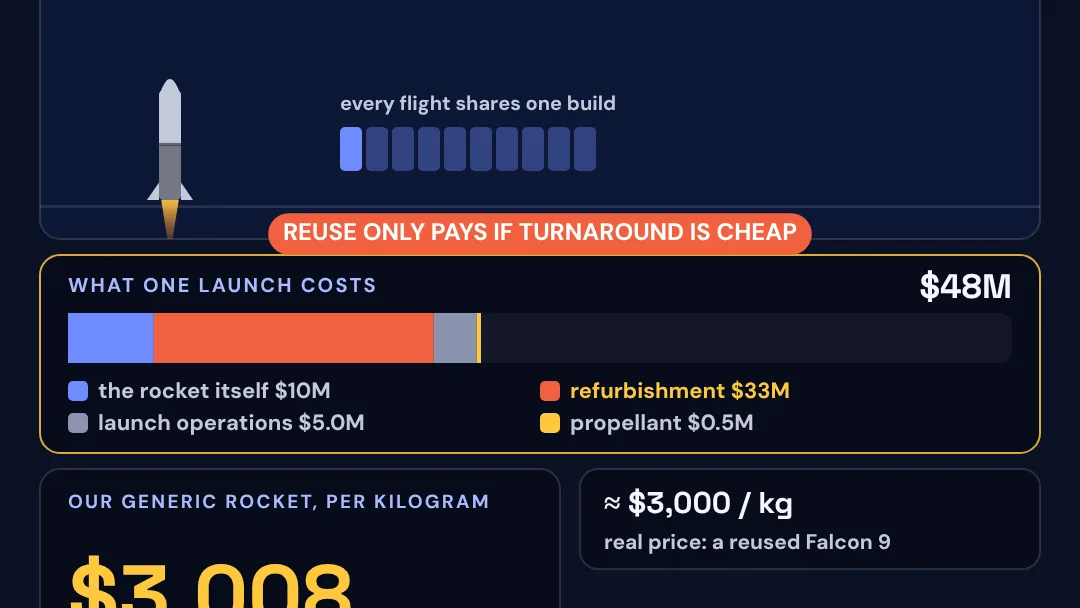 Interactive · Reuse LedgerWhy does reusing a rocket make orbit so much cheaper?Fly one rocket more times, change the refurbishment bill and watch the cost per kilogram move.
- ShortWhy does reusing a rocket make orbit so much cheaper?Cheap fuel, a shared machine, the Shuttle and the catch. Narrated and captioned.
- JournalWhy does reusing a rocket make orbit so much cheaper?Propellant is under one percent of a launch. The rest is the machine, which is why landing it changes the price of orbit, and why the Shuttle never did.
Getting the rocket back
Reuse starts with a landing.
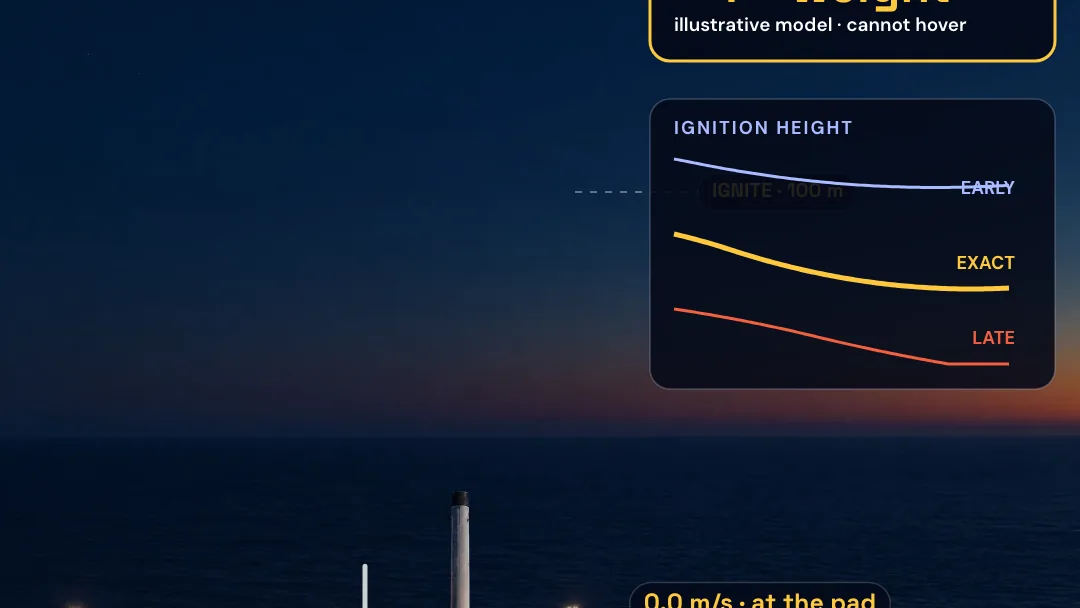 Interactive · Landing BurnWhen should a falling rocket light its engine?Why a booster relights its engines at the last moment.
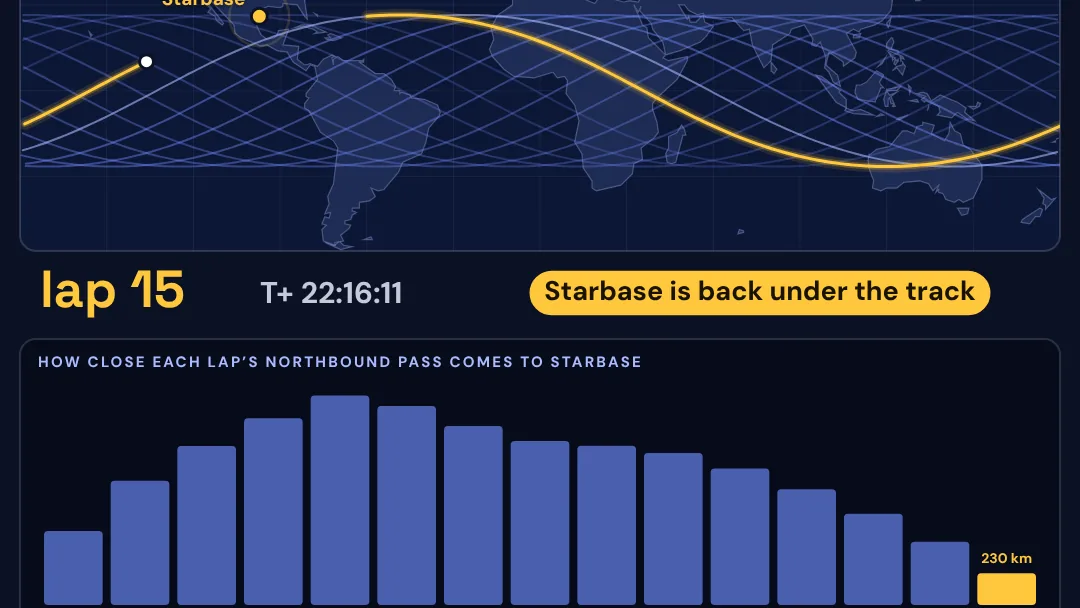 Interactive · Double CatchHow do you catch both halves of a rocket?How a tower catches both halves of Starship.
Getting to orbit at all
What the payload is paying for.
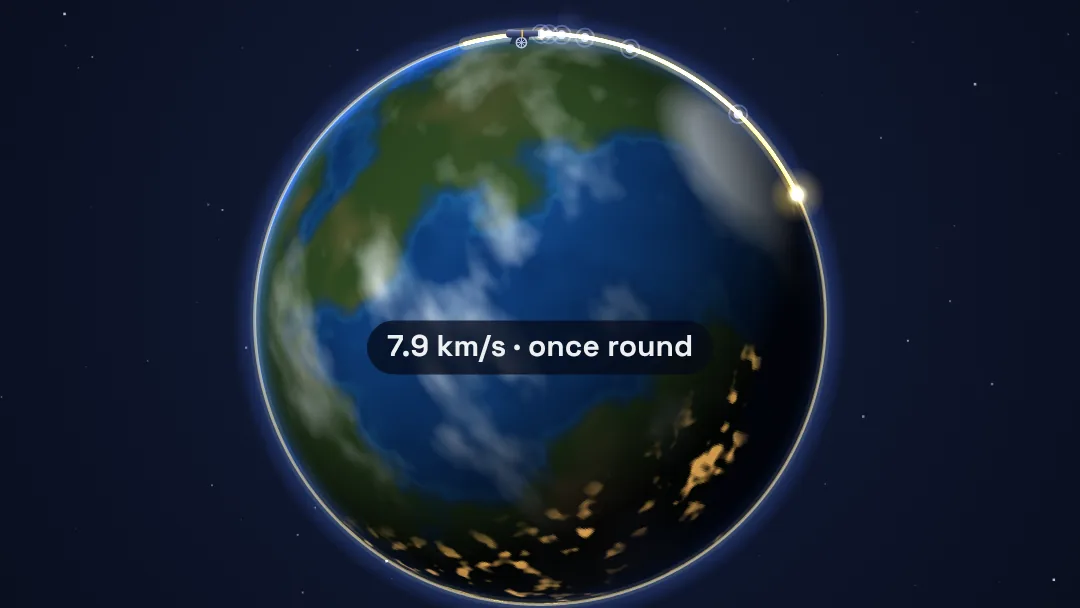 Interactive · Newton's CannonWhy don't satellites fall down?What an orbit is: fire a cannonball until it falls around the Earth.
 Interactive demoRocket Nozzle LabHow a rocket nozzle turns hot gas into thrust.by Ryan Sael · Best on a larger screen
Common questions
How much of a rocket launch is fuel?
Well under 1% of the price. Propellant for a Falcon 9 costs a few hundred thousand dollars; the launch sells for tens of millions.
How much does it cost to send a kilogram to orbit?
By one widely cited NASA estimate, about $54,500 on the Space Shuttle and about $2,700 on a Falcon 9, to low Earth orbit.
Why was the Space Shuttle so expensive if it was reusable?
Each orbiter needed months of inspection and rebuilding between flights, so turnaround cost nearly as much as the hardware it saved.
Will Starship cost under $100 a kilogram?
That is SpaceX’s stated goal for full and rapid reuse. It is not a current price, and no recovered Starship upper stage has flown again yet.
Concepts in this guide
Each one has a plain one-line definition in Concepts A–Z, with every model, film and post where it comes up.
Sources and credits
- H. W. Jones (NASA Ames) · The Recent Large Reduction in Space Launch Cost (2018) About $54,500/kg for the Space Shuttle and about $2,700/kg for Falcon 9 to low Earth orbit.
- SpaceX · Starship Flight 15 upper-stage catch (Nov 14, 2026) The first tower catch of a Starship upper stage.
- SpaceX · Flight 15 booster The Super Heavy booster aborted its catch and splashed down.
- Wikipedia · Reusable launch vehicle History and economics of reuse, including the Shuttle.
- Reuse Ledger · model notesThe generic rocket’s numbers and what the ledger leaves out.
Every creator named here made the work we link to. Listing it does not imply a partnership or endorsement.