Chemistry · lab test
How does a mass spectrometer tell what meat is in a McRib?
Turn “Match a peptide” to pick a peak, “Accelerating voltage” to change the push, and “Protein” to switch between actin and beta-enolase.
1 See
A scientist put a McRib through a mass spectrometer and the first protein match said rat. How does the machine weigh meat, and why was rat the wrong answer?
2 Change
3 Understand
Model notes and sources
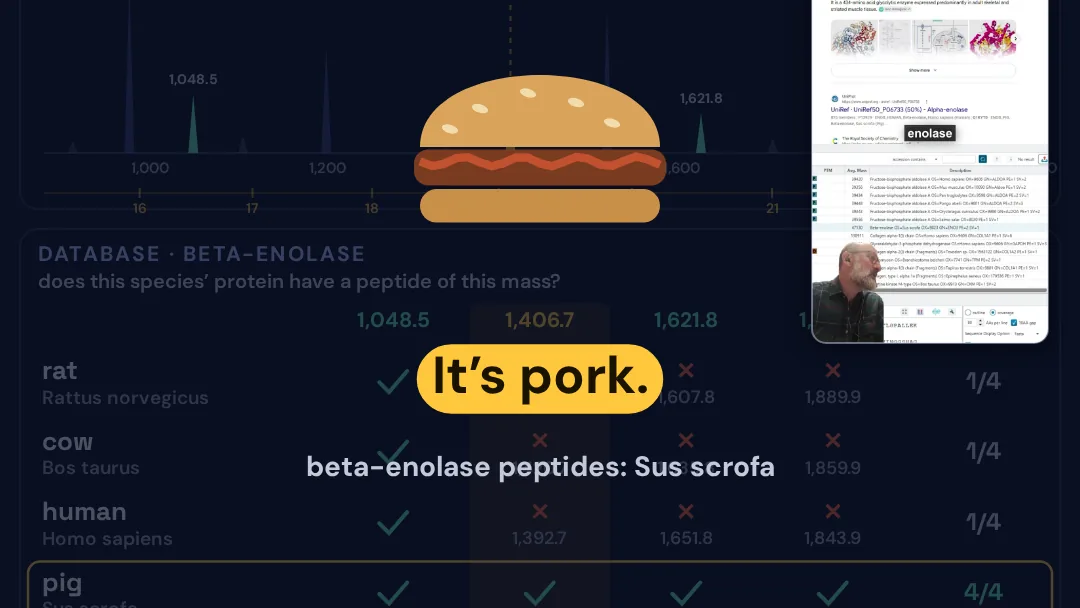
Where this comes from. In November 2026 Benjamin Katz, who makes the YouTube channel Mass Spec Everything, posted a two-part video in which he ran a McRib through a mass spectrometer; excerpts spread widely on X from November 22. In part 2 the sample was digested and run on a Waters QTOF. The top database hit was “skeletal muscle actin, Rattus”, which he explained as homology: actin is so similar across mammals that a rat entry matches as well as any other. A peptide from the rarer protein beta-enolase matched Sus scrofa, the domestic pig. He identified about 40 peptides and called it a poor digest. Replies on X claiming the sample matched human or cow are not part of his result and are not used here.
The idea. A mass spectrometer weighs molecules. Proteins are too big and varied to weigh whole, so an enzyme first cuts them into short pieces called peptides. Trypsin, the usual enzyme in proteomics, cuts after the amino acids lysine (K) and arginine (R). In a time-of-flight instrument the peptides are given an electric charge z and all pushed through the same voltage V, so each gains the same energy zeV = ½mv². Lighter ones end up faster. They then coast down a tube of length L, and the flight time is t = L·√(m / 2zeV), so t ∝ √(m/z): time the arrivals and you have the masses. The software then compares the measured masses with the peptides that every protein in a database would give. A peptide whose sequence is the same in several species fits all of them equally, so it can’t say which animal the meat came from. Only peptides that differ between species can.
The model. An ideal linear time-of-flight tube 1 m long, with every ion singly charged (z = 1) and starting from rest at the same place. At 20 kV a 1,000 m/z peptide crosses it in about 16 µs, at about 62 km/s. A real QTOF accelerates the ions sideways into the flight tube and folds the path with an ion mirror (a reflectron) to sharpen the timing, but the √(m/z) rule is the same. The peptide masses, peak heights and species differences are illustrative, not Katz’s data or real sequences. There are four actin peptides that are identical in rat, cow, human and pig, and four beta-enolase peptides: one shared by all four species and three where only the pig version has that mass. The real search compared about 40 peptides against far more proteins and species, and scored the matches statistically.
The tool’s extra panels. “Flight time vs mass” draws t = L·√(m / 2zeV) at the chosen voltage (gold), with 5 kV and 30 kV for comparison, and marks the chosen peptide. “Detector signal” is the trace the detector would record, one narrow pulse per peptide at its flight time, swept from left to right as the ions arrive; the peak shapes are idealized. “Both proteins” counts how many of the eight illustrative peptides each species’ actin and beta-enolase would explain: the pig explains all eight, the others five.
The film. The mechanism is drawn in code by ExplainerTools, with no AI-generated pictures. The sandwich is a generic icon. The Short also uses short real excerpts, picture only, a few seconds each and credited on screen: Benjamin Katz, @massspec_everything (TikTok), part 1; Benjamin Katz, @massspec_everything (TikTok), part 2. The numbers in the film come from the model, not from the footage.
Sources: Benjamin Katz, Mass Spec Everything, “McRib The Meat - What is it? Part2” (YouTube, November 2026); Wikipedia, “Time-of-flight mass spectrometry”, “Trypsin”, “Peptide mass fingerprinting” and “Actin”; UniProt, the protein database.
An ExplainerTools Original. The experiment and the video excerpts are Benjamin Katz’s McRib mass spectrometry test (Mass Spec Everything, @massspec_everything, November 2026).