Space · Starship Flight 15
How do you catch both halves of a rocket?
Drag the mission clock or press “Play the mission”. Change the liftoff time to see each event in Central time. Click the timeline to jump.
1 See
Starship’s next flight is set to end with two catches, almost a day apart. Why does the ship have to wait so long to come home?
2 Change
3 Understand
Model notes and sources
The plan. Starship Flight 15 (Booster 22 and Ship 42, both third-generation “V3” vehicles) is set to launch from Pad 2 at Starbase, Texas, no earlier than Friday, November 13, 2026, in a 75-minute window that opens at 4:45 p.m. CT, “pending regulatory approval” (SpaceX). It is planned to be the first flight to return both stages to the launch site for a catch; if both catches work, SpaceX calls it “the first full recovery of an orbital launch system”. The booster has been caught three times before, on Flights 5 (October 13, 2024), 7 (January 16, 2025) and 8 (March 6, 2025), all with earlier-generation boosters at Pad 1. No ship has been caught. The launch date, the licence and every time here can change: check SpaceX’s mission page before you watch.
The clock. Every event time is SpaceX’s own event table for Flight 15 (“all times approximate”): hot staging at T+2:21, booster catch at T+6:35, orbit insertion at T+26:10, the Starlink deploy from T+35:01 to T+1:17:40, go/no-go points for bail-out splashdowns off Hawaii (T+1:27:46), off Chile (T+7:15:35) and off Hawaii again (T+20:41:55), the deorbit burn at T+21:35:57, entry at T+22:10:46, the landing burn and flip at T+22:32:16 and the ship catch at T+22:32:34. Central times assume liftoff at the minute you pick in the window.
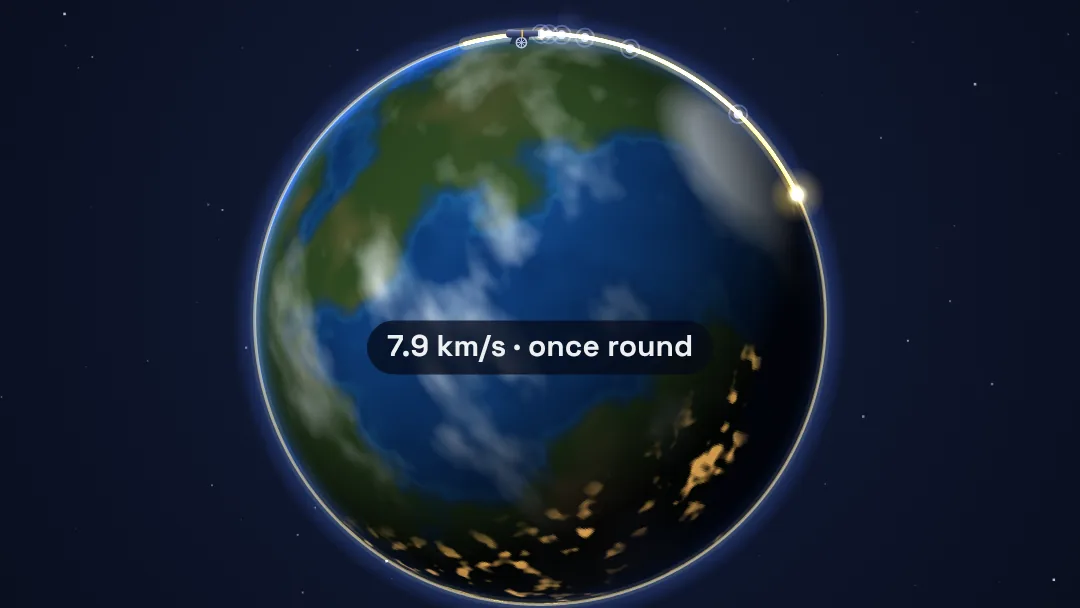
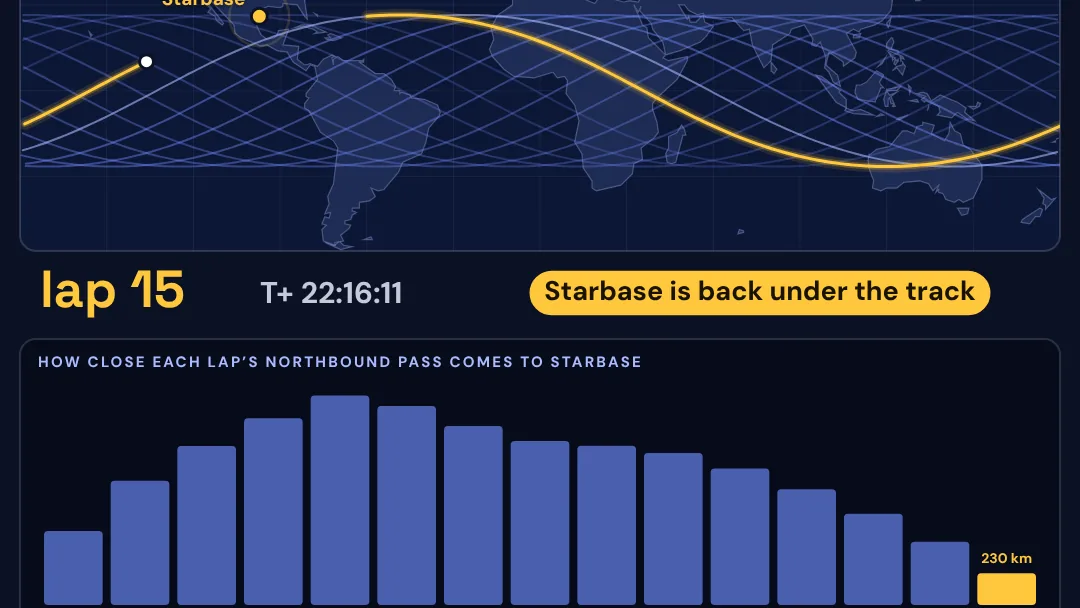
The ground-track model. SpaceX says the ship flies “approximately 14 orbits” at about 275 km and coasts “~21 hours until its orbit aligns with Starbase for a return”. The map shows why with a simple model of our own: a circular 275 km orbit, which takes 90.0 minutes a lap (Kepler’s third law), tilted 26.5° to the equator (our assumption: just above Starbase’s latitude of 26.0°; SpaceX has not published the tilt). Earth turns 360° in 23.93 hours, 22.6° during one lap, and Earth’s equatorial bulge (J2) drags the orbit another 0.5° west, so each pass crosses the map about 23° farther west than the one before. The bars give the closest each pass comes to Starbase in this model; the 15th pass, about 22.4 hours after liftoff, comes within about 230 km, and the ship’s flaps can steer that out during entry. The real trajectory depends on the real orbit and its timing, which the model does not know.
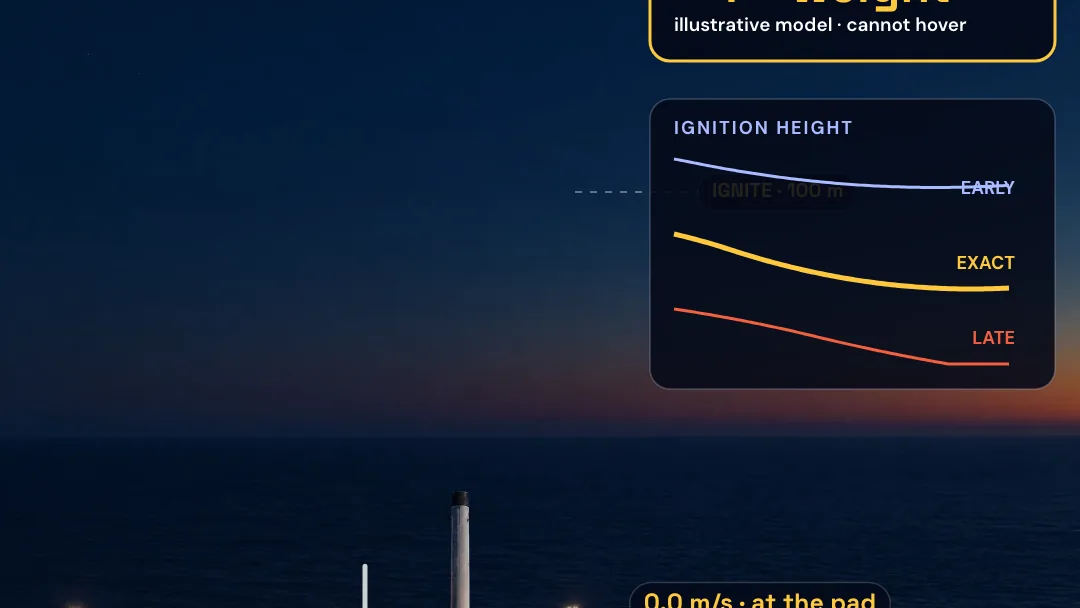
The drawings. The booster’s climb and boostback are a schematic with the altitude stretched (on Flight 7 the booster rose to about 90 km and went more than 60 km downrange). The return map is drawn after SpaceX’s description (entry “at a specific point over the Pacific Ocean, thousands of kilometers uprange”, “a series of small turns” over “sparsely populated areas of northern Mexico and southern Texas”), not from a published trajectory. The tower and vehicles are simplified side views, not to scale. Coastlines: Natural Earth (public domain).
The catch. The booster steers with grid fins (on V3, three larger fins that also carry the catch point), lights its landing burn at T+6:10 and settles onto the arms. The ship falls belly first, lights its three sea-level Raptor engines and flips upright, drops to two engines to move between the arms and to one as it nears a hover; the arms close on “two catch fittings just below the forward flaps”, and the last engine shuts down when the ship registers contact (SpaceX). If anything is off, it can be sent to a planned splashdown instead.
The film. All the footage is SpaceX’s, from its posts on X: the booster catches on Flights 5, 7 and 8, the ship seen from a Starlink V3 satellite’s camera on Flight 13, and SpaceX’s computer animation of the ship catch (labelled “Animation” on screen, because it has not happened yet). The maps, the timeline and the side view are drawn in code by ExplainerTools.
Sources: SpaceX, Starship Flight 15 (mission page and event table, read November 10, 2026); SpaceX, “Returning Starship to the Launch Site” (November 7, 2026); SpaceX, “Introducing Starship V3” (May 12, 2026) and “Starship to Orbit” (September 15, 2026); SpaceX posts on X for Flight 5, Flight 7 and Flight 8, Flight 7’s boostback, the Starlink camera view and the ship-catch animation; FAA, SpaceX Starship (environmental reviews); Natural Earth via world-atlas (coastlines).
An ExplainerTools Original. Video and animation: SpaceX.