Physics · parade day
Why does wind ground the parade balloons?
Turn “Wind speed” and watch the push grow while the lift stays put. Turn “Gusts” to see where a gust swings the balloon, or pick a preset.
1 See
On parade morning, officials check the wind before the giant balloons go up. Why can a breeze that barely ruffles a flag ground a balloon several storeys tall?
2 Change
3 Understand
Model notes and sources
Where this comes from. The 100th Macy’s Thanksgiving Day Parade was set for Thursday, November 26, 2026. The National Weather Service in New York issued a High Wind Watch from 10 a.m. that day, with gusts forecast to about 70 mph in the watch area, and on November 25 Macy’s postponed the parade to Saturday, November 28: the first weather postponement in its history. New York City’s rules keep the giant balloons on the ground if sustained winds exceed 23 mph or gusts exceed 34 mph. The decision is made on parade morning, using the NWS forecast, an on-site meteorologist and wind readings along the route. They were last grounded in 1971. The rules followed the 1997 parade, when the Cat in the Hat balloon struck a lamppost and injured four people (CBS New York, November 24, 2026).
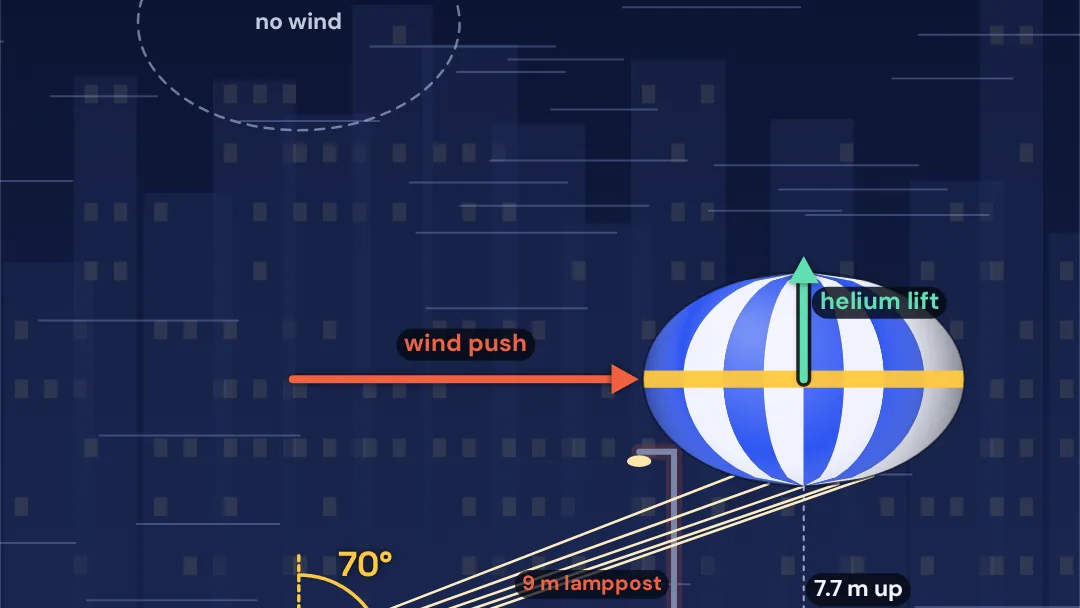
The idea. Helium lifts a balloon because the air it pushes aside weighs more than the helium and the balloon together. That lift does not depend on the wind. The wind’s sideways push is drag, F = ½ ρ v² Cd A: it grows with the square of the wind speed, so doubling the wind from 17 to 34 mph makes the push four times bigger. The tethers have to hold both, so they lean over by the angle whose tangent is push ÷ lift, and the balloon is pulled down and sideways, toward the lampposts and the crowd at the curb.
The model. The balloon is generic and every number for it is illustrative, not a real parade balloon’s: an ellipsoid 12 m long, 8 m tall and 7 m wide (side area about 75 m², volume about 350 m³), a net lift of 1.9 kN (about 190 kg of pull, helium buoyancy minus the balloon’s own weight), a drag coefficient of 0.5 and air at 1.225 kg/m³. It sits in static balance on straight 20 m tethers held 1 m up, so the tether angle is atan(push ÷ lift) and the height of its lowest point is 1 m + 20 m × cos(angle). The street is drawn across the wind, with a 9 m lamppost at the curb 14 m from the handlers. With these numbers the balloon clears the lamppost by 0.2 m at 34 mph and hits it above about 35 mph. A gust is shown as the position the balloon would settle at if that wind were steady. Real handlers shorten the tethers and walk with the balloon, real balloons flex, spin and swing in gusts, and wind between buildings is patchy, so treat the numbers as an illustration of the square law, not a safety limit.
The tool’s extra panels. “How low it gets” plots the model’s lowest point, 1 m + 20 m × cos(atan(push ÷ lift)), against wind speed, with the 9 m lamppost top and the crowd at about 2 m; the curve turns red where this generic balloon would reach the lamppost. The wind gauge shows the sustained wind (white needle) and the gust (gold needle) against the 23 and 34 mph limits, and names the sustained wind on the National Weather Service’s Beaufort scale with its usual land effect. Gusts are animated as the balloon swinging between its steady position and the gust position; with reduced motion it stays still.
The film. The mechanism is drawn in code by ExplainerTools, with no AI-generated pictures. The balloon in the diagrams is a generic shape, not a drawing of any parade character. The Short also uses short real excerpts, picture only, a few seconds each and credited on screen: Valeria VSport / ViaggioSport (YouTube); Eyewitness News ABC7NY (YouTube). The numbers in the film come from the model, not from the footage.
Sources: CBS New York, report on the parade’s balloon wind rules (November 24, 2026); National Weather Service New York, NY, High Wind Watch for November 26, 2026; Associated Press, report on the postponement (November 25, 2026); NASA Glenn Research Center, “The Drag Equation”; National Weather Service, “Beaufort Wind Scale”; Wikipedia, “Buoyancy” and “Macy’s Thanksgiving Day Parade”.
An ExplainerTools Original. Wind rules and history: CBS New York; forecast: National Weather Service New York; postponement: Associated Press. Footage: Valeria VSport (2019 parade); Eyewitness News ABC7NY (1997 parade).