Topic guide · A trackpad that talks
How can a MacBook trackpad talk with no speaker?
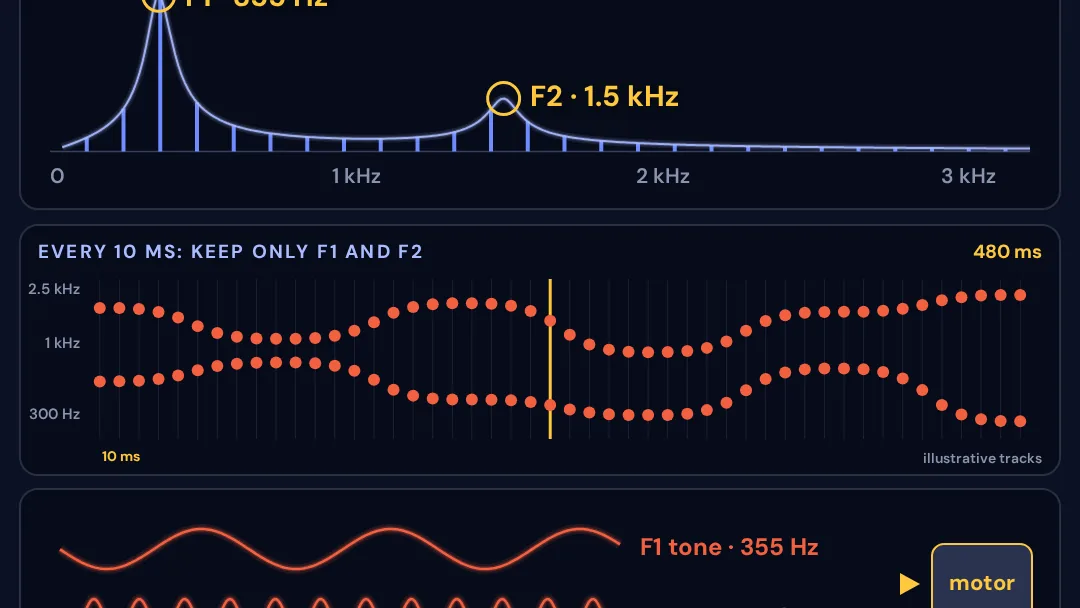
A MacBook trackpad has no speaker, only a haptic motor that jolts the glass so you feel a click. Tap it a few times a second and you feel clicks; tap it hundreds or thousands of times a second and the glass vibrates fast enough to be heard. Cody Collier’s open-source nospeaker drives the motor up to about 4,000 times a second; it is loud from about 100 Hz to 4 kHz, loudest near 1 kHz. To speak, it finds the voice’s two strongest resonances (formants) every 10 ms and plays them as two tones. Two tones instead of a full voice is why it sounds robotic. In Haptic Speaker Lab you can speed up the taps yourself.
- Speaker in a MacBook trackpad
- none
- nospeaker’s top tap rate
- ≈ 4,000 a second
- Loud on the trackpad
- ≈ 100 Hz – 4 kHz
- Voice analysed every
- 10 ms · 2 formants
Source · nospeaker README Figures from Cody Collier’s README (November 2026). Clicks fuse into a tone above about 20 a second, the bottom of human hearing.
Interactive · ExplainerTools
Haptic Speaker Lab
Turn “Tap rate” from 3 clicks a second to 4,000 and watch the taps fuse into a tone. Turn “Speak a vowel” to play a vowel as two formant tones.
Model · schematic actuator, illustrative loudness
What is under a MacBook trackpad?
Not a speaker. A Force Touch trackpad, built into MacBooks since 2015, is a glass plate with pressure sensors and a haptic actuator, Apple’s Taptic Engine: a small electromagnetic motor that gives the glass a short jolt. The jolt is the “click” you feel, even though the glass barely moves. In November 2026 the developer Cody Collier released nospeaker, an open-source app (MIT licence) that drives that motor to make sound.
How do taps become a sound?
By going faster. Each tap moves the glass, and the glass pushes on the air.
- A few a second
Separate clicks you feel, and can count by ear.
- About 20 a second
A train of clicks fuses into a pitch: the bottom of human hearing.
- Hundreds to thousands
The glass vibrates at the tap rate, and you hear a tone at that many hertz. nospeaker goes up to about 4,000 a second.
The trackpad is a quiet, uneven speaker: its README reports it loud from about 100 Hz to 4 kHz, with a few dead spots, and loudest near 1 kHz.
How does it turn tones into speech?
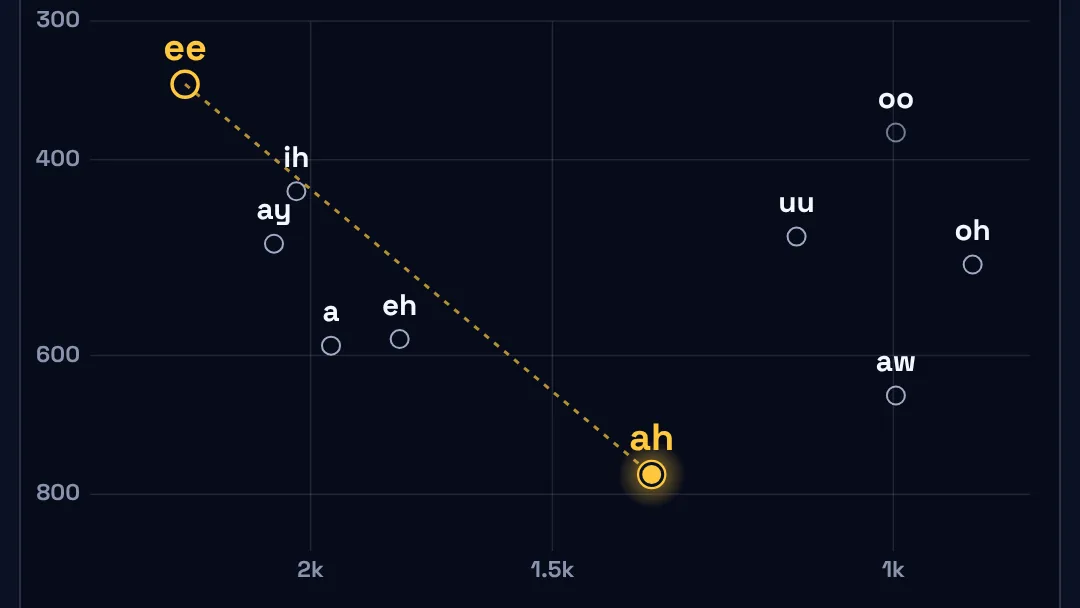
A voice is a buzz full of harmonics, shaped by the resonances of the throat and mouth, the formants. The first two, F1 and F2, are enough to tell most vowels apart: about 270 and 2,290 Hz for “ee” and 730 and 1,090 Hz for “ah” in an average man’s voice (Peterson & Barney, 1952). Every 10 ms, nospeaker uses linear prediction to find the two strongest resonances of a synthesized voice, and plays them on the motor as two tones, restarted on each beat of the pitch so they buzz rather than whistle.
Why does it sound robotic?
Because two tones are all that is left. A real voice has dozens of harmonics in every moment, and their pattern carries the speaker’s character, breathiness and timbre. Keeping only F1 and F2 keeps enough of each vowel to follow, especially if you read along, and throws the rest away. The README also notes that two resonances beat three in a blind test, partly because the motor’s strength is split fewer ways.
Try it: speed up the taps yourself
- 1 See
Open Haptic Speaker Lab: a trackpad cut in half, its motor tapping three times a second.
- 2 Change
Turn Tap rate up past 20 a second, or press Loudest · 1,000 a second. The strip of taps fuses into a band and the marker moves into the loud zone.
- 3 Understand
Turn Speak a vowel, or press Say “ee” and Say “ah”: two coral tones replace the full spectrum.
Where does this model stop?
The cut-away trackpad and its actuator are schematic, not Apple’s design. The tool counts taps from the tap rate; nospeaker actually hands the motor short lists of sine tones through Apple’s private MultitouchSupport framework, which a macOS update could break. The loudness curve is an illustrative shape matching the README’s description, not a measurement, and real trackpads differ. The vowels are textbook averages, and “Hear it” plays an approximation on your own speakers.
Explore by question
Taps, tones and vowels. Each card answers one part of the question.
Haptic Speaker Lab
Model · schematic actuator, illustrative loudness
 Interactive · Haptic Speaker LabHow can a MacBook trackpad talk with no speaker?Speed up the taps from felt clicks to a heard tone, then speak a vowel as two tones.
- ShortHow can a MacBook trackpad talk with no speaker?The muted MacBook, the motor under the glass and the two-tone voice. Narrated and captioned.
- JournalHow can a MacBook trackpad talk with no speaker?There’s no speaker in a MacBook trackpad, only a haptic motor. Tap it thousands of times a second and the glass sings; two formant tones make it talk.
Where formants come from
The same two resonances, made by a real mouth.
 Interactive · Vowel LabHow does one buzz become every vowel?Move the tongue and jaw and hear one buzz become every vowel.
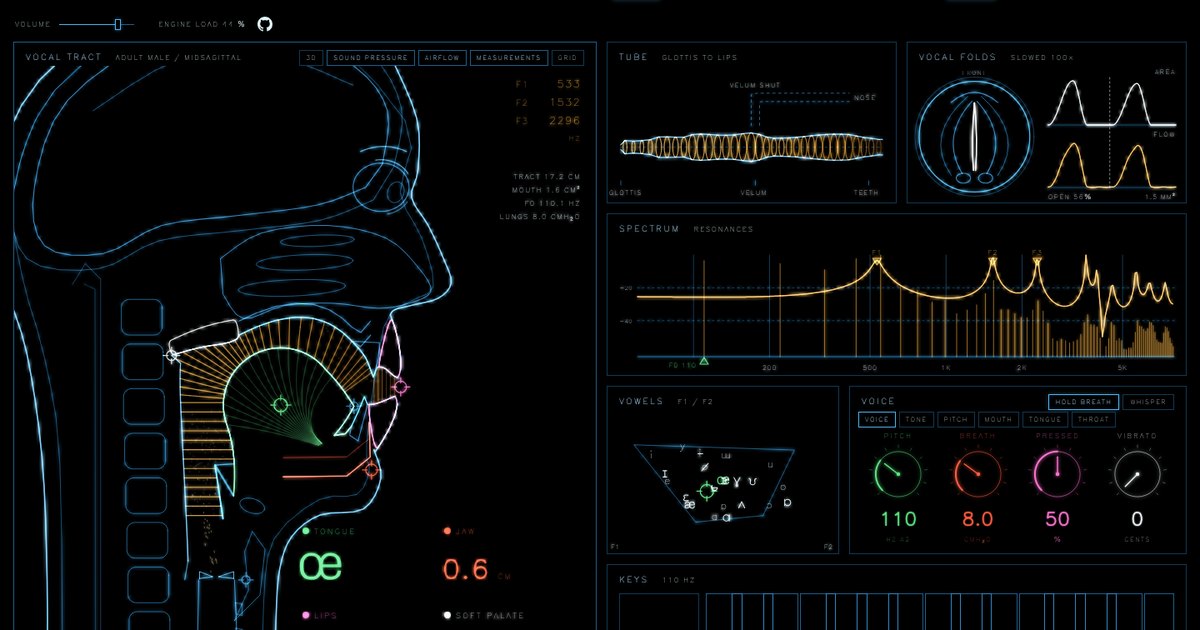 Interactive demoCHIMERA vocal synthCHIMERA by Jameson Hodge: a voice simulated from the lungs to the lips.by Jameson Hodge
Sound as moving air
Any vibrating surface pushes the air; waves add and cancel.
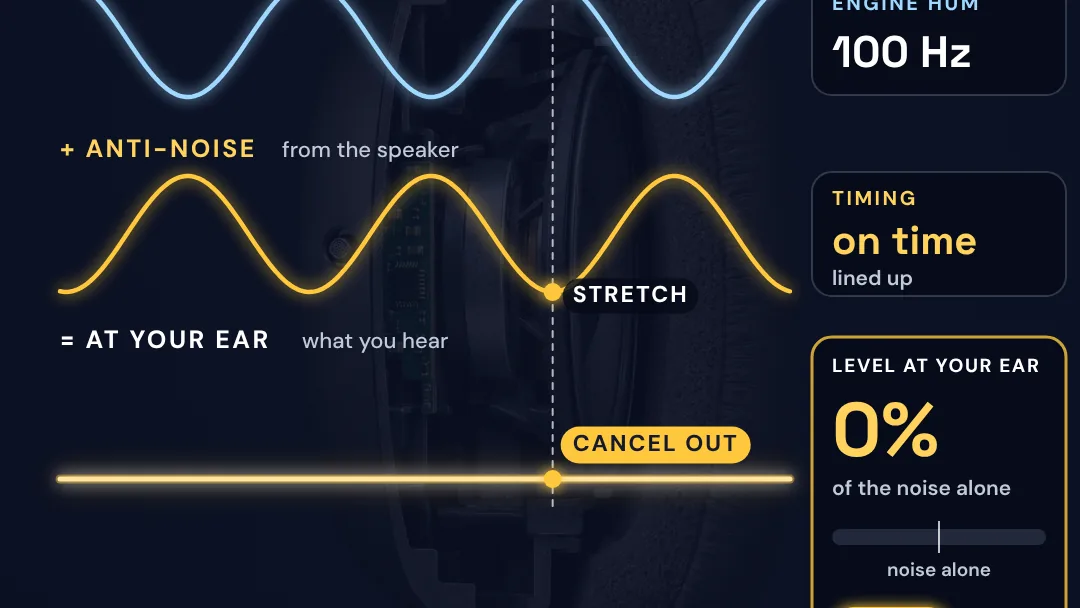 Interactive · Noise Cancelling LabHow do noise-cancelling headphones work?Play anti-noise against a hum and watch the waves cancel.
Common questions
Does a MacBook trackpad have a speaker?
No. A Force Touch trackpad has a haptic motor, Apple’s Taptic Engine, that jolts the glass to make the click you feel. nospeaker makes sound by driving that motor thousands of times a second.
How fast does the motor have to tap to make sound?
Above about 20 taps a second, clicks fuse into a pitch. nospeaker goes up to about 4,000 a second, and the trackpad is loud from about 100 Hz to 4 kHz, loudest near 1 kHz.
Why does the trackpad voice sound robotic?
It plays only the voice’s two strongest resonances (formants) as two tones, updated every 10 ms, instead of the dozens of harmonics in a real voice.
Is nospeaker safe to run?
Its author says it never drives the motor past its normal maximum strength. It uses a private Apple framework, so a macOS update could break it.
Concepts in this guide
Each one has a plain one-line definition in Concepts A–Z, with every model, film and post where it comes up.
Sources and credits
- Cody Collier · nospeaker (GitHub, MIT licence) How it works, the 4,000-a-second motor, the 100 Hz–4 kHz range and the two-formant voice.
- G. E. Peterson & H. L. Barney · Control Methods Used in a Study of the Vowels (J. Acoust. Soc. Am., 1952) Average formants of American English vowels.
- Wikipedia · Formant What formants are and how F1 and F2 separate vowels.
- Wikipedia · Force Touch The trackpad and its Taptic Engine.
- Haptic Speaker Lab · model notesThe schematic actuator, the illustrative loudness curve and the vowel data.
Every creator named here made the work we link to. Listing it does not imply a partnership or endorsement.