Technology · hack
How can a MacBook trackpad talk with no speaker?
Turn “Tap rate” from clicks to thousands a second, or pick a preset. Turn “Speak a vowel” to play a vowel as two tones. Press “Hear it” for an approximate sound through your own speakers.
1 See
A developer muted his MacBook and made the trackpad talk. There is no speaker in there, only a tiny motor that taps the glass. How does a tap become a voice?
2 Change
3 Understand
Model notes and sources
Where this comes from. In November 2026 the developer Cody Collier published nospeaker on GitHub, an open-source app (MIT licence) that mutes the Mac and speaks through the Force Touch trackpad instead. A Force Touch trackpad has no speaker: the click you feel is made by a haptic actuator, Apple’s Taptic Engine, which jolts the glass. nospeaker drives that actuator through Apple’s private MultitouchSupport framework, so a macOS update could break it. This tool explains the idea; all credit for the hack goes to its author.
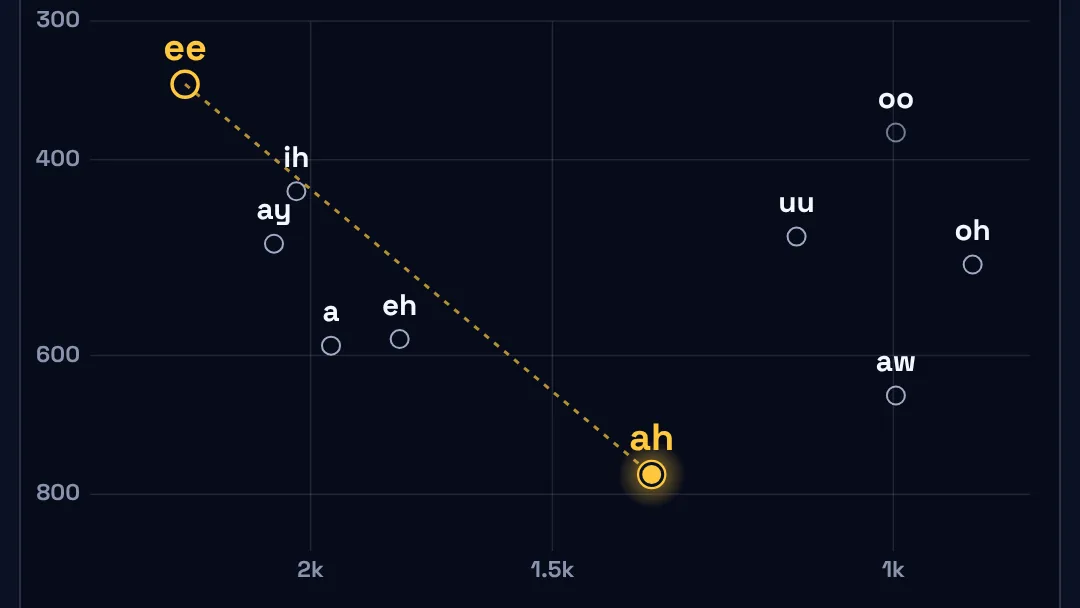
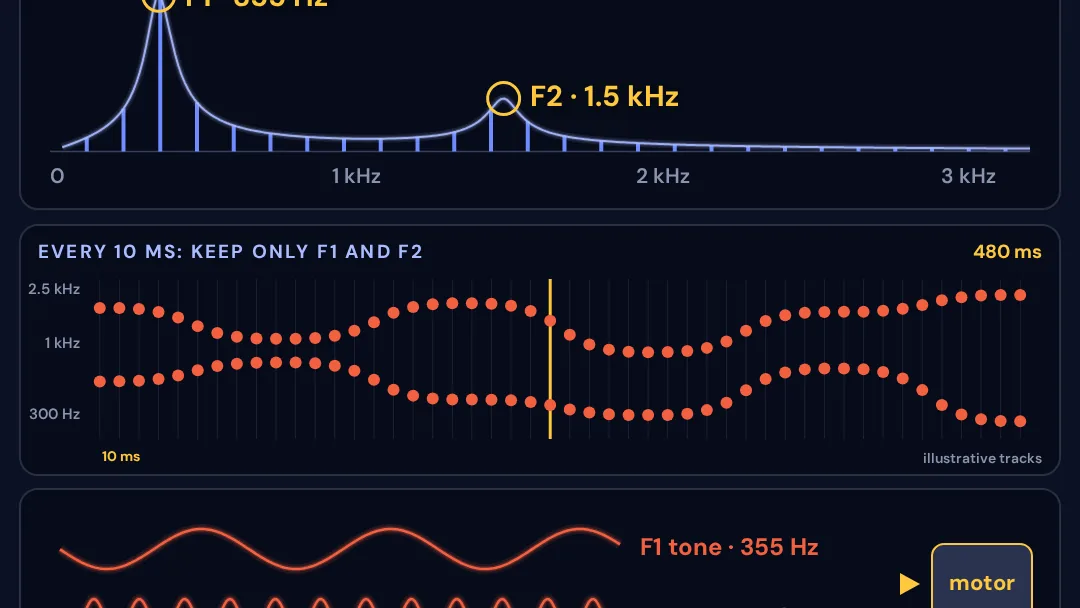
The idea. A tap is a single jolt of the glass. A few taps a second are separate clicks you feel. Fire them faster than about 20 a second and they fuse into a pitch, the way any train of clicks does: the tap rate becomes the frequency of a note. nospeaker can fire the actuator up to about 4,000 times a second, and its README says the usable output runs from roughly 100 Hz to 4 kHz, loudest near 1 kHz. To speak, it analyses the voice every 10 ms with linear prediction, keeps the two strongest resonances of the vocal tract (the formants F1 and F2) and plays them as two tones on the actuator, restarted on each pitch period. A real voice has dozens of harmonics shaped by those resonances; two tones keep enough to recognise the vowel, and lose the rest. That is why it sounds robotic.
The model and its limits. The cut-away trackpad is a schematic drawing of a glass plate and a coil-and-mass actuator, not Apple’s design and not to scale. Taps are counted exactly from the tap rate. That is a simplification: nospeaker actually hands the motor short lists of sine tones, each with a frequency, strength and length, but the effect on the glass is the same idea, a back-and-forth hundreds or thousands of times a second. The 20-taps-a-second line between felt clicks and heard tone is the usual textbook figure for the bottom of human hearing. The gold loudness curve is an illustrative shape drawn to match the README’s description (a smooth hump, loudest at 1 kHz, about 12 dB down at 100 Hz and 4 kHz); it is not a measurement of any MacBook. The README’s own measurement, made with the MacBook’s microphone, is bumpier, with a few dead spots where the glass resonates, and loudness differs between trackpads. The vowels use the classic average first and second formants of men from Peterson & Barney (1952), and the two tones are restarted at a 120 Hz pitch. The formant tracks in the film are illustrative, not an analysis of a real recording. “Hear it” plays an approximation through your own speakers, only when you press it; it does not drive your trackpad.
The film. The mechanism is drawn in code by ExplainerTools, with no AI-generated pictures. The Short also uses short real excerpts, picture only, a few seconds each and credited on screen: Cody Collier, @codycollier (X); iFixit (YouTube), “Inside Apple’s Force Touch Trackpad”. The numbers in the film come from the model, not from the footage.
Sources: Cody Collier, demo video (X, November 22, 2026) and nospeaker (GitHub, MIT licence, November 2026) and its README; G. E. Peterson & H. L. Barney, “Control Methods Used in a Study of the Vowels”, J. Acoust. Soc. Am. 24, 175 (1952); Wikipedia, “Formant”, “Source–filter model” and “Force Touch”.
An ExplainerTools Original. The hack and the demo video are Cody Collier’s (nospeaker, MIT licence). Teardown footage: iFixit.