Topic guide · Astronomy
Does Earth really corkscrew through space?
Yes, but the coil is stretched almost straight, and it is not a vortex. Ride along with the Sun and Earth goes round it in a near-circle. The Sun itself orbits the centre of the Milky Way at about 230 km/s, NASA says, so seen from the galaxy that circle is pulled out into a helix. In one year Earth goes round once, about 940 million km, while the Sun carries it about 7.3 billion km: one turn of the coil is 24 times longer than it is wide. The orbits are tilted about 60° to the Sun’s path, so Earth spends half of every year ahead of the Sun, not trailing behind it.
- The Sun around the galaxy
- ≈ 230 km/s
- One year of Earth’s coil
- 7.3 billion km long, 300 million km wide
- Orbits’ tilt to the Sun’s path
- ≈ 60°
- One lap of the galaxy
- ≈ 230 million years
Model · circular orbits, Sun at 230 km/s Circular orbits around the Sun and a circular orbit around the galaxy, using NASA’s round 230 km/s and 230 million years. Earth’s orbit is 2π × 149.6 million km ≈ 940 million km long.
Interactive · ExplainerTools
Galactic Path Lab
Speed up the Sun from 0 to 230 km/s and watch the planets’ circles stretch into coils. Stretch the time from a month to a galactic year, tilt the orbits, and drag the stage to look from any side.
Model · circular orbits, Sun at 230 km/s
How does a circle become a coil?
It is the same motion, seen from two places.
- Ride along
Watch from the Sun and it stands still. Earth goes round it once a year on a near-circle, about 940 million km long, at 29.8 km/s. This is the textbook picture.
- Step off
Watch from the Milky Way instead. The Sun is now moving, at about 230 km/s, and it carries the planets with it.
- Add the two
A point going round a circle whose centre moves steadily traces a helix. Each turn is as long as the distance the centre moves in one orbit, and as wide as the orbit.
Neither picture is wrong. A speed or a path is always measured against something: against the Sun the orbits are near-circles, against the galaxy’s centre they are coils. Nothing pulls the planets along behind the Sun. They keep orbiting it, and the whole system moves together.
How stretched is the coil?
Far more than most pictures show. In one year Earth goes round the Sun once, a loop of about 940 million km. In the same year, moving at about 230 km/s, the Sun carries it about 7.3 billion km, nearly eight times as far. So one turn of Earth’s coil is 7.3 billion km long and only 300 million km wide, the width of its orbit: 24 times longer than it is wide.
Drawn to scale and seen from the side, a year of Earth’s path is a gentle wave, almost a straight line. It looks like a tight corkscrew only when you see it nearly end-on, along the path, or when the Sun is slowed down, which is what most animations do. Over longer times the coils become too fine to see: a human lifetime of 80 years carries the Solar System about 580 billion km, and all the planets’ paths merge into one thread, the Sun’s own path.
What do the viral animations get right and wrong?
The best-known one is DjSadhu’s 2012 “helical model” animation (YouTube), watched millions of times: the Sun streaks through space with the planets spiralling behind it. On 2 November 2026 a coded simulation of the same idea, posted by @PhilosophyOfPhy on X, went viral again.
The helix is real. When the 2012 animation spread, astrophysicist Rhys Taylor called that part perfectly correct. What he and Phil Plait objected to was the vortex: the animation draws the orbits face-on to the Sun’s motion, with the planets trailing behind it. In fact the plane of the planets’ orbits is tipped about 60° to the plane of the Milky Way, Astronomy magazine notes, and so about 60° to the Sun’s direction of travel. Plait’s point follows from that: the planets are sometimes ahead of the Sun and sometimes behind it. In the model Earth spends half of each year in front, up to about 75 million km ahead.
How long is one lap? About 230 million years, NASA says; Live Science quotes astronomer Keith Hawkins giving 220 to 230 million. On the way round, Earth circles the Sun about 230 million times.
Try it: speed up the Sun
- 1 See
Open Galactic Path Lab and tap Textbook view. Sun’s speed is 0: you ride along with the Sun. Earth goes round reads 1 loop · 940 million km and Coil: length ÷ width reads a circle.
- 2 Change
Tap One year, true scale. The Sun now moves at 230 km/s and the view turns side-on: The Sun moves reads 7.3 billion km and Coil: length ÷ width 24×, nearly a straight line. Then tap Viral vortex (squashed): orbits face-on and the Sun slowed to 28 km/s give the tight corkscrew of the animations, only 5.9× longer than wide.
- 3 Understand
Tap One year, true scale again and drag Orbit tilt from 60° to 90° and back to see what the real tilt changes. Then tap One galactic year: The Sun moves reads 176,000 light-years, Earth goes round 230 million loops, and the coils vanish into one thread around the galaxy.
Where does this model stop?
Galactic Path Lab uses circular orbits at constant speeds; real ones are slightly elliptical, Mars’s by about 9%. It puts the Sun on a circular orbit around the galaxy at 230 km/s with a 230-million-year lap, NASA’s round figures; published speeds run from about 220 to 240 km/s and galactic years from about 220 to 250 million years. The real Sun also bobs up and down through the galaxy’s disc, a full cycle taking roughly 60 million years, which the model leaves out.
The paths are to scale, but the Sun and planets are drawn many times larger than they are, and the Milky Way is an illustration: its arms are not mapped, and only the Sun’s distance from the centre is real. The film uses short, credited excerpts of DjSadhu’s animation, a corrected animation by morn1415 (YouTube) and the @PhilosophyOfPhy post; the coils, the galaxy and the numbers come from the model.
Explore by question
How a path looks depends on who is watching. Each card shows the same idea from another side.
Galactic Path Lab
Model · circular orbits, Sun at 230 km/s
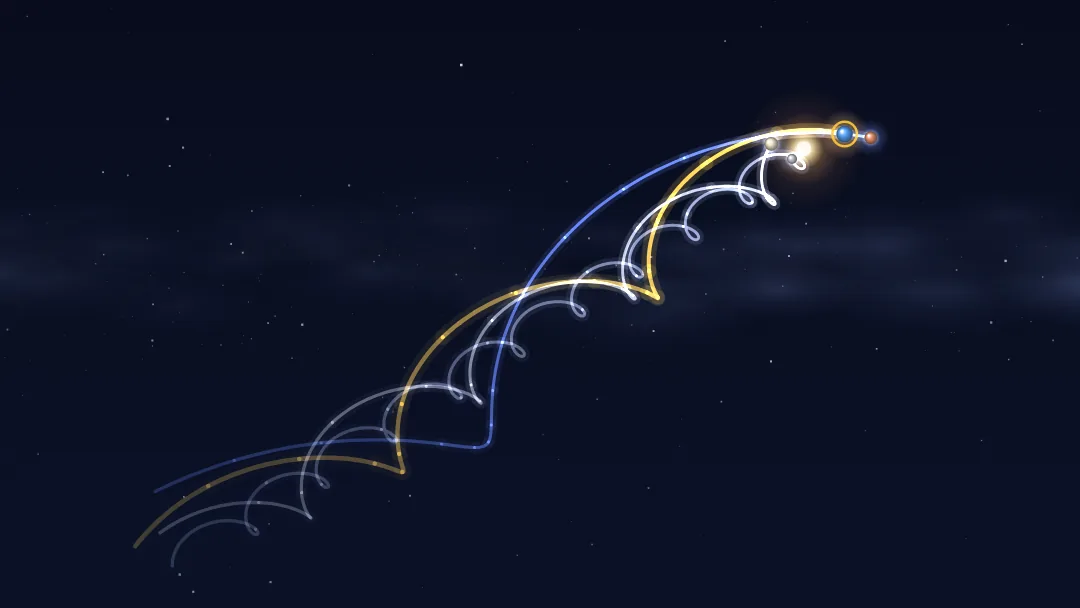 Interactive · Galactic Path LabDoes Earth really corkscrew through space?Speed up the Sun and watch the planets’ circles stretch into coils, then run a whole galactic year.
- Short · 43 secondsDoes Earth really corkscrew through space?The viral picture, the circles from the Sun, the coil from the galaxy and the 60° tilt. Narrated and captioned.
- JournalDoes Earth really corkscrew through space?Seen from the galaxy, Earth’s orbit is a coil, but stretched almost straight: 7.3 billion km long a year and 300 million km wide, tilted about 60°, not a vortex.
The same motion, another viewpoint
Where you watch from changes the shape of a path. These two make the same point closer to home.
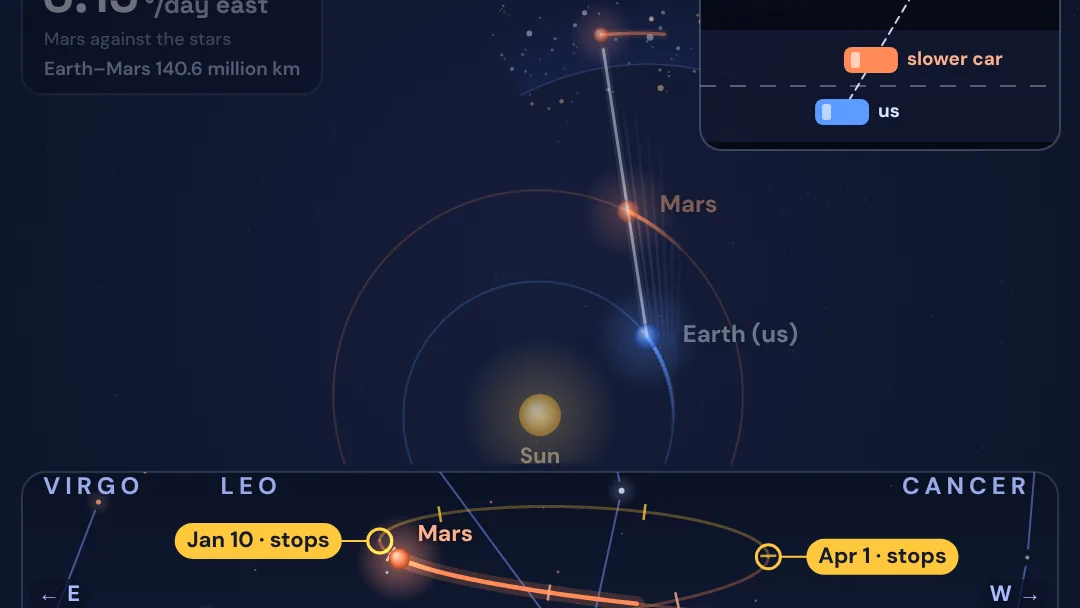 Interactive · Mars LoopWhy does Mars seem to move backward?Drag the date and watch Mars loop backward against the stars as Earth overtakes it.
- Interactive demoEarth and SunSwitch between Earth-centred and Sun-centred views of the same motion.by Andrew Marsh · Opens on the creator’s site
Why the orbits are circles at all
The coil starts as an orbit. These explain why a planet keeps going round.
 Interactive articleEarth and SunAn interactive article on Earth’s motion around the Sun.by Bartosz Ciechanowski
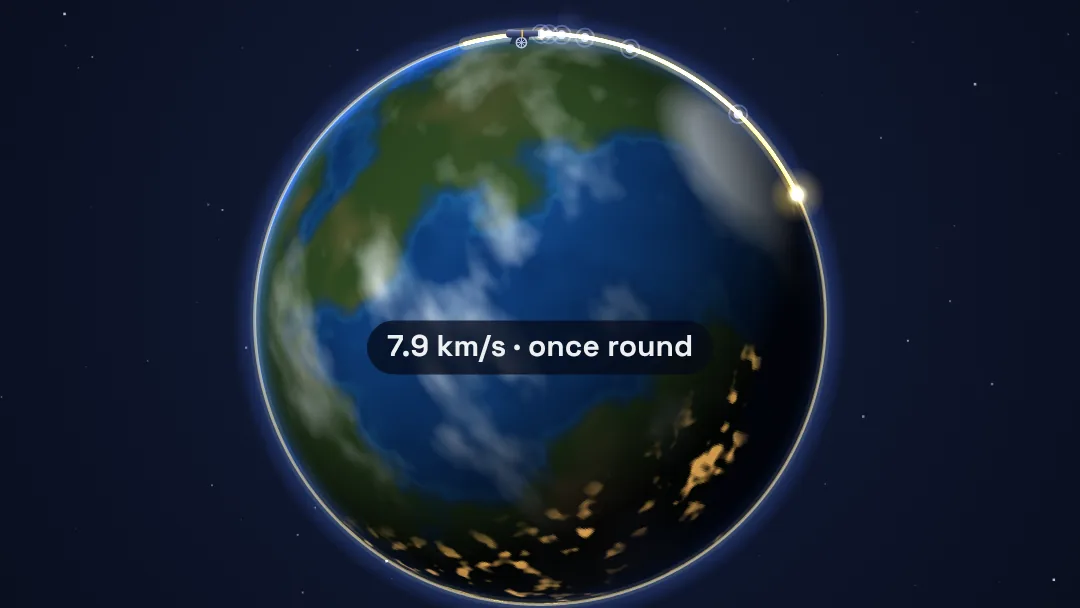 Interactive · Newton's CannonWhy don't satellites fall down?Fire Newton’s cannonball faster until the ground curves away as fast as it falls.
Common questions
Is the Solar System a vortex?
No. The planets’ paths are helical when seen from the galaxy, but nothing drags them behind the Sun. Their orbits are tilted about 60° to the Sun’s direction of travel, so each planet is ahead of the Sun for half its orbit and behind it for the other half.
How fast are we moving through space?
It depends on what you measure against. Earth goes round the Sun at about 30 km/s. The Sun, carrying Earth, orbits the Milky Way’s centre at about 230 km/s, NASA says. Measured against the cosmic microwave background, the Sun moves at about 370 km/s in yet another direction.
Why is the corkscrew so stretched?
Because the Sun moves almost eight times faster around the galaxy than Earth moves around the Sun. In one year Earth goes round once, about 940 million km, while the Sun carries it about 7.3 billion km, so each turn is 24 times longer than it is wide.
Is Earth ever in front of the Sun?
Yes, for half of every year. Because the orbits are tilted about 60° to the Sun’s path, Earth swings up to about 75 million km ahead of the Sun and then the same distance behind it.
How long is a galactic year?
About 230 million years, NASA says, the time the Sun takes to go once round the Milky Way. Estimates run from about 220 to 250 million years, depending on the measured speed and distance from the centre.
Sources and credits
- NASA StarChild · Does the Sun move around the Milky Way? The Sun moves at about 828,000 km/h (230 km/s) and takes about 230 million years to orbit the Milky Way.
- Live Science · How long is a galactic year? Keith Hawkins, University of Texas at Austin: about 230 km/s, 220 to 230 million years, about 28,000 light-years from the centre.
- Astronomy · In which direction does the Sun move through the Milky Way? The Solar System’s plane is tilted about 60° to the galaxy’s; the Sun also moves up and down through the disc.
- Universe Today · Is the Solar System really a vortex? Rhys Taylor on the 2012 animation: the helical paths are correct; the vortex and the face-on orbits are not.
- Bad Astronomy · No, our Solar System is not a “vortex” Phil Plait: the plane is tipped about 60° to the galaxy, so the planets are sometimes ahead of the Sun and sometimes behind it.
- Galactic Path Lab · model notesThe equations, the 230 km/s and 230-million-year figures, the 60° tilt worked out from galactic coordinates, and what the model leaves out.
Every creator named here made the work we link to. Listing it does not imply a partnership or endorsement.