Space · interactive
Does Earth really corkscrew through space?
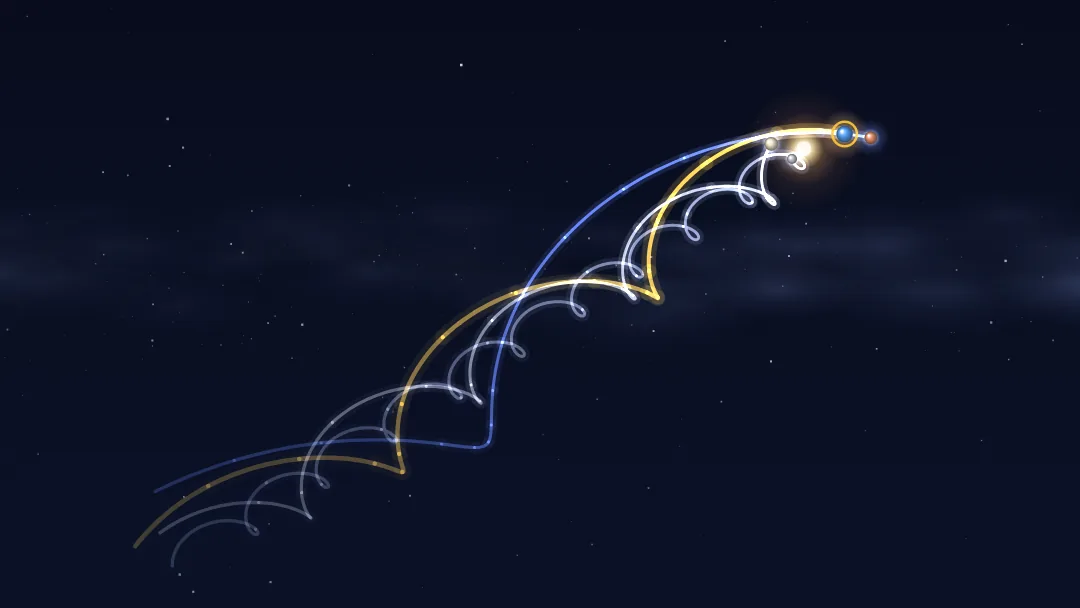
The planets’ paths over the time shown, to scale; the Sun and planets are drawn much larger than they are. Earth is gold. Drag the stage to turn the view.
1 See
Animations show the planets corkscrewing behind a racing Sun. Ride along with the Sun and they go round in circles; watch from the galaxy and each orbit becomes a coil, stretched almost straight. Does Earth really corkscrew through space?
2 Change
3 Understand
Model notes and sources
Model. The Sun moves on a circle around the Milky Way’s centre at V = 230 km/s, NASA’s figure, so in a time t it covers V·t: 7.26 billion km a year (48.5 AU). A galactic year is taken as 230 million years (NASA; Live Science quotes 220 to 230 million), which puts the circle’s radius at V·T/2π ≈ 28,100 light-years with these round numbers, a little more than the measured distance from the Sun to the Galactic Centre, about 26,700 light-years (GRAVITY, 2019). Each planet moves on a circle of radius a and period P around the Sun: Venus 0.723 AU and 0.615 years, Earth 1 AU (149,597,870.7 km) and 1 year, Mars 1.524 AU and 1.881 years, Jupiter 5.203 AU and 11.86 years. Earth’s orbit is 2π AU ≈ 940 million km long, covered at 29.8 km/s. The orbits lie in one plane tilted β to the Sun’s direction of travel; the real tilt is about 60°. A watcher who moves along with a fraction (1 − f) of the Sun’s motion sees a planet at f·(the Sun’s path) + (the planet’s circle), so the Sun’s speed control (f × 230 km/s) slides from riding with the Sun (f = 0, circles) to the galaxy’s view (f = 1, coils).
Why a coil, and why so stretched. A point going round a circle whose centre moves steadily traces a helix. Its length per turn is how far the centre moves in one orbit; its width is the orbit’s diameter. For Earth that is 7.26 billion km against 300 million km, so one turn is 24 times longer than it is wide. The ratio of the speeds says the same thing: 230 ÷ 29.8 ≈ 7.7, so in one year the Sun carries Earth 7.7 times as far as Earth goes round it. Drawn to scale and seen from the side, a year of Earth’s path is a gentle wave. It only looks like a tight corkscrew when seen almost end-on, as in the film’s coil shot, or when the Sun is slowed down, as in most animations.
The tilt. The plane of the planets’ orbits (the ecliptic) is tilted about 60° to the plane of the Milky Way (60.2°: the north ecliptic pole is at galactic latitude 29.8°, longitude 96.4°). The Sun moves along the galactic plane toward longitude 90°, 30.4° from the north ecliptic pole, so the orbits are also tilted about 60° to the direction of travel (both angles computed from the standard J2000 galactic coordinates). A planet’s distance ahead of the Sun is a·cos β·sin θ, with θ its angle round the orbit: Earth is up to 75 million km ahead of the Sun for half the year and behind it for the other half. The popular “vortex” animation (DjSadhu, 2012) draws the orbits face-on to the motion with the planets trailing behind the Sun. Astronomers who answered it, Rhys Taylor in Universe Today and Phil Plait in Bad Astronomy, agreed that the planets’ paths really are helical, but with the 60° tilt the planets are sometimes ahead of the Sun and sometimes behind it, and nothing is dragged behind like a vortex: the Sun’s gravity simply carries the planets along.
Which picture is right? Both. A speed or a path is always measured against something. Against the Sun the orbits are near-circles; against the Milky Way’s centre they are coils. Measured against the cosmic microwave background, the Sun moves at about 370 km/s in yet another direction, and the paths would look different again. The tool uses the galactic view because that is the one the corkscrew picture describes.
The pictures. Everything on the stage is drawn in code from the model, to scale, except the Sun and planets, which are drawn many times larger than they are. The Milky Way is a generic barred spiral drawn for illustration; its arms are not mapped, and only the Sun’s distance from the centre is real. The film opens on the picture that went viral: DjSadhu’s 2012 “helical model” animation (YouTube), an artist’s animation that is not to scale. On the tilt it shows part of morn1415’s “How the Solar System really moves (Update!)” (YouTube), which draws the orbits with their real tilt, and while the coils form, the opening of the 2 November 2026 post by @PhilosophyOfPhy (X), a coded simulation that went viral that week. All three are shown picture only, a few seconds each, credited on screen, with their own watermarks left whole. Without them, the opening corkscrew is drawn in code and labelled as the popular picture: orbits face-on to the motion and the Sun slowed to about 28 km/s. The film’s coil shot is to scale but seen almost along the path; the fly-outs carry a scale bar.
Limits. Circular orbits at constant speeds (real ones are slightly elliptical; Mars’s most of these, by about 9%) and a circular galactic orbit. The Sun’s real galactic path also wanders in and out a little and bobs up and down through the disc, a full cycle taking roughly 60 million years (Astronomy magazine); the model leaves that out. Published speeds run from about 220 to 250 km/s (about 247 km/s from the apparent motion of Sagittarius A*, the black hole at the centre) and galactic years from about 220 to 250 million years; the tool uses NASA’s round 230 and 230. The orbits’ plane is held fixed in space, so over a galactic year its tilt to the direction of travel changes as the Sun’s heading turns. The planets’ pulls on each other and the spiral arms’ own slow pattern are left out.
Sources: NASA StarChild, Does the Sun move around the Milky Way? (828,000 km/h; about 230 million years per orbit); Live Science, How long is a galactic year? (Keith Hawkins, University of Texas at Austin: about 230 km/s, 220 to 230 million years, about 28,000 light-years from the centre); GRAVITY Collaboration, A geometric distance measurement to the Galactic Center black hole with 0.3% uncertainty (2019: 8.178 kpc, about 26,700 light-years); Reid & Brunthaler, The proper motion of Sagittarius A*. III (2020: 30.3 km/s per kpc, about 247 km/s); Astronomy, In which direction does the Sun move through the Milky Way? (the 60° tilt; the Sun’s up-and-down motion); Universe Today, Is the Solar System really a vortex? (Rhys Taylor, 2013); Phil Plait, Bad Astronomy, No, our Solar System is not a “vortex”; NASA, Planetary Fact Sheet (orbit sizes and periods); Wikipedia, Astronomical unit, Earth’s orbit (29.78 km/s), Galactic coordinate system and Cosmic microwave background (the 370 km/s dipole).
An ExplainerTools Original. Prompted by the “helical model” animations of the Solar System (DjSadhu, 2012) and astronomers’ replies to them (Rhys Taylor, Phil Plait).