Science · Interactive demo
How do you fly faster than sound without a sonic boom?
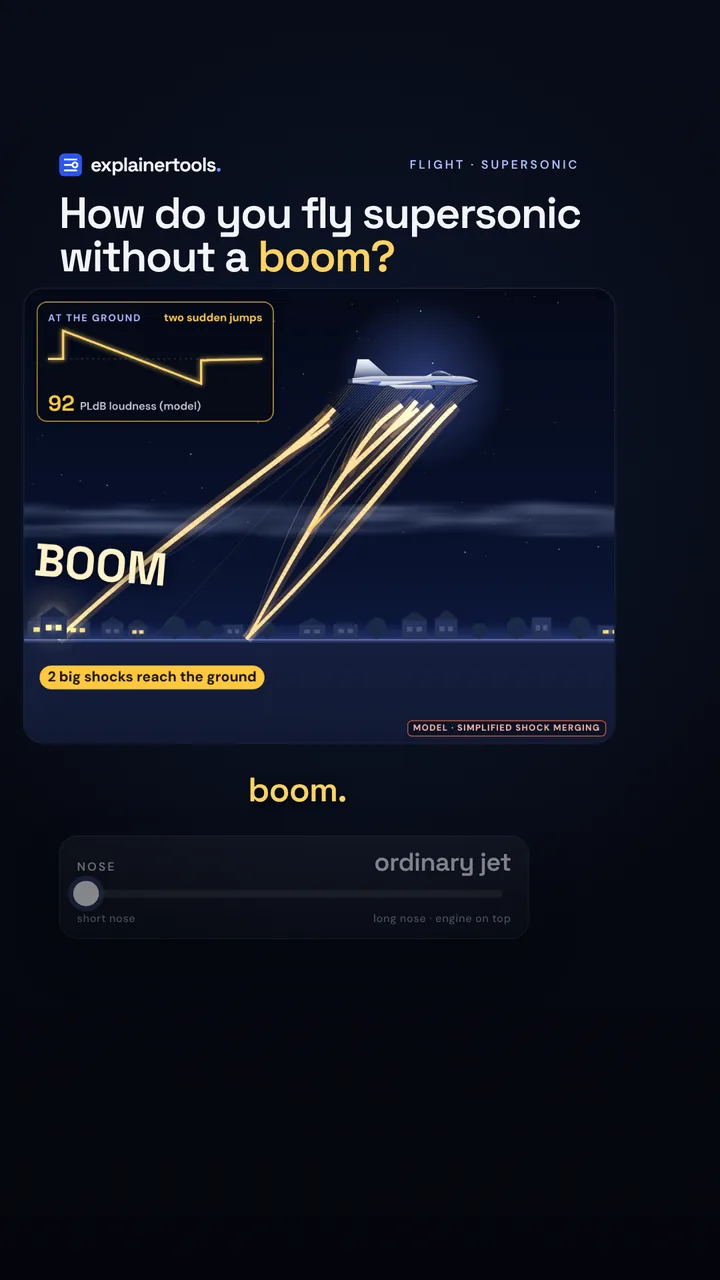
Stretch a supersonic jet’s nose and watch its shock waves stop merging on the way down: the sharp double boom becomes a soft thump.
Created by ExplainerTools.
About this explainer
- Made by
- ExplainerTools
- Format
- Interactive demo
- Subject
- Science
- Where it runs
- Plays here
- Full tool
- Open the tool page
- Published
- Added to collection
- supersonic flight
- sonic booms
- shock waves
- NASA
- aircraft design
How the model works
An ordinary supersonic jet hits the ground with a sharp double boom. NASA's X-59 flies just as fast, but it is shaped so that people below should hear only a soft thump. How do you fly faster than sound without a sonic boom?
- Noseshort nose → long nose (X-59)
- SpeedMach 1.1 → Mach 2
- Altitude30,000 ft → 60,000 ft
Whitham’s F-function theory with nonlinear aging in the standard atmosphere and exact shock fitting; two jets of the same assumed weight (24,000 lb), an ordinary 19.5 m jet built from its parts and a designed low-boom X-59 shape. Loudness is an A-weighted stand-in set so the X-59 shape reads NASA’s 75 PLdB target; not a CFD result, and not to scale.
Model notes and sources
Model. A supersonic jet pushes the air aside, and every place where its cross-section or its lift grows (nose, canopy, inlet, wings, tail) starts a pressure wave. In G. B. Whitham's theory the jet is summed up by its F-function, F(y) = (1/2π) ∫ A″(ξ) / √(y − ξ) dξ, where A is the equivalent area: the jet's cross-section plus a lift term β W / (2q), with β = √(M² − 1), weight W and dynamic pressure q. Far below, the overpressure is Δp / pv = γ M² F(y) / √(2βr) (γ = 1.4, pv the air pressure at the jet). Each point of the wave travels a little faster the stronger it is: its position shifts by k F(y) S, with k = (γ + 1) M⁴ / √(2β³). In uniform air the age S would be √r; in the standard atmosphere (ISA: 6.5 K per km to 11 km, isothermal above) it is S = ∫ Z (pv/p) d√r with Z = √(ρc / ρvcv), which grows ever more slowly as the wave goes down into denser air. Where faster parts overtake slower ones, shocks form; the tool places them exactly with the equal-area rule, done as a lower convex hull (the Lax–Oleinik solution). At the ground the amplitude is multiplied by Z and by 1.9 for the reflection.
Why ordinary jets boom twice. The shocks from the front of the jet have stronger air behind them, so they catch up with the ones ahead and merge into a single bow shock; at the back the same happens to the tail shocks. What reaches the ground is an N-wave: a sudden jump up, a steady fall, and a sudden jump back, heard as “boom-boom”. The basics of the Mach cone and the boom carpet are in our Sonic Boom Lab.
The two shapes. Both weigh 24,000 lb (assumed; Lockheed Martin gives the X-59's take-off weight as about 25,000 lb, other sources up to about 32,300 lb). The ordinary jet is 19.5 m long; its equivalent area is built from its parts (a 3.5 m pointed nose, a bubble canopy, a belly inlet, a wing carrying all the lift, the tail) and its F-function computed from that. At Mach 1.4 and 55,000 ft the model gives it an N-wave of about 0.8 psf that lasts about 135 ms (Carlson's simplified method gives a similar size for a jet like this). The X-59 end is 30.4 m long (the X-59 is 99.7 ft, almost a third of it nose). Its F-function is a designed low-boom one, as NASA's designers worked backwards from a target signature: five small steps (nose, canard, canopy, wing, engine) on a gentle ramp, spaced so they cannot catch up before the ground at the design point, then a slow expansion and recovery at the back. The engine on top matters because the wing shields the ground from its inlet's shock; the long nose spreads the front compression over a longer distance. In between the two ends the tool smooths the ordinary jet's F-function and blends it into the X-59's. The lift part of the X-59's F-function scales with speed and altitude.
Loudness. NASA rates booms in perceived level, PLdB (Stevens' Mark VII). This tool uses a simpler stand-in: the A-weighted sound exposure of the modelled ground signature, with each shock's rise time set to 1 ms × (1 psf / jump), as weak shocks are thicker. A constant is added so the X-59 shape at Mach 1.4 and 55,000 ft reads 75 PLdB, NASA's target. The ordinary jet then reads about 92, and the X-59 shape's pressure takes about 15 ms to build instead of about 1 ms. NASA gives Concorde's boom as about 105 PLdB; Concorde was more than ten times heavier (about 185 t at take-off) and two to three times as long as these jets, so the Mach 2 preset is only its speed.
Mach cutoff. If the jet moves over the ground slower than sound travels in the warm air at the ground (about 340 m/s), its shock waves bend back up before they land and no boom reaches the ground. The tool applies this for still air in the standard atmosphere, below about Mach 1.15 at 55,000 ft.
Limits. The vertical scale is squeezed (the ground is 17 km below a 30 m jet), and the spread of the shocks is squeezed with depth so the picture fits. The model ignores refraction other than the cutoff, wind, turbulence (which roughens real shocks), atmospheric absorption, the jet's exhaust plume and three-dimensional flow near the jet; the X-59's real shape was designed with CFD and wind-tunnel tests. Numbers from the model are approximate; the 75 and 105 PLdB figures are NASA's.
The X-59. NASA and Lockheed Martin Skunk Works built the X-59 for NASA's Quesst mission. It first flew on 28 October 2025, went supersonic in June 2026 and reached Mach 1.53 (about 1,010 mph) in September 2026, NASA says. Its long nose blocks the view ahead, so the pilot sees forward through a camera and screen, the eXternal Vision System. A year after its first flight, after more than 40 flights, it flew across the country via El Paso and Fort Worth to Kennedy Space Center. Next, NASA plans acoustic tests and then flights over US communities to ask people what they hear. Civil supersonic flight over US land has been banned since 1973 (14 CFR 91.817); in July 2026 the FAA proposed replacing the ban with a limit of 0.11 psf on the boom's pressure at the ground; the rule is not final.
The pictures. Everything on the stage is drawn in code from the model. The film also shows three short pieces of real footage, picture only, each credited on screen: the X-59 landing at Naval Air Station Joint Reserve Base Fort Worth on 28 October 2026 and taking off from there the next day, filmed by spotter @LensOfMae (take-off), shown whole with her watermark; and NASA's AirBOS schlieren image of two T-38s flying supersonic, their shock waves made visible (NASA Armstrong, YouTube, 2019), cropped to leave out NASA's caption. The T-38s are ordinary jets, not the X-59. The Concorde in the film is drawn in code.
An ExplainerTools Original. After NASA's X-59 and its Quesst mission (NASA and Lockheed Martin Skunk Works). Model after G. B. Whitham's theory of supersonic flow (1952).
Watch it move
- How do you fly faster than sound without a sonic boom?45-second Short
Explore interactive ideas in space, science, math, and more. Try a demo, read an interactive article, watch a short video, and follow what makes you curious.
New Originals
Change one thing and see why.
The three newest models, each with a short film. Watch the question, then play with the answer.


Follow your curiosity
A collection of small doors into big ideas.
Format
Swipe or scroll for more formats →
Subject
Swipe or scroll for more subjects →
Topic
Swipe or scroll for more topics →
Sort by
Rankings count activity here on ExplainerTools. Newest means added to this collection.
Loading collection…
Make something click.
Made an explainer, or found one you love? Give it a place in the collection.