Engineering · Interactive demo
Why launch rockets from a 20 km tower?
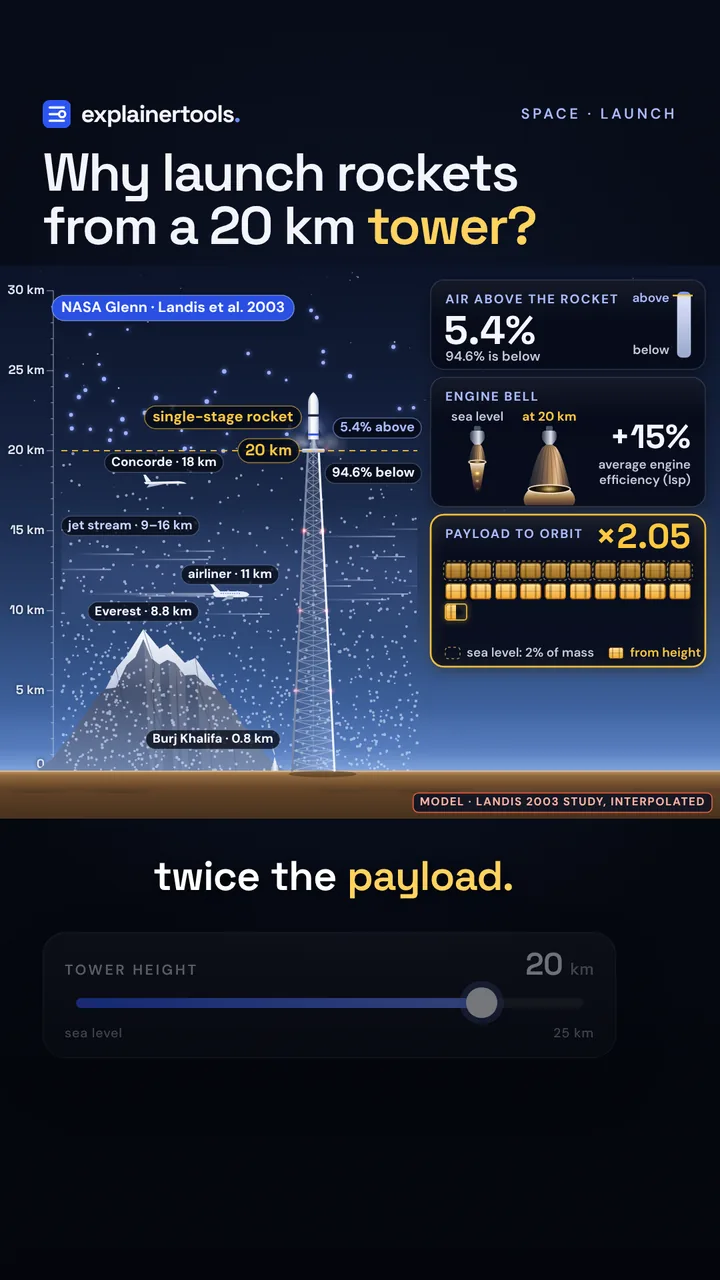
Raise a rocket’s launch pad from sea level to 20 km and watch the air fall away, the engine bell grow and the payload double, from a NASA Glenn study.
Created by ExplainerTools.
About this explainer
- Made by
- ExplainerTools
- Format
- Interactive demo
- Subject
- Engineering
- Where it runs
- Plays here
- Full tool
- Open the tool page
- Published
- Added to collection
- rockets
- launch towers
- atmosphere
- rocket engines
- Neal Stephenson
How the model works
Half of all the air sits within 5.5 km of the ground, and a rocket has to shove through all of it. Neal Stephenson thinks somebody ought to build a tower 20 km tall and launch from the top. Why would that help so much?
- Tower heightsea level → 25 km
- Payload share of the rocketsingle-stage ~2% → 8%
Presets Sea level · 0 kmBurj Khalifa · 0.8 kmEverest · 8.8 kmAirliner cruise · 11 kmStephenson’s tower · 20 km
US Standard Atmosphere 1976 for the air; rocket gains interpolated from Landis, Denis & Lyons (NASA Glenn, 2003), a single-stage-to-orbit design with payload 2% of liftoff mass. The tower’s structure, winds and cost are not modeled.
Model notes and sources
Model. Air pressure follows the US Standard Atmosphere 1976, with h in metres: p = 101,325 × (1 − 2.25577×10⁻⁵ h)5.25588 Pa below 11 km; p = 22,632 × e−1.57688×10⁻⁴ (h − 11,000) from 11 to 20 km; p = 5,474.89 × (1 + (h − 20,000) / 216,650)−34.1632 from 20 to 32 km. Pressure is the weight of the air overhead, so the share of the atmosphere above a height is p/p0: 31% at Everest’s 8,849 m, 22% at 11 km, 11.9% at 15 km, 5.4% at 20 km (94.6% below) and 2.5% at 25 km. The rocket’s gains are from Geoffrey Landis, Vincent Denis and Valerie Lyons’s NASA Glenn study of a single-stage-to-orbit rocket launched from altitude (Table 3). Compared with a sea-level launch, at 5, 10, 15, 20 and 25 km the velocity lost to drag falls by 0.30, 0.94, 1.24, 1.39 and 1.46%; the average specific impulse (Isp, the engine’s efficiency) rises by 4.70, 8.70, 12.25, 15.40 and 18.22%, largely because the engine can use a bigger, vacuum-style bell from liftoff; and the final mass delivered to orbit rises by 5.00, 9.64, 13.49, 16.79 and 19.68%. The drag saving is the smallest of the three; most of the gain comes from the engine’s efficiency. Between those rows the tool interpolates with a monotone cubic (PCHIP), which passes through every row. The engine bells are drawn to show the trend; their sizes are not from the study.
Why the payload doubles. Landis’s rocket is 87.5% propellant, so 12.5% of its liftoff mass reaches orbit as structure plus payload. Launched higher, that final mass grows by F(h), the Table 3 gain. The structure does not change, so the payload gets all of it: payload = p + 12.5% × F(h), and the multiplier is 1 + 12.5 × F(h) / p. At p = 2% this reproduces Landis’s payload column: at 20 km, 2% + 2.1% = 4.1% of liftoff mass, ×2.05 (his table: +104.9%). The crates show 10 × the multiplier. Other payload shares on the Payload share control are our extrapolation of his single-stage result; a two-stage rocket gains less.
The catch. Height is not speed. 20 km of height is worth g·h = 9.81 × 20,000 ≈ 196 kJ per kg; orbital speed, about 7.8 km/s sideways, is worth ½v² ≈ 30.4 MJ per kg. So the tower supplies about 0.6% of the energy (the same as about 626 m/s of speed, √(2gh)). This comparison leaves out the losses to gravity and drag on the climb. The film’s Earth view is to scale: radius 6,371 km, the tower 20 km and an orbit 200 km up, where the circular speed √(μ/r) is about 7.8 km/s (μ = 398,600 km³/s²). The tower itself is the hard part. Landis’s Table 1 (from his 1998 study) puts a 15 km tower supporting a 2,000-tonne launch at about 5,300 t in cast steel, with an area taper of 2.6:1, or about 280 t in graphite-epoxy. Wind is the real enemy: the jet stream blows about 9–16 km up, and Stephenson, who studied the idea with Arizona State engineer Keith Hjelmstad, said in 2013: “In a windless environment making a structure that tall would almost be trivial.” Thoth Technology patented a 20 km inflatable tower in 2015. Not modeled: the tower’s structure and cost, winds, how the rocket would be lifted and fuelled up there, and any rocket other than Landis’s single-stage design. Rockets already launch from high up: Virgin Orbit’s LauncherOne was dropped from a 747 at about 10.7 km, and Pegasus from an L-1011 at about 12 km.
The pictures. Everything on the stage is drawn in code from the model. The side view is to scale in height (0–30 km); the rocket, the aircraft and the tower’s width are not. The air dots are spread so that their density follows the air’s, so the share of dots above a height is the share of the atmosphere above it. In the Short, any real footage (Neal Stephenson on Core Memory; a rocket engine) is a short excerpt, picture only, credited on screen; the numbers come from the model, not from the clips.
Neal Stephenson. In his conversation with Ashlee Vance (Core Memory, episode 94, 28 October 2026, from 1:13:43) he names the idea he would still back: “the one that I still think somebody ought to build is the tall tower”. Among its advantages: “it’s not as noisy up there”, so the rocket need not be built to survive its own noise.
Sources: G. A. Landis, V. Denis and V. Lyons, High Altitude Launch for a Practical SSTO (STAIF 2003, NASA Glenn Research Center); Core Memory episode 94, video (chapter “Rockets, Guns and Giant Towers”, 1:13:43) and episode page; Wikipedia, U.S. Standard Atmosphere, Jet stream, Burj Khalifa (828 m), Mount Everest (8,849 m), Concorde (cruise about 18 km), LauncherOne and Pegasus; Motherboard, The twelve-mile-high skyscraper is on pause thanks to the jet stream (19 September 2013); Arizona State University, Project Hieroglyph: Tower Project Overview; Silicon Republic, 20 km space elevator idea awarded a patent (Thoth Technology, 2015).
An ExplainerTools Original. Concept from Neal Stephenson’s conversation with Ashlee Vance on Core Memory (episode 94, October 2026).
Watch it move
- Why launch rockets from a 20 km tower?39-second Short
Explore interactive ideas in space, science, math, and more. Try a demo, read an interactive article, watch a short video, and follow what makes you curious.
New Originals
Change one thing and see why.
The three newest models, each with a short film. Watch the question, then play with the answer.

Follow your curiosity
A collection of small doors into big ideas.
Format
Swipe or scroll for more formats →
Subject
Swipe or scroll for more subjects →
Topic
Swipe or scroll for more topics →
Sort by
Rankings count activity here on ExplainerTools. Newest means added to this collection.
Loading collection…
Make something click.
Made an explainer, or found one you love? Give it a place in the collection.