Topic guide · Space
What are the ways to space besides a rocket from the ground?
Orbit is mostly a speed problem: about 7.8 km/s, sideways. A rocket from the ground carries the fuel for all of it through the thickest air. Each alternative attacks one part of that. A 20 km tower starts above 94.6% of the air, and a single-stage rocket launched there carries about twice the payload. A sling or a gun gives the speed up front, but the push has to fit in a short space: about 10,000 g on SpinLaunch’s planned arm, a few hundred g in Longshot’s planned 10 km gun, and either way a wall of air at the exit. A whip concentrates energy until its tip outruns sound: a head start, not orbit.
- Tall tower
- ×2 payload
- Spin launch
- ≈10,000 g
- 10 km gun
- ≈287 g
- Orbit needs
- 7.8 km/s
Models · four ExplainerTools Originals Tower: Landis, Denis and Lyons (NASA Glenn, 2003). Sling: a = v²/r on an assumed 46 m arm at 2.1 km/s. Gun: a = v²/2L, 10 km at 7.5 km/s.
Interactive · ExplainerTools
Tall Tower Launch
Raise the launch pad from sea level to 25 km and watch the air fall away, the engine bell grow and the payload double. Then try the sling, the gun and the whip below.
Model · NASA Glenn single-stage study
Why is getting to orbit so hard?
Space is close: 100 km up, an hour’s drive if the road went straight up. Staying there is the hard part. To orbit, a spacecraft has to move sideways at about 7.8 km/s, fast enough that it falls around the Earth instead of into it. Height is a small share of the job: 20 km of height is worth about 0.6% of the energy of orbital speed.
A rocket has to carry the fuel for all that speed, and the fuel for carrying the fuel. In the NASA Glenn single-stage design the ideas below are measured against, 87.5% of the rocket at liftoff is propellant and only 2% is payload. That makes a rocket very sensitive to small gains: anything that saves a little speed, or lets the engine work a little better, goes straight into that 2%.
Neal Stephenson spent Blue Origin’s first years, from 1999 to the end of 2006, on studies of the alternatives. On Core Memory episode 94 he went through four of them with Ashlee Vance. Read the whole conversation in our Journal: Towers, slings, whips and space guns.
What does a 20 km tower buy?
“The one that I still think somebody ought to build is the tall tower,” Stephenson said. Air pressure is the weight of the air above you, so at 20 km about 94.6% of the atmosphere is below the launch pad. Drag, it turns out, is the small part of the gain: in Geoffrey Landis’s NASA Glenn study the speed lost to drag falls by only about 1.4%. The big gain is the engine. In thin air it can wear a long vacuum-style bell from liftoff, and its average efficiency rises about 15%. The mass that reaches orbit grows by about 17%, and because the structure does not change, all of it goes to the payload: 2% becomes 4.1%, about twice as much.
The catch is the tower. Winds in the jet stream blow at 9 to 16 km, right through its middle, and a 2015 patent for a 20 km inflatable tower by Thoth Technology is as far as anyone has got.
What does a sling cost the payload?
SpinLaunch spins a projectile on an arm inside a vacuum chamber and lets go. Its planned full-size machine would release at up to 4,700 mph (2.1 km/s), about a quarter of orbital speed, and a small rocket would do the rest. Stephenson knew the idea as the Slingatron: “it’s a big gun, basically.”
The cost is the spin. Holding something on a circle takes a = v²/r: double the speed and the force quadruples. On an assumed 46 m arm, 2.1 km/s means about 9,800 g, close to the 10,000 g SpinLaunch designs its payloads for. Fighter pilots train for about 9 g. Then the projectile leaves the vacuum at Mach 6 into the thick air near the ground, about 23 atmospheres on its nose.
Why would anyone build a 10 km gun?
Longshot, in Oakland, fires payloads with pairs of gas tanks along the barrel that go off in turn behind the projectile. Its ~21 m test gun reached Mach 4.6. Its plan for orbit is a gun about 10 km long, and Ashlee Vance asked Stephenson about exactly that.
Length is the point. To reach a speed v in a barrel of length L with a steady push, the acceleration is a = v²/2L. The test gun averages about 6,000 g. Spread a near-orbital 7.5 km/s over 10 km and it is about 287 g, inside the 250–500 g Longshot is aiming for, which hardened electronics and rugged satellites can be built to take. People need about 3 g, which would take a barrel about 1,030 km long. And whatever leaves the muzzle at Mach 22 meets about 340 atmospheres of air: Stephenson’s warning that “all big gun systems have got problems … around what happens when you meet the atmosphere.”
Could a whip help a rocket?
“As a kind of almost tongue in cheek thing, I looked at gigantic steel bull whips,” Stephenson said, “which is still a topic I’m obsessed with.” A whip crack is a tiny sonic boom. A loop rolls down the whip, and as the whip thins the same energy is carried by less and less mass, so the loop speeds up. With a tip one tenth as thick as the handle, the end reaches about 32 times the loop’s starting speed, past the 343 m/s of sound.
That is nowhere near orbit, and Stephenson says so: giant whips or chain loops could not get there. But the rocket equation rewards any head start. A whole rocket starting at a bullwhip’s 379 m/s would need 93.3% of its liftoff mass as fuel instead of 94.0%, and that sliver raises its payload by about 36%.
Why did none of these fly?
Not because of physics. In those years, Stephenson said, the business of space was mostly launching huge, very expensive satellites to geostationary orbit, where the price of the rocket was “kind of a round off error.” Those satellites need insurance, “and you’re not gonna get insurance on a brand new launch … a radically new launch concept.” A delay of a few weeks is a few weeks of a satellite earning nothing. So Blue Origin chose rockets, and the radical ideas went to startups: SpinLaunch’s test flights in New Mexico, Longshot’s gun in Oakland, Green Launch’s hydrogen gun at Yuma. The tower is still waiting for someone to build it.
Try it: four models, four questions
- 1 Tower
Open Tall Tower Launch and drag the tower to 20 km. The air above falls to 5.4% and the payload crates read ×2.05.
- 2 Sling and gun
In Spin Launch Lab, halve the release speed and watch the g-load drop to a quarter. In Space Gun Lab, stretch the barrel from 21 m to 10 km and watch 6,000 g become a few hundred.
- 3 Whip
In Whip Crack Lab, start from a rope and thin the tip to 1/10. The tip speed crosses 343 m/s and the whip cracks.
Where do these models stop?
Each tool is a model with its assumptions written on it. The tower’s gains are interpolated from one single-stage design; the tower’s own structure, winds and cost are left out. The sling and the gun give steady or average loads, and real guns push hardest early, so their peaks are several times higher. None of them follows the payload through the air after it leaves, and both still need a small rocket to finish the orbit. The whip is an ideal tapered whip with no air drag, so its speeds are an upper bound. The films use short, credited excerpts of real footage; the numbers come from the models.
Explore by question
Four ideas from one conversation. Each group has a model to change, a Short and a Journal post.
The tall tower
Start above most of the air
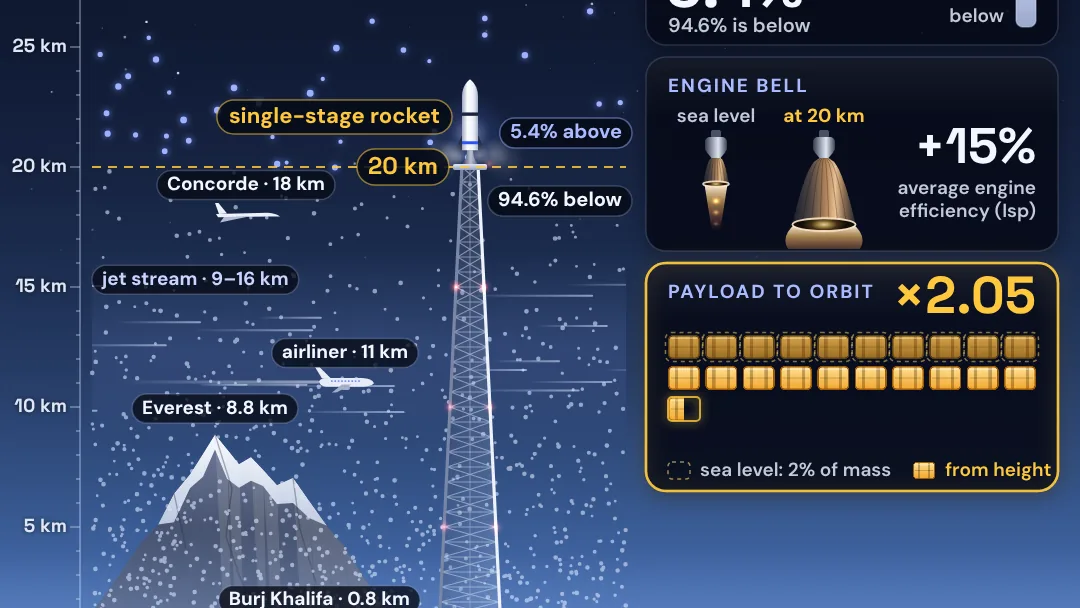 Interactive · Tall Tower LaunchWhy launch rockets from a 20 km tower?Raise the launch pad from sea level to 25 km and watch the payload double.
- Short · 39 secondsWhy launch rockets from a 20 km tower?Neal Stephenson’s tower, the vacuum bell and the 2% payload. Narrated and captioned.
- JournalWhy launch rockets from a 20 km tower?From 20 km up, 94.6% of the air is below the rocket. A NASA study found a single-stage rocket launched there carries about twice the payload, mostly because the engine can use a bigger bell. The catch: orbit is about speed, not height.
The sling
Throw it, and pay in g
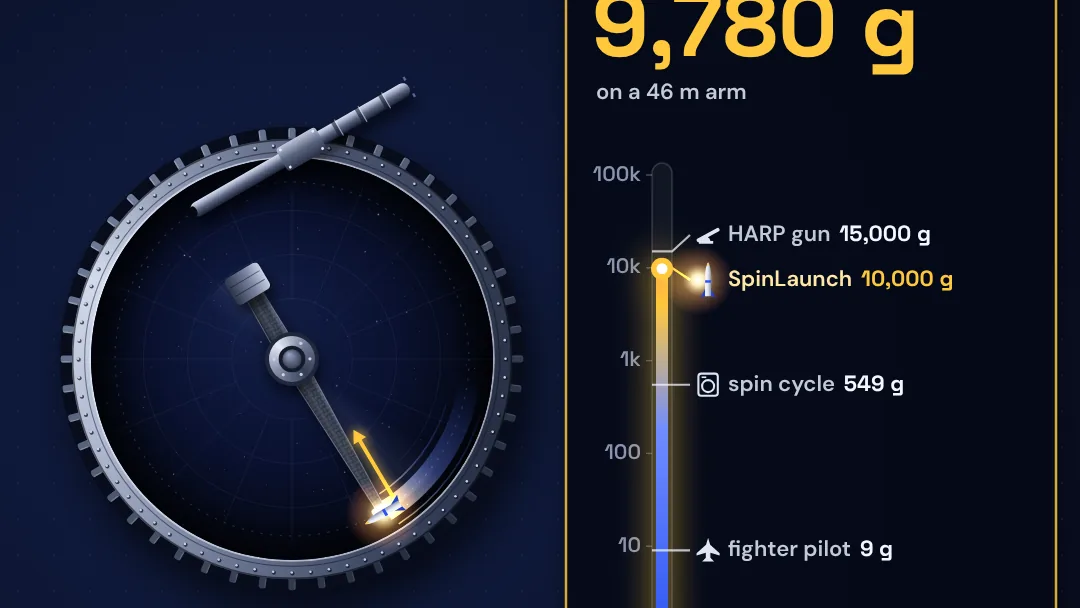 Interactive · Spin Launch LabHow does SpinLaunch throw rockets into space?Spin a payload on a 46 m arm to 4,700 mph, then let go.
- Short · 36 secondsHow does SpinLaunch throw rockets into space?SpinLaunch’s throw, and why doubling the speed quadruples the force. Narrated and captioned.
- JournalHow does SpinLaunch throw rockets into space?SpinLaunch spins a projectile in a vacuum chamber and lets go at up to 4,700 mph. The force grows with the square of the speed, so the payload feels about 10,000 g, more than a thousand times a fighter pilot’s limit.
The space gun
Make the barrel long enough
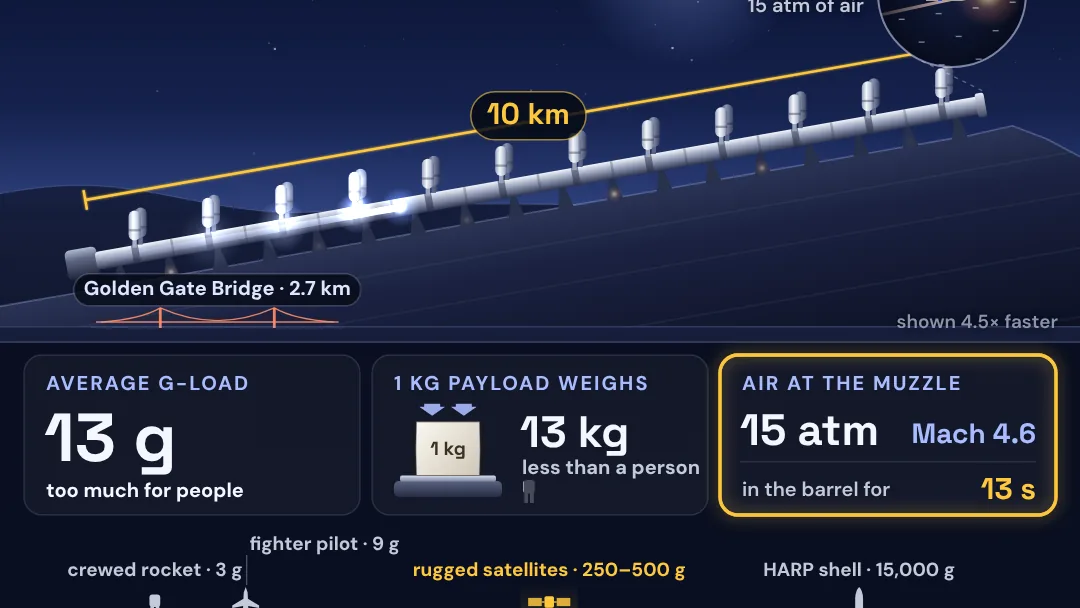 Interactive · Space Gun LabWhy build a 10 km space gun?Stretch the barrel from 10 m to 2,000 km and watch the g-load fall.
- Short · 39 secondsWhy build a 10 km space gun?Longshot’s 10 km plan: a few hundred g for satellites, never for people. Narrated and captioned.
- JournalWhy build a 10 km space gun?Longshot wants to fire payloads toward orbit from a gun 10 km long. A short barrel has to shove with thousands of g; spread the same push over 10 km and near-orbital speed costs a few hundred g. Rugged satellites can take that. People can’t.
The whip
Concentrate the energy
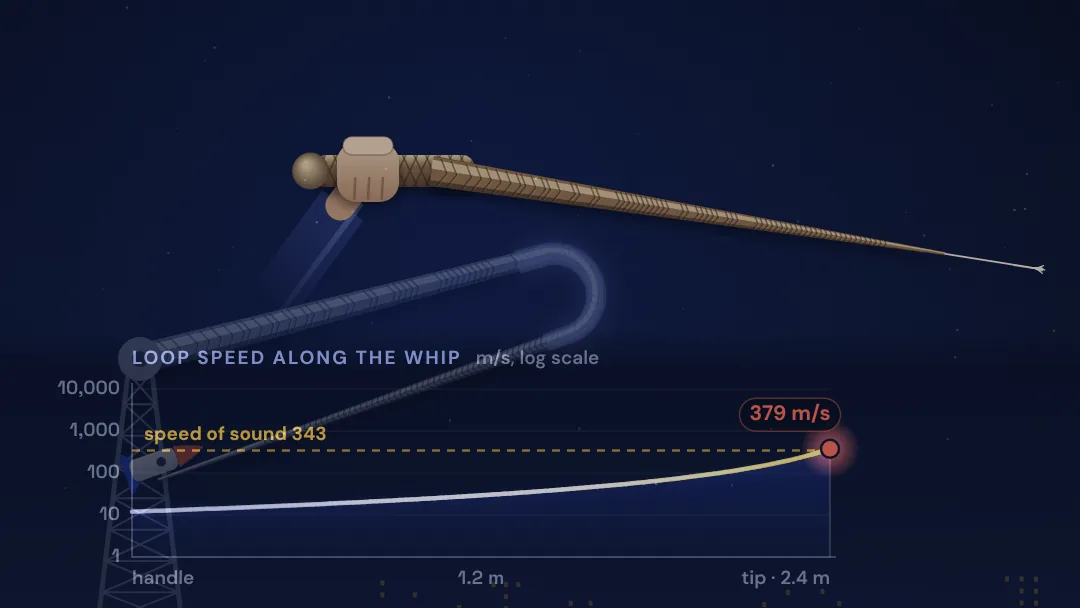
- Short · 39 secondsWhy does a whip crack?A crack is a tiny sonic boom, and a head start for a rocket. Narrated and captioned.
- JournalWhy does a whip crack?A whip crack is a tiny sonic boom. A loop rolls down a tapering whip, the same energy is carried by less and less mass, and the tip ends up faster than sound. Neal Stephenson has written five essays about giant steel ones.
Common questions
Is space far away?
No. The usual edge of space, the Kármán line, is 100 km up. The hard part is speed: about 7.8 km/s sideways to stay in low orbit, which is why most of a rocket is fuel.
Has anyone built a launch tower?
Not a tall one. Thoth Technology patented a 20 km inflatable tower in 2015, and Stephenson studied tower designs with Arizona State engineers in 2013. Rockets do start high in other ways: Pegasus drops from an airliner at about 12 km.
Could people ride SpinLaunch or a space gun?
No. People can take a few g for minutes; a crewed rocket keeps to about 3 g. SpinLaunch’s payloads feel about 10,000 g, and even a 10 km gun means a few hundred g. A gun gentle enough for people would be about 1,000 km long.
Why do slings and guns still need a rocket?
They throw the payload from the ground, so it has to climb through the air and then turn its upward path into a circle. Both take a small rocket burn high up, and the air takes some of the speed on the way.
What is the rocket equation?
Tsiolkovsky’s rocket equation says the speed a rocket can reach grows only with the logarithm of how much of it is fuel. So each extra bit of speed costs exponentially more fuel, and any head start, from a tower, a sling, a gun or a whip, saves a lot.
Concepts in this guide
Each one has a plain one-line definition in Concepts A–Z, with every model, film and post where it comes up.
Sources and credits
- Core Memory · Neal Stephenson with Ashlee Vance (episode 94) The chapter “Rockets, Guns and Giant Towers”: Blue Origin’s early launch studies, the tower, the whips, slings and guns, and why new launch ideas were uninsurable.
- NASA Glenn · High Altitude Launch for a Practical SSTO (Landis, Denis and Lyons, 2003) The study behind the tower’s doubled payload: drag, engine efficiency and mass to orbit from 5 to 25 km.
- Wikipedia · SpinLaunch The 33 m test machine, the test flights and the planned 4,700 mph, 10,000 g orbital accelerator.
- Core Memory · The Space Gun Trying To Outflank SpaceX Ashlee Vance’s own film on Longshot, the company he asked Stephenson about.
- New Atlas · Interview with Longshot’s Mike Grace Mach 4.6 in the test gun, about 30,000 g at peak, and the 10 km plan.
- Neal Stephenson · KdK: Kinetik der Kontinua His essay series on long, flexible things that move, from whip cracks to chain-flingers, and why they cannot reach orbit.
- American Scientist · Crackin’ Good Mathematics Goriely and McMillen’s tapered whip: a tip one tenth the handle’s diameter reaches about 32 times the loop’s speed.
- Ways to space · the four modelsEach tool’s model notes list its equations, inputs and limits: the tower, the sling, the gun and the whip.
Every creator named here made the work we link to. Listing it does not imply a partnership or endorsement.