Engineering · Interactive demo
How does SpinLaunch throw rockets into space?
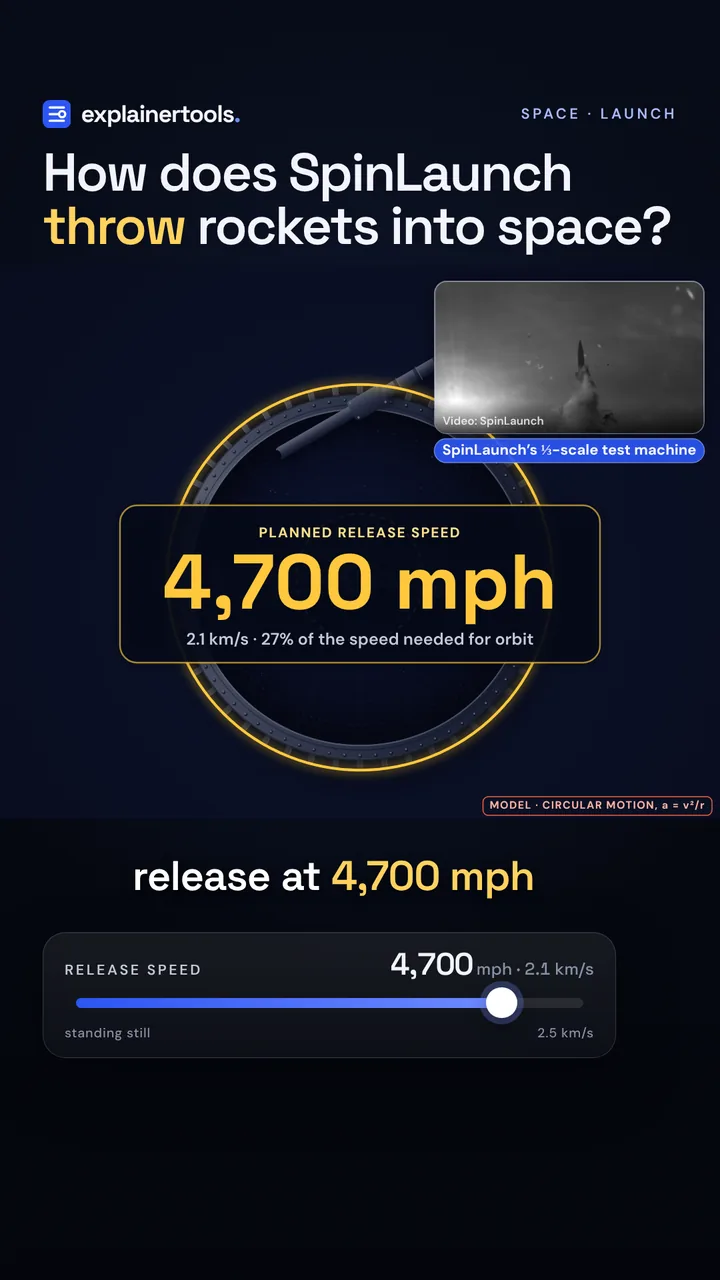
Spin a payload on a 46 m arm to 4,700 mph, then let go. See why the g-force grows with the square of the speed, and what the air does at Mach 6.
Created by ExplainerTools.
About this explainer
- Made by
- ExplainerTools
- Format
- Interactive demo
- Subject
- Engineering
- Where it runs
- Plays here
- Full tool
- Open the tool page
- Published
- Added to collection
- SpinLaunch
- rockets
- centripetal force
- g-force
- kinetic launch
How the model works
SpinLaunch doesn’t light a fire to leave the ground. It spins a projectile on an arm inside a vacuum chamber and lets go at thousands of miles an hour. So what does that spin do to the payload?
- Release speed50 m/s → 2.5 km/s
- Arm radius25 cm → 500 m
- Payload mass1 kg → 400 kg
Circular motion, a = v²/r, on an assumed 46 m arm (SpinLaunch has not published the arm length); steady load at full speed. Ignores the arm’s own mass, the climb through the air and the rocket’s drag and gravity losses.
Model notes and sources
Model. A payload of mass m rides at the tip of an arm of radius r, moving at speed v. Holding it on the circle takes an inward acceleration a = v²/r; the g-load is a / 9.80665 m/s². The spin rate is v / (2πr) × 60 rpm, and the pull on the arm is F = m·v²/r, shown in tonnes-force. Each kilogram leaves with v²/2 of kinetic energy (2.2 MJ at 2.1 km/s). At the exit, the air load is the dynamic pressure q = ½ρv², with ρ = 1.07 kg/m³ (the US Standard Atmosphere at about 1.4 km, the height of Spaceport America), shown in atmospheres (101,325 Pa); Mach = v / 340 m/s. “Speed for orbit” compares the release speed with 7.8 km/s.
The planned machine. SpinLaunch says its orbital accelerator would release at up to 4,700 mph (2.1 km/s) inside a vacuum chamber about 100 m across, with payloads built for up to about 10,000 g; the projectile’s own rocket would ignite at about 60 km and supply the rest of the speed. SpinLaunch has not published the arm’s length, so the 46 m arm here is our assumption (it fits inside a 100 m chamber). With it, the model gives about 9,780 g, 436 rpm and a pull of about 1,960 tonnes-force on a 200 kg payload, about 4.4 times the 447.7 t maximum takeoff weight of a Boeing 747-8. Half the speed gives a quarter of the g-load (about 2,440 g). Keeping a 2.1 km/s throw at 1,000 g would take an arm about 450 m long; at 100 g, about 4.5 km. The air at the exit presses about 23 atm on the nose at Mach 6.2.
The marks on the g-meter. Fighter pilots: about 9 g sustained, with a g-suit and straining. Washing machine: our example of a 1,400 rpm spin cycle on a drum of 25 cm radius (36.7 m/s), which gives 549 g. SpinLaunch: its stated 10,000 g. HARP gun: the 16-inch gun of the 1960s High Altitude Research Project fired at 2,164 m/s with up to 15,000 g at launch, about the same speed as SpinLaunch’s planned release.
Limits. The g-load is the steady load at full speed; the push along the circle while spinning up is small by comparison. The model ignores the arm’s own mass (which the arm must also hold against the spin), the counterweight, the time spent in the tube, the slowing and heating as the projectile climbs through the air, and the extra speed the rocket must make up for drag and gravity. The pressure right at a blunt nose is higher than q. The drawing is rescaled to fit, and the spin is shown slowed down by the factor on the stage.
Why it’s hard. The g-force grows with the square of the speed and falls only in proportion to the arm’s length, so a fast throw on a short arm is brutal: electronics can be hardened like artillery parts, but people can’t ride it. And all of that speed meets the thick air near the ground at once.
The pictures. Everything on the stage is drawn in code from the model. In the film, the opening shot (a projectile bursting through the launch tube’s membrane) and one picture-in-picture insert (the 33 m test machine, then a launch) are short excerpts of SpinLaunch test-flight video, picture only and credited on screen. Between them, the same test machine at Spaceport America, New Mexico, is drawn at dawn in slow motion, and the release is shown in slow motion where the stage says so. SpinLaunch flew 10 test flights from this machine from October 2021 (the first at 20% power) to September 2022, reaching about 30,000 ft; Flight Test 10 carried payloads from NASA, Airbus US, Cornell and Outpost. In September 2026 its planned Meridian satellite constellation split from SpinLaunch.
Neal Stephenson. On Core Memory, Neal Stephenson recalled the Slingatron, a spiral-track accelerator from the 1990s: “it’s a big gun, basically.” And “all big gun systems have got problems … around what happens when you meet the atmosphere.”
Sources: SpinLaunch (Wikipedia: 33 m test machine, test flights, 4,700 mph, 10,000 g, ignition near 60 km, payload mass, Meridian); Keeptrack, SpinLaunch deep dive (100 m chamber, 200–400 kg payloads); Meridian Space, Meridian splits from SpinLaunch; Space.com, Slingatron (Derek Tidman); Wikipedia, G-force (pilots sustain about 9 g); Wikipedia, Martlet 2 (the HARP 16-inch gun: 2,164 m/s, 15,000 g); Wikipedia, Boeing 747-8 (987,000 lb, 447.7 t maximum takeoff weight); Wikipedia, Spaceport America (elevation 1,401 m); US Standard Atmosphere; Neal Stephenson with Ashlee Vance, Core Memory episode 94 (chapter at 1:13:43) and the episode page.
An ExplainerTools Original. Concept from Neal Stephenson’s conversation with Ashlee Vance on Core Memory (episode 94, October 2026).
Watch it move
- How does SpinLaunch throw rockets into space?36-second Short
Explore interactive ideas in space, science, math, and more. Try a demo, read an interactive article, watch a short video, and follow what makes you curious.
New Originals
Change one thing and see why.
The three newest models, each with a short film. Watch the question, then play with the answer.
Follow your curiosity
A collection of small doors into big ideas.
Format
Swipe or scroll for more formats →
Subject
Swipe or scroll for more subjects →
Topic
Swipe or scroll for more topics →
Sort by
Rankings count activity here on ExplainerTools. Newest means added to this collection.
Loading collection…
Make something click.
Made an explainer, or found one you love? Give it a place in the collection.