Science · Interactive demo
Do your fingers ever really touch?
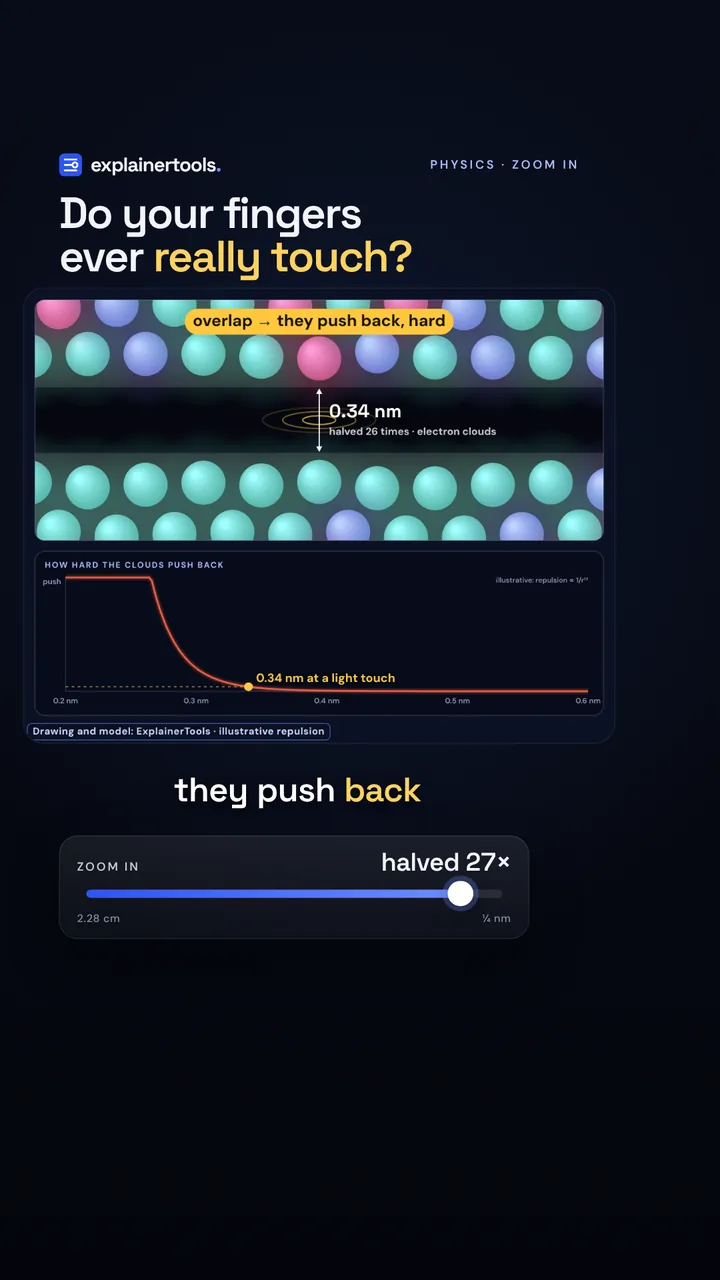
Zoom in on the gap between two fingertips, halving it 26 times: Zeno’s halving can’t keep them apart, but electron clouds stop at about a third of a nanometre.
Created by ExplainerTools.
About this explainer
- Made by
- ExplainerTools
- Format
- Interactive demo
- Subject
- Science
- Where it runs
- Plays here
- Full tool
- Open the tool page
- Published
- Added to collection
- physics
- atoms
- zeno's paradox
- infinite series
- scale
- touch
How the model works
A viral film halves the gap between two fingertips 26 times and says it never closes. Is that Zeno’s paradox, or physics?
- Zoom in2.28 cm → electron clouds
- Press harderlight touch → 20× harder
A schematic zoom built from typical sizes (fingertip curvature, ridges, flat skin cells, keratin fibres, atoms); the gap halves from 2.28 cm until it reaches a contact distance of 0.34 nm (two carbon atoms’ van der Waals radii); the push-back is an illustrative 1/r^13 repulsion.
Model notes and sources
Where this comes from. In November 2026 a 3D film by An Xuan (@anxuanng on X) went viral with more than 18 million views. It starts with two fingertips 2.28 cm apart and halves the gap 26 times, past fingerprint ridges, skin cells, keratin and atoms. It ends at 0.332 nm with “The gap never closes. Electrons push back.” A community note on the post points out that it mixes two separate ideas. This tool pulls them apart.
Idea 1: halving forever (Zeno). Zeno of Elea’s dichotomy paradox says that to cross a gap you must first cross half of it, then half of what is left, and so on forever, so you can never arrive. The answer from mathematics is that the halves add up: ½ + ¼ + ⅛ + … = 1 exactly. Moving at a steady speed, each half also takes half as long, so infinitely many steps take a finite total time (the gap divided by the speed). Halving cannot keep two fingers apart. The bar under the drawing shows the halves filling the gap.
Idea 2: electrons push back (physics). What actually stops the gap is the atoms themselves. Every atom is wrapped in a cloud of electrons. When the clouds of two atoms start to overlap, they repel very steeply, because of the Pauli exclusion principle (no two electrons can share the same state) and the electrical repulsion between the clouds. So two surfaces stop when their outermost atoms sit about the sum of their van der Waals radii apart: about 0.34 nm for two carbon atoms (1.70 Å each), about 0.24 nm for two hydrogen atoms (Bondi, 1964). Physicists and chemists call that contact. It is what touching is, so in that sense your fingers do touch.
The model. The gap starts at 2.28 cm, the film’s starting gap, and halves with the zoom (gap = 2.28 cm ÷ 2n) until it reaches the contact distance, 0.34 nm, about 26 halvings in, where it stops. “Press harder” multiplies the push by up to 20. The model uses an illustrative repulsion that grows as 1/r13, the steepness of the Lennard-Jones repulsive term, so 20 times the push only squeezes the gap to about 0.27 nm. The real force between skin surfaces depends on the molecules, water and oils in the way. The drawing is schematic, built from typical sizes, not a measurement of one finger: fingertips about 8 mm in radius, ridges about 0.45 mm apart, flat dead skin cells about 35 µm across and 0.5 µm thick, keratin fibres about 10 nm, atoms about 0.3 nm apart. Real fingertips also touch only at the tops of the ridges and of the cells, so the true area in contact is a small fraction of what it looks like.
The film. The opening shot and the electron-cloud shot are short excerpts from An Xuan’s film, credited on screen. The zoom drawings, the Zeno bar and the repulsion chart are drawn in code by ExplainerTools.
Sources: N. Huggett, “Zeno’s Paradoxes”, Stanford Encyclopedia of Philosophy; A. Bondi, “van der Waals Volumes and Radii”, J. Phys. Chem. 68, 441 (1964); R. P. Feynman, The Feynman Lectures on Physics, vol. I, ch. 1 (“Atoms in motion”); Wikipedia, “Pauli exclusion principle” and “Lennard-Jones potential”; An Xuan, the film on X (November 10, 2026).
An ExplainerTools Original. Inspired by An Xuan’s film (@anxuanng on X).
Watch it move
- Do your fingers ever really touch?58-second Short
Go deeper
- Do your fingers ever really touch?Topic guide
- Do your fingers ever really touch?Journal
Explore interactive ideas in space, science, math, and more. Try a demo, read an interactive article, watch a short video, and follow what makes you curious.
New Originals
Change one thing and see why.
The three newest models, each with a short film. Watch the question, then play with the answer.
Follow your curiosity
A collection of small doors into big ideas.
Format
Swipe or scroll for more formats →
Subject
Swipe or scroll for more subjects →
Topic
Swipe or scroll for more topics →
Sort by
Rankings count activity here on ExplainerTools. Newest means added to this collection.
Loading collection…
Make something click.
Made an explainer, or found one you love? Give it a place in the collection.