Topic guide · Chips in space
Why can Google’s AI chip in orbit only run in bursts?
Partly because of heat. Space is cold but almost empty, so there is no air to carry a chip’s heat away. It can only leave as infrared light glowing from a radiator, and a small radiator glows away less heat than a hard-working chip makes. The extra heat soaks into the metal until the chip reaches its temperature limit and must stop and cool. NPR reported that the chips on Google’s first Project Suncatcher satellite run a Gemma model for about 15 minutes at a time because of heat-management constraints. In Orbit Chip Lab, an illustrative satellite tuned to that figure, a 300 W chip on a 0.5 m² radiator runs 15 minutes per burst; twice the power cuts each burst to about 4 minutes, and a radiator four times bigger lets it run nonstop.
- Each burst, 300 W chip
- 15 min
- Twice the power
- ≈ 4.3 min
- Radiator glow at 60 °C
- ≈ 590 W/m²
- Nonstop at 600 W
- ≈ 1.4 m² of radiator
Model · lumped thermal, illustrative satellite One temperature for the chip, heat pipes and radiator; a white radiator (emissivity 0.85) glowing from one face; a 60 °C limit and a 30 °C restart, in sunlight. Tuned so the 300 W burst matches the 15 minutes reported for Google’s prototype; Google hasn’t published its chips’ power or radiator size.
Interactive · ExplainerTools
Orbit Chip Lab
Turn up the chip’s power from 10 W to a 50 kW rack, grow the radiator from 0.2 to 200 m², and change how long each orbit spends in Earth’s shadow. Watch the temperature climb to the limit over one 95-minute orbit, and the bursts shrink, stretch or vanish.
Model · lumped thermal, illustrative satellite
Where does a chip’s heat go in orbit?
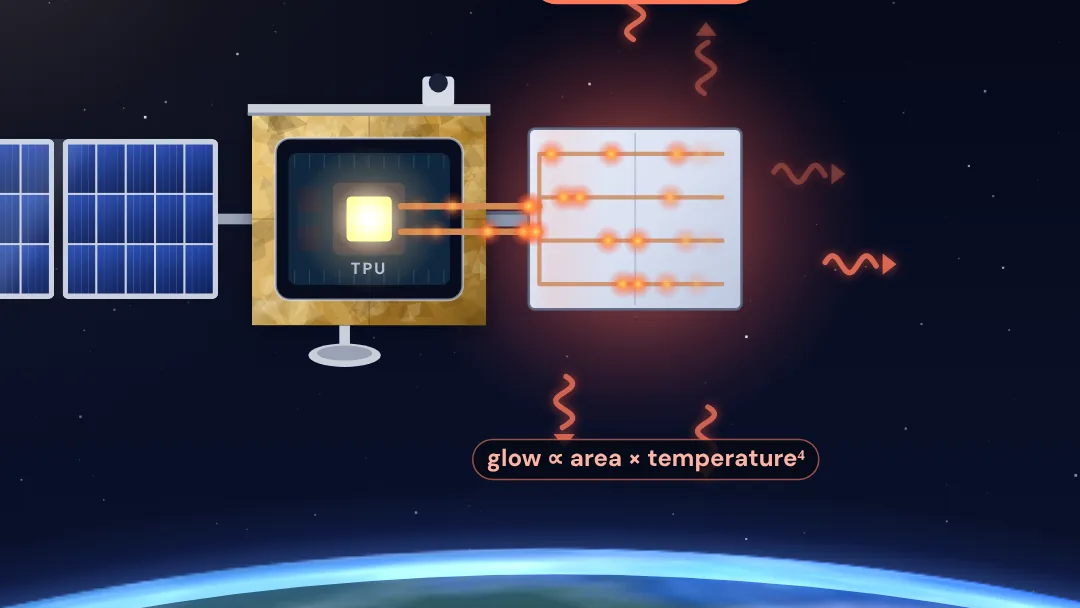
On Earth, a hot chip hands its heat to the air: a fan pushes cool air across metal fins and carries the warm air away. In orbit there is almost no air. A fan has nothing to push, and the vacuum around a satellite insulates it, like the walls of a vacuum flask. So the heat takes a longer road.
- Make
A computing chip turns nearly all the power it draws into heat, in a patch the size of a fingernail.
- Carry
Heat pipes or a pumped liquid loop carry that heat out of the satellite’s body to a radiator, a flat panel that faces open space.
- Glow
The radiator sheds the heat as infrared light, the way a stovetop glows, only too dim for eyes to see.
- Soak in
If the chip makes heat faster than the radiator glows it away, the extra soaks into the metal of the chip, pipes and panel, and the temperature climbs until the chip has to stop.
That last step is the burst. A radiator that can keep up lets the chip run nonstop. One that can’t gives it a time budget: run until the metal reaches the limit, then rest while the radiator catches up.
How much heat can a radiator glow away?
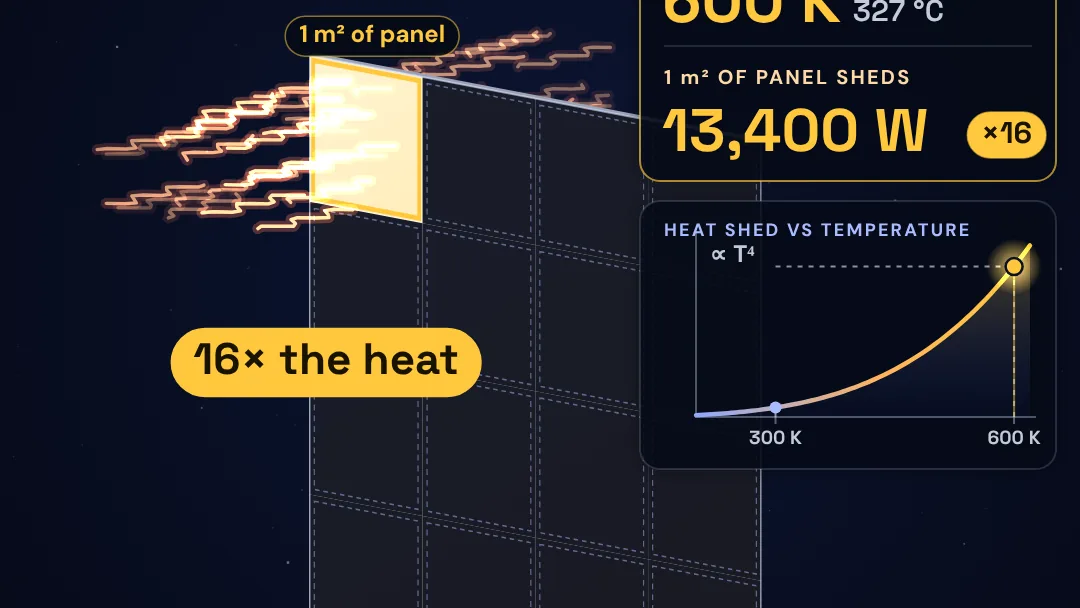
Less than you might think. Every surface glows in the infrared, and the Stefan–Boltzmann law says how much: in proportion to its area and to its temperature to the fourth power, counted from absolute zero. A white radiator panel at 30 °C glows away about 410 watts per square metre; at 60 °C, about 590. Hotter helps a lot, since doubling the absolute temperature would multiply the glow 16 times, but a chip can’t run very hot. In sunlight the panel also soaks up some light from the Sun and Earth; the model assumes 150 W per square metre.
So the model’s 0.5 m² radiator, about the size of a doormat, can glow away at most about 220 W before it reaches the 60 °C limit. Give it a 300 W chip and the chip outpaces the radiator by about 80 to 170 W, depending on how hot the panel already is. That surplus heats the metal from the 30 °C restart to 60 °C in 15 minutes. The radiator then needs about 11 minutes in sunlight to cool it back down, or 8.5 minutes in Earth’s shadow, where it soaks up less light.
Double the chip to 600 W and the surplus more than doubles, so each burst shrinks to about 4.3 minutes, while the cool-down takes as long as before. Over a 95-minute orbit with 35 minutes in shadow, the chip computes about 65 minutes at 300 W and only 31 at 600 W. A radiator that can shed the chip’s whole output at 60 °C, about 0.7 m² for 300 W or 1.4 m² for 600 W, lets it run nonstop.
What did Google’s satellite actually do?
Project Suncatcher is Google Research’s long-shot study of AI computing in space. Its 2025 design paper, by Travis Beals, imagines clusters of satellites carrying Google’s TPU chips in a dawn–dusk orbit, where solar panels get nearly constant sunlight; it lists thermal management among the unsolved challenges. The first prototype, built with Planet and carrying four TPUs, launched on SpaceX’s Transporter-18 rideshare on October 1, 2026. It flies in a standard orbit and uses batteries, NPR reported, and its chips run a Gemma model for 15 minutes at a time because of heat-management constraints. Beals told NPR the radiators are one of the heaviest components on the mission, and every kilogram has to be launched.
On October 30, Google said Gemma 4, running on one of those TPUs, sent back its first complete answer from orbit: a haiku that begins “Blue marble below.” TechCrunch reported that power demands allow only one TPU on at a time, for about 20 minutes, so power limits the runs too. Google hasn’t published the chips’ power draw, the radiator’s size or the temperature limits.
Try it: turn up the power
- 1 See
Open Orbit Chip Lab and tap Suncatcher-like: 15-min bursts. Each burst (in sunlight) reads 15 min, Cool-down to 30 °C 11 · 8.5 min and Computing per orbit 65 of 95 min. If it never stopped, the chip would settle at 80 °C, over the limit.
- 2 Change
Tap Twice the power. Each burst falls to 4.3 min, the cool-down stays the same, and computing drops to 31 of 95 min. Then tap Bigger radiator: 2 m²: the same 600 W chip settles at 38 °C and runs nonstop. Or drag the radiator’s edge on the stage.
- 3 Understand
Tap Data-centre rack: 40 kW. On the small radiator a burst lasts 3 s; to run nonstop it would need about 90 m² of radiator. Then try Always in sunlight: with no shadow to cool in, the 300 W chip computes 58 of 95 min instead of 65.
Where does this model stop?
Orbit Chip Lab is an illustrative satellite, not Google’s. Google hasn’t published the numbers that would set the real burst length, so the model picks a 300 W chip, a 0.5 m² radiator and a heat capacity that together give the reported 15 minutes. It shows why heat alone produces bursts, not the prototype’s real values.
One temperature stands for the whole heat path; a real chip runs tens of degrees hotter than its radiator, and heat pipes have limits of their own. The sunlight and Earth light the radiator soaks up are two fixed numbers, not a calculation of the satellite’s attitude or the eclipse geometry. The rest of the satellite is assumed to shed its own heat, and batteries, solar power and ground-station passes are left out. Very large chips on small radiators reach temperatures no hardware would survive; the model just keeps counting. The film uses two short clips, credited on screen: the launch from Google’s post and the haiku arriving from Sundar Pichai’s post; everything else is drawn from the model.
Explore by question
A chip makes heat, pipes carry it, a radiator glows it away. Each card answers one part of the question.
Orbit Chip Lab
Model · lumped thermal, illustrative satellite
 Interactive · Orbit Chip LabWhy can Google's AI chip in orbit only run in bursts?Turn up the chip’s power or grow the radiator, and watch the temperature climb to the limit and the bursts shrink or vanish.
- Short · 42 secondsWhy can Google's AI chip in orbit only run in bursts?The launch, the haiku, a fan with nothing to push, and the burst shrinking as the power goes up. Narrated and captioned.
- JournalWhy can Google's AI chip in orbit only run in bursts?Google’s AI chip in orbit wrote a haiku, but reportedly runs only about 15 minutes at a time. In a vacuum heat leaves only as infrared glow, and a small radiator can’t keep up.
How radiators shed heat
The deeper heat question: why a vacuum makes cooling hard, why the glow grows with temperature to the fourth power, and why spacecraft radiators are big.
 Interactive · Space Radiator LabIf space is so cold, why is cooling a spacecraft so hard?Change the heat to dump and the radiator’s size, and see the temperature a spacecraft’s radiator settles at.
Moving heat away from a chip
Before a radiator can glow, the heat has to get there. Phones and satellites both use the same boil-and-condense trick.
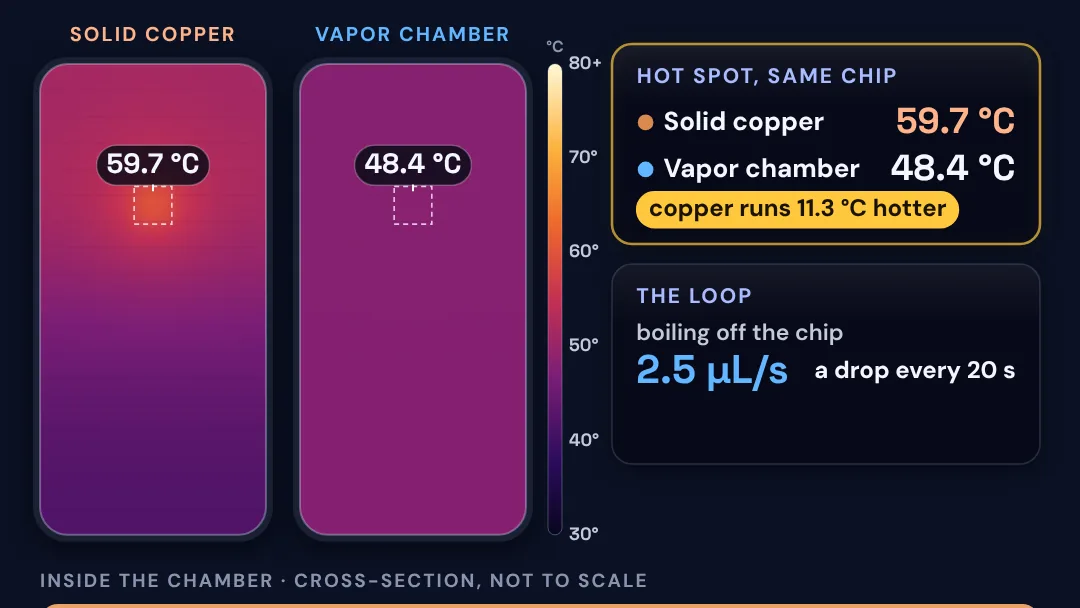 Interactive · Vapor Chamber LabHow can a few drops of liquid cool a phone?Turn a phone chip up to a 13 W burst and watch a vapor chamber spread its heat until the wick runs dry.
- Short · 43 secondsHow can a few drops of liquid cool a phone?Real iPhones in infrared and the loop inside a vapor chamber. Narrated and captioned.
The same glow, a whole planet, and Earth’s shadow
Earth also cools only by glowing infrared into space, and a satellite in low orbit passes in and out of Earth’s shadow.
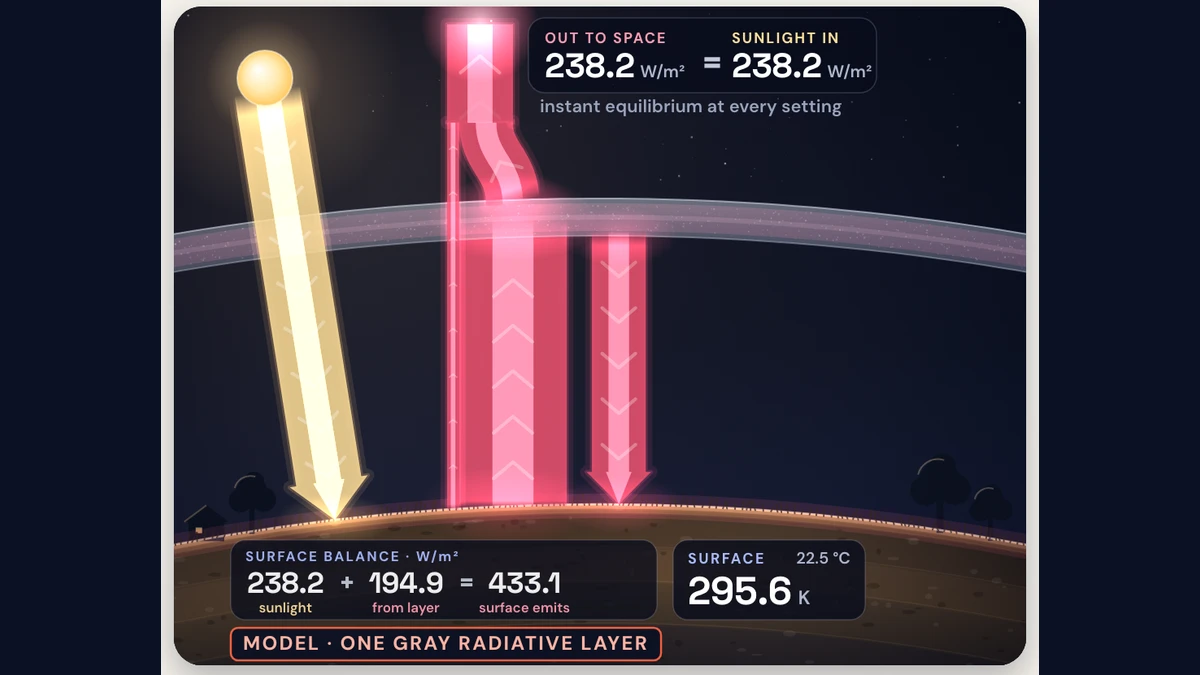 Interactive · Greenhouse BalanceWhy does the ground stay warm?Follow the sunlight in and the infrared out, and see what sets a planet’s temperature.
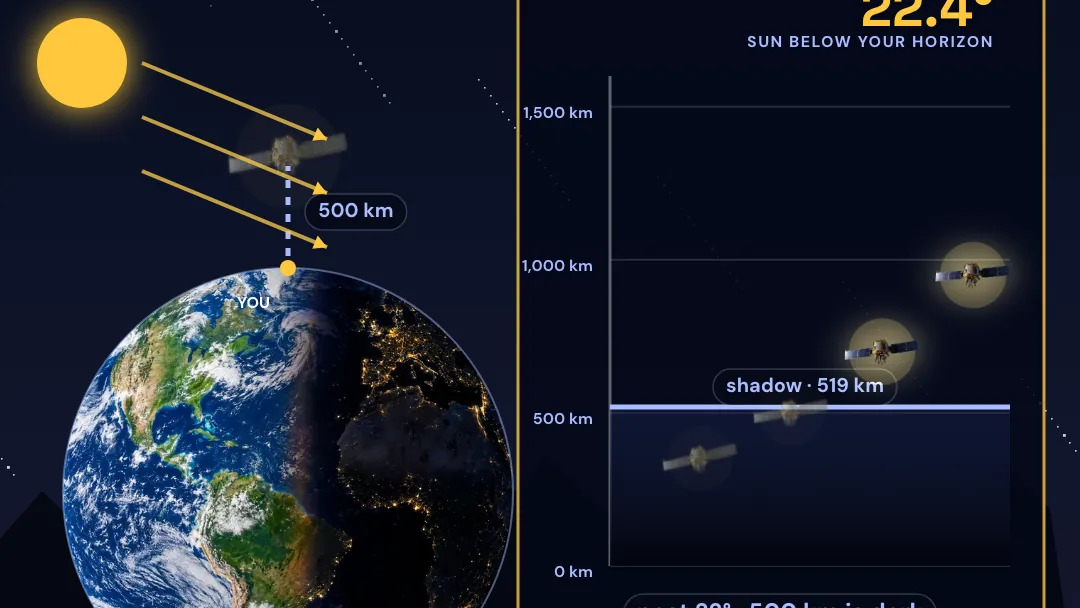 Interactive · Satellite DuskWhy do you mostly see satellites just after sunset?Move the Sun below the horizon and watch Earth’s shadow climb past a 500 km satellite.
Common questions
If space is so cold, why does a chip overheat there?
Because space is cold but almost empty. Cold air cools a chip on Earth by touching it and carrying the heat away. In orbit there is nothing to touch, so heat can leave only as infrared light from a radiator. A radiator at 60 °C glows away only about 590 W per square metre, so a small one can’t keep up with a busy chip.
Why not just add a fan or liquid cooling?
A fan needs air to push, and there is almost none. Liquid loops and heat pipes do work in space, and satellites use them, but they only move heat to the radiator. In the end the radiator still has to glow it all away.
Does Earth’s shadow help?
In the model, yes. In shadow the radiator soaks up less light, so it cools the chip from 60 to 30 °C in about 8.5 minutes instead of 11. A 300 W chip computes about 65 minutes of a 95-minute orbit with 35 minutes of shadow, and 58 if it never leaves the sunlight. Google’s long-term plan uses a dawn–dusk orbit with nearly constant sunlight, which helps the solar panels more than the radiators.
How big a radiator would a data-centre rack need?
In the model, a 40 kW rack would need about 90 m² of radiator glowing from one face at 60 °C, about a third of a tennis court. On the small 0.5 m² radiator, it would reach the limit in about 3 seconds. That is why space data centres are as much a radiator problem as a power one.
Is heat really what limits Google’s chip?
It is one limit. NPR reported that the chips run for 15 minutes at a time because of heat-management constraints. TechCrunch reported that power demands allow only one TPU on at a time, for about 20 minutes. Google hasn’t published the details, so the tool shows the heat side only.
Sources and credits
- Google Research · Exploring a space-based, scalable AI infrastructure system design (Travis Beals, November 4, 2025) Project Suncatcher’s design: TPU satellites in a dawn–dusk sun-synchronous orbit, prototypes with Planet, and thermal management listed among the open challenges.
- NPR · Google launches Project Suncatcher, a step towards AI data centers in space October 1, 2026, corrected October 2: four TPUs built with Planet, a standard orbit with batteries, Gemma runs of 15 minutes at a time because of heat, and radiators among the heaviest components.
- Google · Project Suncatcher’s first response from orbit October 30, 2026: Gemma 4 on an orbiting TPU sends back its first complete answer, a haiku.
- TechCrunch · Google’s first data center satellite is online and writing poetry October 30, 2026: power demands allow only one TPU on at a time, for about 20 minutes.
- Wikipedia · Stefan–Boltzmann law Radiated power per square metre is emissivity × σ × T⁴, with σ = 5.67 × 10⁻⁸ W/m²K⁴.
- Orbit Chip Lab · model notesThe equation, every assumed value, how the burst was tuned to 15 minutes, and what the model leaves out.
Every creator named here made the work we link to. Listing it does not imply a partnership or endorsement.