Space · interactive
If space is so cold, why is cooling a spacecraft so hard?
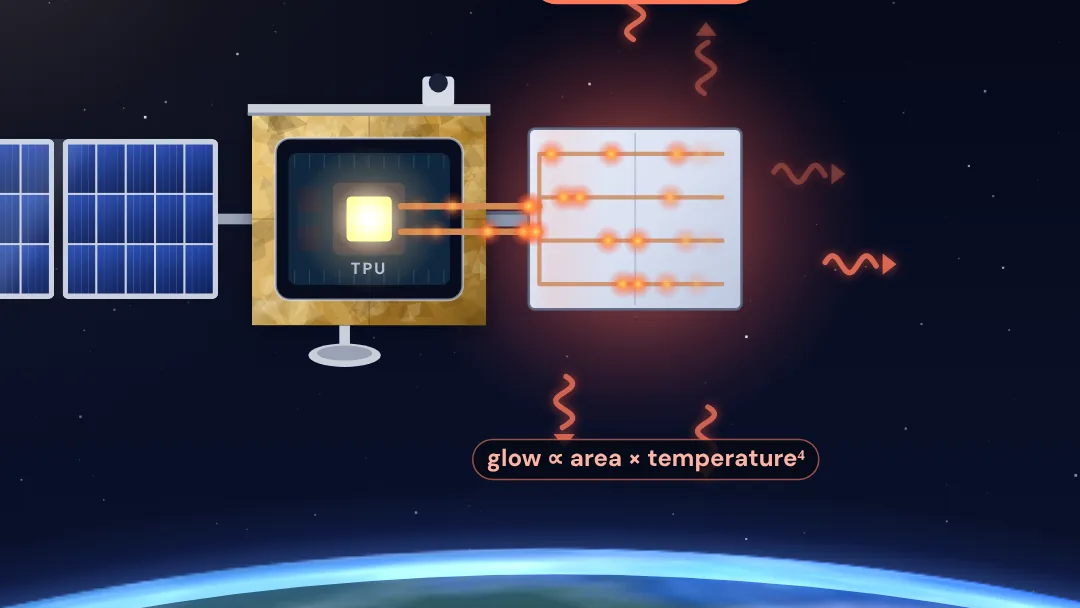
A radiator in deep space, in false colour: its size is set by the heat it must dump and how hot it runs. Drag along the curve to change the temperature, or turn the panel toward the Sun.
1 See
Deep space is about −270 °C, yet a spacecraft overheats unless it carries big white radiators. There is no air to carry its heat away, so the heat has to leave as light. If space is so cold, why is cooling a spacecraft so hard?
2 Change
3 Understand
Model notes and sources
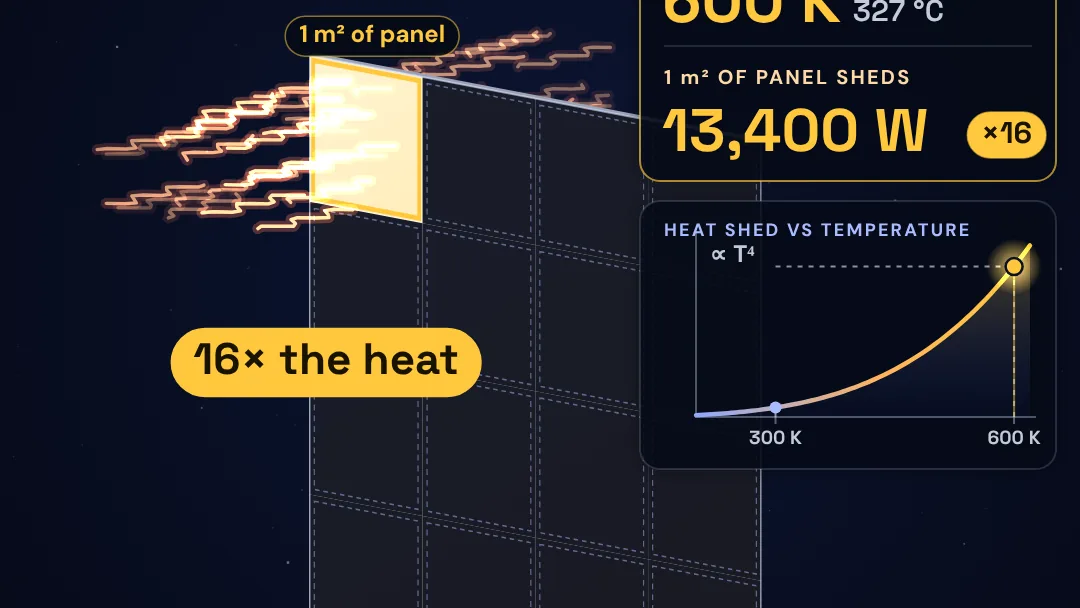
Model. A flat panel in deep space radiates from both faces as a grey body: qout = 2εσ(T4 − Tbg4) watts per square metre of panel, with σ = 5.670 × 10⁻⁸ W/m²·K⁴ (the Stefan–Boltzmann constant), T the panel's absolute temperature and Tbg = 2.7 K the cosmic background. The coating is a white thermal-control paint with infrared emittance ε = 0.91 and solar absorptance α = 0.15 (AZ-93; the space station's radiators are painted with the similar Z-93). Sunlight of 1,361 W/m² falls on one face at angle β to the panel's plane and adds α × 1,361 × sin β. The net heat shed per square metre is q = qout − α × 1,361 × sin β, and a radiator that must dump Q watts at temperature T needs A = Q / q. At 300 K (27 °C) a square metre sheds about 836 W; at 600 K about 13,400 W, sixteen times as much, because 24 = 16. A 1 GW load at 300 K needs about 1.2 km².
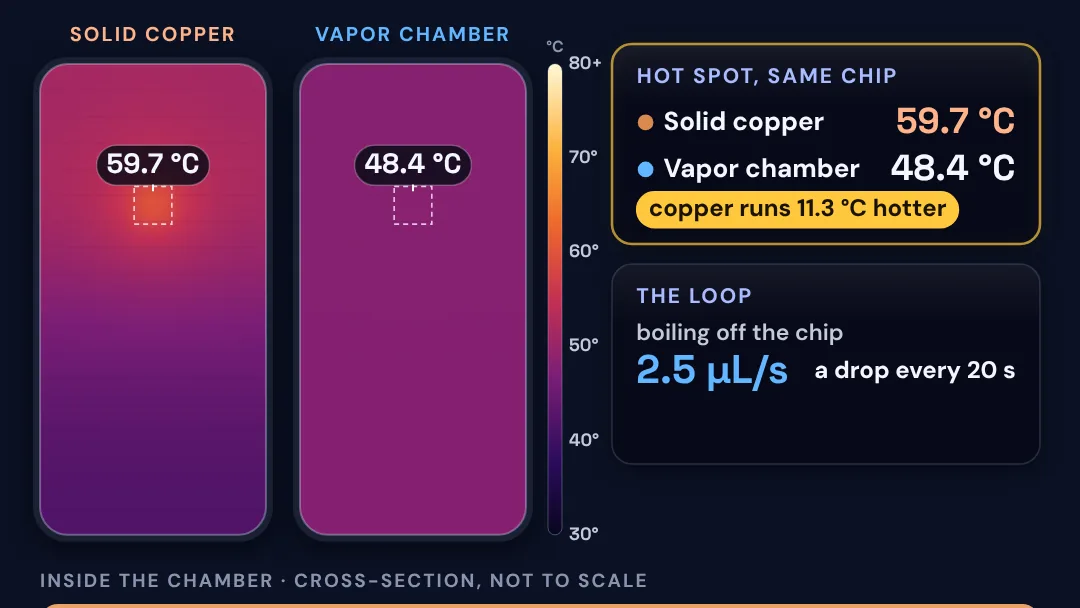
Why it's hard. A vacuum has almost no molecules, so heat can't be conducted or carried away by moving air or water, the way a fan or a cooling tower does it on Earth. That is also how a vacuum flask works. Heat can leave only as infrared light from surfaces that see the cold sky, and at temperatures electronics can stand (processor limits are usually 100–110 °C, and the radiator must be cooler than the electronics for heat to flow to it) that is a few hundred to about a thousand watts per square metre. So radiators are big, painted white so sunlight warms them little, and turned edge-on to the Sun. A panel can't be folded into a compact heat sink either: fins that face each other only trade light. Spacesuits and the Space Shuttle also dumped heat by letting water evaporate into space, but that uses up water.
The space station. NASA's External Active Thermal Control System rejects up to 70 kW through two ammonia loops and six radiators, each eight panels long and 23.3 m × 3.4 m, painted white with Z-93 and turned edge to the Sun in daylight; the ammonia leaves the radiators as cold as −40 °C. A doubles tennis court is 23.77 m long. The station's radiators total about 475 m² per face, about three times this deep-space model's 153 m² for 70 kW, because in low orbit the warm Earth fills much of each panel's sky and adds its own infrared and reflected sunlight, the panels run cold, and they are sized for the hottest orbits.
A debate on X. On 2–3 November 2026 a debate on X about data centres in space, started by Utrecht University professor Jan Broersen, who called them nearly impossible to build, turned on cooling. Elon Musk wrote that about 1,300 W/m² is easily achievable for an aluminium radiator pointed away from the Sun, and that solar panels, at about 250 W/m², would need about five times the radiator's area. In this model, 1,300 W per square metre of panel means a panel at about 62 °C radiating from both faces, or about 125 °C from one. The film doesn't take a side: it shows what the numbers depend on.
The pictures. Everything on the stage is drawn in code; the infrared colours are false colour, since a panel at these temperatures doesn’t glow visibly. In the film the satellite, the air molecules, the thermos and the station are drawn too (the station’s layout is schematic; its truss, solar wings, radiators and the tennis court are to scale), and the spacecraft’s warmth gauge is illustrative. The film also uses four short pieces of real footage, picture only, each credited on screen: two shots of the space station filmed from the departing Crew-2 Dragon on 8 November 2021, one against black space and one showing its radiators over the ocean (NASA, SpaceX Crew-2 Flight Day 3 Highlights), and two thermal-camera clips from a TikTok by @ivy_doll_too, in which a hairdryer’s hot air and then a heat lamp’s light warm a clipboard. The numbers come from the model.
Presets. A laptop: 50 W with the panel at 45 °C (illustrative). The station: 70 kW (NASA) with the panel at −15 °C, an assumed average between its warm inlet and the −40 °C outlet goal. A server rack: 40 kW at 40 °C, an illustrative high-density rack. 1 GW at 27 °C, a round number for a very large data centre. Facing the Sun turns the panel face-on and keeps the other settings.
Limits. The panel is one temperature all over (real panels cool along the coolant's path), has no Earth below it, and sees only deep space and, if turned, the Sun. It ignores the heat pumps, pumps and pipes that move heat to the panel, and the solar panels that power everything. Real radiators near Earth need more area than this model says.
Sources: NASA, Active Thermal Control System (ATCS) Overview (70 kW; radiator size, Z-93 coating, edge to Sun); NASA NTRS, ISS radiator face sheet paper (six radiators of eight panels, Z93 paint); NIST, Stefan–Boltzmann constant; NASA Goddard, CMB intensity (COBE FIRAS: 2.725 K); Modus Advanced, AZ-93 white thermal control paint (α 0.15, ε 0.91); Intel, Information about temperature for Intel processors (junction limits usually 100–110 °C); ITF, Rules of Tennis (court 23.77 m); BigGo Finance, Musk pushes back on space data center cooling doubts; Wccftech, Elon Musk defends space AI satellites (3 Nov 2026); Wikipedia, Stefan–Boltzmann law and Spacecraft thermal control.
An ExplainerTools Original.