Skip to the interactive
ExplainerTools Watch the 42-second film

Space · interactive

Why can Google's AI chip in orbit only run in bursts?

Model · lumped thermal, illustrative satellite

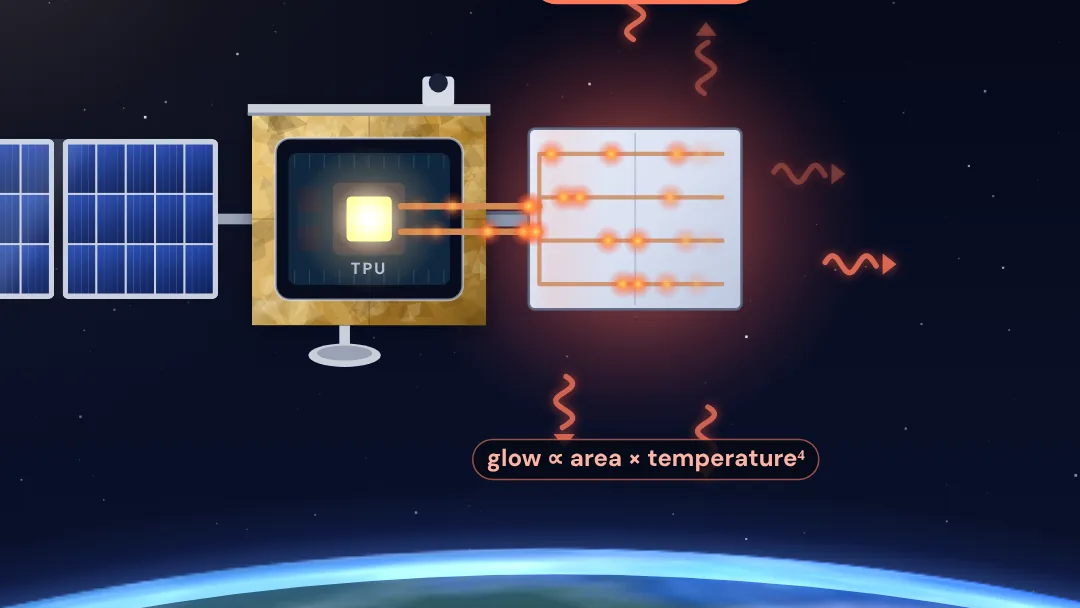
Top: an illustrative satellite; heat pipes carry the chip's heat to a white radiator, which glows it away as infrared. Bottom: its temperature over one 95-minute orbit. Drag the radiator's edge to resize it.

1 See

Google ran Gemma 4 on a TPU in orbit, and it wrote a haiku. But its chips reportedly run only about 15 minutes at a time. Why can Google's AI chip in orbit only run in bursts?

2 Change

3 Understand

The 42-second film · Watch with transcript
Watch the 42-second film
Model notes and sources

Model. One temperature T stands for the chip, its cold plate, the heat pipes and the radiator: C dT/dt = P − A(εσT4 − q). P is the chip's power while it computes, all of which becomes heat. The radiator of area A glows from one face with emissivity ε = 0.85 (white radiator paint) and σ = 5.67 × 10⁻⁸ W/m²K⁴, so each square metre glows away about 410 W at 30 °C and 590 W at 60 °C. q is the sunlight and Earth light the radiator soaks up: 150 W/m² in sunlight and 60 W/m² (Earth's infrared only) in Earth's shadow, both assumed. The heat capacity C = 1,430 J/K plus 4,400 J/K per m² of radiator (about 1.6 kg of aluminium for the chip, cold plate and pipes, plus a 4.9 kg/m² panel) was tuned so that a 300 W chip on a 0.5 m² radiator, starting at 30 °C in sunlight, reaches the 60 °C limit in 15.0 minutes, the burst length reported for Google's prototype. The chip stops at 60 °C and starts again once the radiator has cooled it to 30 °C. An orbit takes 95 minutes, with up to 36 minutes in Earth's shadow at 500 km (the Earth's shadow control).

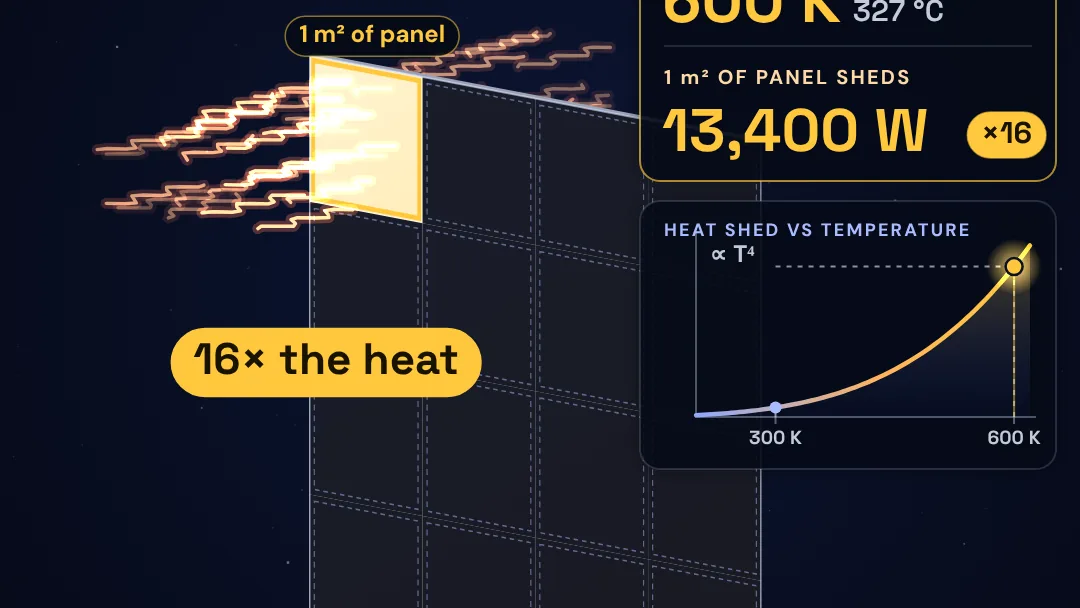
Why bursts. In a vacuum no air touches the chip, so fans and convection do nothing; heat leaves only as infrared light from the radiator, εσT4 per square metre. If the chip makes more heat than the radiator can glow away below the limit (here at most 222 W for 0.5 m² at 60 °C, against 300 W), the surplus warms the metal and the temperature climbs. A burst lasts roughly CΔT ÷ (P − the heat radiated): double the power to 600 W and it falls from 15 to 4.3 minutes, while the cool-down (about 11 minutes in sunlight, 8.5 in shadow) stays the same. A radiator big enough to shed P at 60 °C, P ÷ 443 W/m² in sunlight, lets the chip run nonstop: 0.68 m² for 300 W, 1.4 m² for 600 W, and about 90 m² for a 40 kW data-centre rack, a third of a tennis court. Google lists thermal management among the significant engineering challenges that remain, and Travis Beals, who leads Project Suncatcher, told NPR the radiators are among the heaviest components of the current mission.

Google's satellite. Project Suncatcher, announced by Google Research on 4 November 2025, studies constellations of solar-powered satellites carrying TPUs in a dawn–dusk sun-synchronous orbit with nearly constant sunlight. Its first prototype, built with Planet and carrying four TPUs, launched on SpaceX's Transporter-18 rideshare on 1 October 2026; it flies in a standard orbit and uses batteries. NPR reported that its chips run a Gemma model for 15 minutes at a time because of heat-management constraints. On 30 October 2026 Google said Gemma 4, running on an orbiting TPU, sent back its first complete answer, a haiku. TechCrunch reported that power demands allow only one TPU on at a time, for about 20 minutes, so power limits the runs too. Google has not published the chips' power, the radiator's size or the temperature limits, so the satellite here is illustrative: it shows why heat alone produces bursts, not this satellite's real numbers.

Limits. One temperature stands in for the whole heat path; a real chip runs tens of degrees hotter than its radiator, and heat pipes have limits of their own. The surroundings are two fixed numbers rather than a calculation of the satellite's attitude, Earth's reflected light or the eclipse geometry. The rest of the satellite is assumed to shed its own heat, and batteries, solar power and ground-station passes, which also limit real runs, are left out. The radiator's mass grows with its area, but launch cost is not modelled. Above a few square metres the drawing is not to scale, and very large chips reach temperatures no real hardware would survive; the model just keeps counting.

The pictures. The satellite, Earth, fans and graphs are drawn in code. The film also shows two short real clips, picture only, each credited on screen: the Falcon 9 launch of 1 October 2026 from Google's post (@Google), and the ground-station terminal as Gemma's haiku arrives, from Sundar Pichai's post of 30 October 2026 (@sundarpichai). The numbers come from the model.

Sources: Google Research, Exploring a space-based, scalable AI infrastructure system design (Travis Beals, 4 Nov 2025); NPR, Google launches Project Suncatcher, a step towards AI data centers in space (1 Oct 2026, corrected 2 Oct); Google, Project Suncatcher's first response from orbit (30 Oct 2026); TechCrunch, Google's first data center satellite is online and writing poetry (30 Oct 2026); Wikipedia, Stefan–Boltzmann law and Spacecraft thermal control.

An ExplainerTools Original. Film footage: @Google (the launch) and @sundarpichai (the haiku arriving).
Learn more

Learn more about cooling in orbit

This model shows why a small radiator turns computing into bursts. The guide adds how much a radiator can glow away, what Google’s satellite reported, and where the model stops.

Keep exploring

Up next

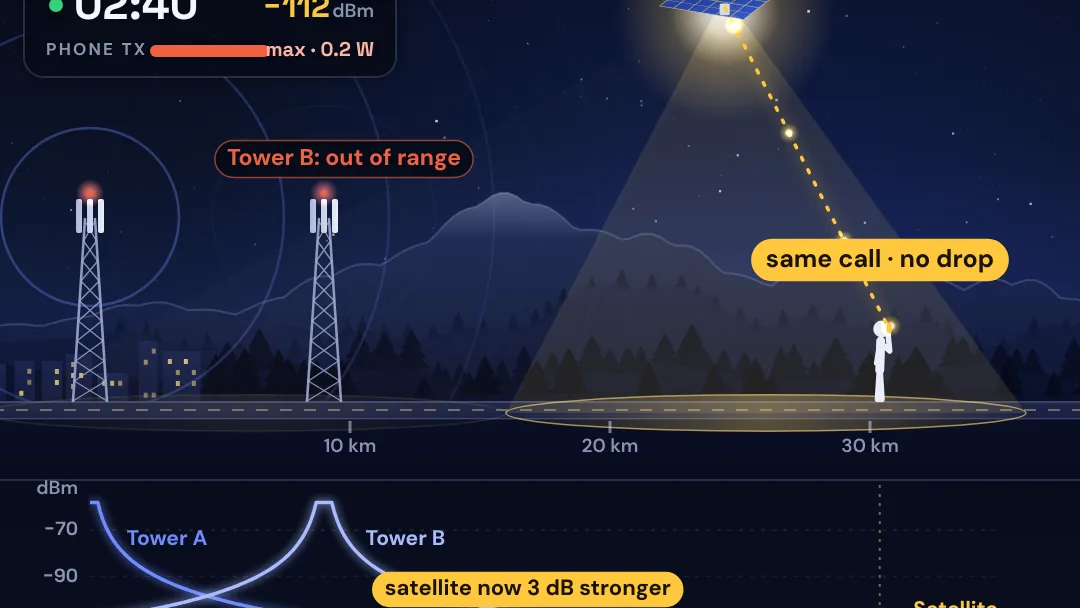
  1. Interactive · EngineeringHow can your phone hop from a cell tower to a satellite mid-call?
  2. Interactive · EngineeringHow can a few drops of liquid cool a phone?
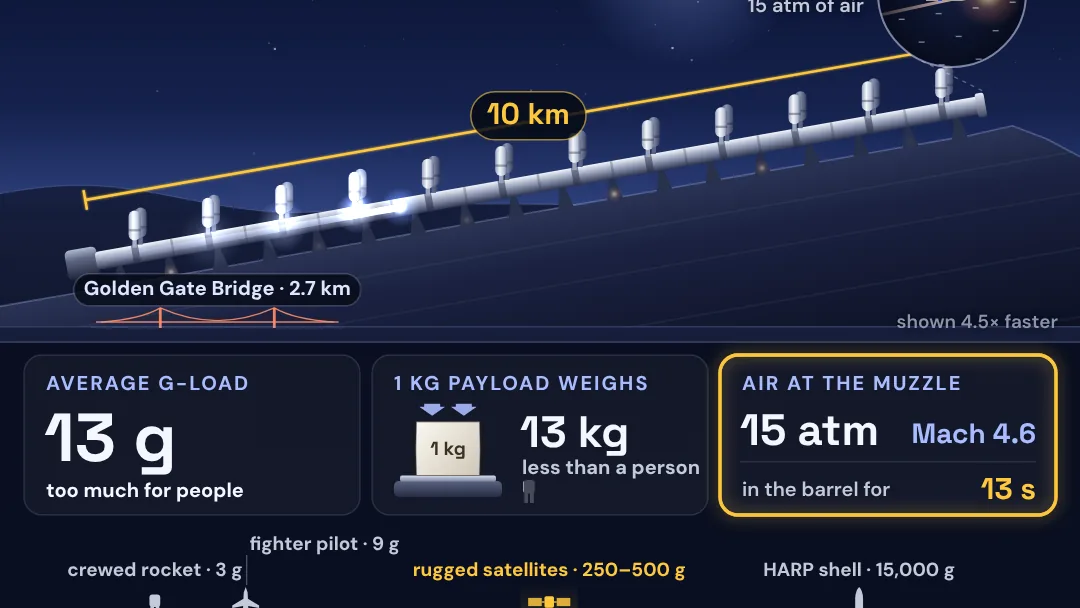
  3. Interactive · EngineeringWhy build a 10 km space gun?

Behind the film

Concepts in this film

The ideas the film moves through, with this model’s numbers, the research behind each one and where else it comes up.

All concepts, A to Z

Heat balance

A chip in orbit holds a steady temperature only if its radiator glows heat away as fast as the chip makes it. The tool’s white radiator sheds εσT4, about 590 W per square metre at the 60 °C limit, but soaks up 150 W/m² of sunlight and Earth light, so a 0.5 m² panel can dump at most 222 W against the chip’s 300 W. The other 78 W has nowhere to go but into the metal. A radiator of P ÷ 443 W/m² keeps up: 0.68 m² for 300 W, 1.4 m² for 600 W, about 90 m² for a 40 kW data-centre rack.

Related research Spacecraft thermal control (Wikipedia)NPR, Google launches Project Suncatcher, a step towards AI data centers in space (2026)

See also Space Radiator Lab: why the glow grows as T⁴Greenhouse Balance: the ground’s own heat balanceWhy are AI data centers using so much electricity? by TED-Ed

Heat capacity

Heat capacity is the energy it takes to warm something by one degree, so it sets how long spare heat can soak in before the limit. The model lumps the chip, cold plate, heat pipes and radiator into one block of about 3,630 J/K for a 0.5 m² radiator, roughly 1.6 kg of aluminium plus a 4.9 kg/m² panel, tuned so a 300 W chip takes the 15 minutes NPR reported to climb from 30 to 60 °C. That climb stores about 109 kJ. At 600 W the surplus is about three and a half times bigger, and the same 109 kJ fills in 4.3 minutes.

Related research Heat capacity (Wikipedia)Thermal mass (Wikipedia)

See also Vapor Chamber Lab: soaking up heat without warmingSpace Radiator Lab: how big a radiator must be

Duty cycle

A duty cycle is the share of time something is switched on. Here the chip stops at 60 °C and starts again once the radiator has cooled it to 30 °C, about 11 minutes later in sunlight, so a 300 W chip computes 15 minutes out of every 26, 58% of the time. At 600 W it runs 4.3 minutes out of 15, 28%, and the average heat stays at about 170–175 W either way: over each cycle the radiator must shed everything the chip makes. Laptop and phone chips do a gentler version, slowing down near their limit, usually 100–110 °C for Intel processors.

Related research Intel, Information about temperature for Intel processorsDuty cycle (Wikipedia)

See also Space Radiator Lab: a radiator big enough to run nonstopPhone cooling: how a vapor chamber cools a phoneWhy are AI data centers using so much electricity? by TED-Ed

Heat pipe

A heat pipe is a sealed tube with a wick and a little fluid inside: the fluid boils at the hot end, the vapour rushes to the cold end and condenses, and the wick pulls the liquid back with no pump. It moves heat far better than a solid copper rod of the same size, which is why satellites and laptops use heat pipes to carry a chip’s heat out to a radiator or fins; in orbit the wick also does the job gravity can’t. In the tool the pipes are lumped in with the chip and radiator as one temperature. In a real satellite the chip runs tens of degrees hotter than its radiator, and a pipe pushed past its limit dries out.

Related research Heat pipe (Wikipedia)

See also Vapor Chamber Lab: a flat heat pipe in a phoneVapor Chamber Lab: when the wick runs drySpace Radiator Lab: the space station’s pumped ammonia loops

Dawn–dusk orbit

A sun-synchronous orbit passes near the poles and slowly turns to keep pace with the Sun, so the satellite crosses each place at the same local time every day. Line it up over the boundary between day and night and the satellite rides that line in near-constant sunlight: Google’s Suncatcher design would fly there, to keep its solar panels lit and cut the need for heavy batteries. The first prototype flies in a standard orbit instead and uses batteries: at 500 km an orbit takes 95 minutes, up to 36 of them in Earth’s shadow. In the tool the shadow cuts the light the radiator soaks up from 150 to 60 W/m², so a resting chip cools from 60 to 30 °C in 8.5 minutes instead of 11.

Related research Google Research, Exploring a space-based, scalable AI infrastructure system design (Travis Beals, 2025)Sun-synchronous orbit (Wikipedia)

See also Satellite Dusk: when Earth’s shadow reaches a satelliteSpace Mirror Lab: still sunny 600 km up after sunsetNewton’s Cannon: why satellites don’t fall down

About this tool

Why can Google's AI chip in orbit only run in bursts?

Turn up an orbiting AI chip’s power and watch a small radiator fall behind: the heat soaks in, it hits the limit, and computing comes in bursts.

Subject
Engineering
Topics
space · satellites · AI chips · heat · radiators · data centers
Published
In the catalog
Why can Google's AI chip in orbit only run in bursts?

The same idea, by other creators