Topic guide · Sunlight from orbit
Can a mirror in space light up the night?
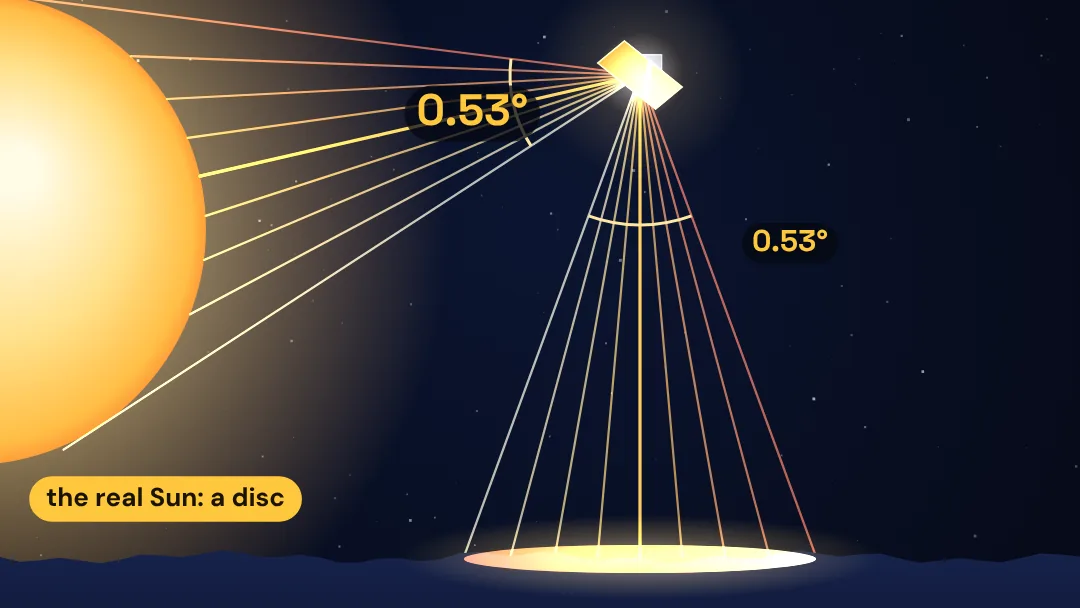
Yes, a patch of ground about 5.6 km wide, for a few minutes at a time, and no brighter than a few full moons for the mirror being tested. After sunset, a satellite 600 km up is still in sunshine, and a tilted mirror can send that light down. But the Sun is a disc about 0.53° wide, so a flat mirror’s reflection spreads at that angle and lands about 5.6 km across, whatever the mirror’s size. A bigger mirror only puts more light into the same spot: in our model about 0.84 lux for the 18 m test mirror Reflect Orbital got permission to launch in 2026, and about 7.4 lux, like a lit street, for the 54 m mirrors it plans. Each mirror passes in about 4 minutes, and astronomers estimate the glow would spread for kilometers.
- Spot from 600 km
- ≈ 5.6 km
- 18 m test mirror
- 0.84 lux ≈ 3 full moons
- 54 m planned mirror
- 7.4 lux ≈ a lit street
- One pass overhead
- ≈ 4 min
Model · flat mirror, 0.53° Sun, no clouds A flat mirror straight overhead under a clear sky. Spot = mirror size + altitude × tan 0.53°; light = 100,000 lux × 0.9 reflectivity × cos 45° × mirror area ÷ spot area. A pass counts the minutes the mirror is more than 30° up in the spot’s sky.
Interactive · ExplainerTools
Space Mirror Lab
Grow a mirror in orbit from 1 m to 100 m, raise it from 300 to 2,000 km, or aim up to 20,000 mirrors at one spot. Watch the spot on a desert valley stay the same width and only get brighter.
Model · flat mirror, 0.53° Sun, no clouds
How does a mirror in orbit light the ground?
In three steps, and the third one sets the size of the spot.
- Still sunny
After sunset your ground is in Earth’s shadow, but a satellite 600 km overhead stays in sunshine until the Sun is about 24° below your horizon. That is why you see satellites shine after dusk.
- Tilt
At dusk the sunlight reaches the satellite sideways. A flat mirror turned about 45° sends it straight down.
- Spread
Sunlight comes from a disc about 0.53° wide, not from a point. So the reflection spreads at 0.53° on the way down and lands as a spot.
A flat mirror works like a pinhole: each point of the Sun’s disc sends its own ray, and after the mirror those rays arrive at slightly different places. The spot is an image of the Sun. From 600 km it is 600 km × tan 0.53° ≈ 5.6 km across, plus the width of the mirror itself, a few dozen meters at most. A bigger mirror makes the image brighter, not smaller. Only a curved mirror or a lower orbit could shrink it.
How bright would the spot be?
The light that lands is the sunlight the mirror catches, spread over the spot. Direct sunlight at the ground is about 100,000 lux. An aluminized film reflects about 90%, and a mirror turned 45° to the sideways dusk sunlight catches about 71% of what it would face-on. Divide by the spot’s 25 km² and an 18 m mirror gives about 0.84 lux. A full moon high in a clear sky gives about 0.26 lux, so that is about 3 full moons.
The 54 × 54 m mirrors Reflect plans to build toward have nine times the area, so about 7.4 lux, close to a lit residential street (European road-lighting class P3 asks for 7.5 lux). A cloudy day is roughly 1,000 lux or a few times that: in the model, 400 of the 54 m mirrors on one spot give about 3,000 lux. Matching direct sunlight would take about 13,500.
Not everyone agrees on the first number. Reflect says its test mirror would give about the light of a full moon. Kocifaj, Bakos and Kundracík estimate about four full moons, and about 9.5 lux for a 54 m mirror. Our model, a perfectly flat mirror straight overhead, falls between the two.
How long can one mirror light a spot?
A few minutes. At 600 km a satellite moves at about 7.6 km/s and laps Earth every 96.5 minutes. It is more than 30° up in a spot’s sky for only about 4 minutes; lower than that it is farther away, so its light spreads thinner. Reflect says each pass of its demonstration would last up to about five minutes, within two hours of sunset.
For light without gaps, a new mirror has to arrive every 4 minutes: about 24 spaced around one orbit. Earth turns under that orbit, so lighting a place for hours takes many such orbits. That is why the company talks of thousands of satellites, and eventually up to 50,000.
What is Reflect Orbital doing, and why do astronomers object?
Reflect Orbital, a startup in Hawthorne, California, says it wants to sell sunlight after dark: to solar farms after sunset, to rescue crews and disaster zones, and to work sites. The US Federal Communications Commission approved its first demonstration satellite, Eärendil-1, in July 2026: an 18 × 18 m mylar mirror, meant for an orbit about 600 km up. As of late October 2026 it had not launched. The company has tested a small mirror under a hot-air balloon by day, and in October 2026 staged a night mock-up near Mount Whitney with ground spotlights, not mirrors.
Air scatters part of every beam, so the glow spreads beyond the spot. For one 54 m mirror, Kocifaj and colleagues estimate a sky brighter than a full-moon night out to about 14 km, and for 400 mirrors on one spot a glow visible from 80 km. The American Astronomical Society and dark-sky groups also warn of eye damage to people looking through telescopes and of bright moving points across the sky. Reflect says it will light only approved sites, keep light away from observatories and protected habitats, switch the light off quickly and turn idle mirrors edge-on, and it disputes some of the study’s assumptions.
Try it: grow the mirror
- 1 See
Open Space Mirror Lab and tap Reflect’s 18 m test mirror. Spot width reads 5.6 km and Brightness 0.84 lux, about 3 full moons. Each pass lasts 4.1 min.
- 2 Change
Tap Planned 54 m mirror. The spot stays 5.6 km wide; the brightness rises to 7.4 lux, like a lit street. Now tap Higher orbit: 1,200 km: the 18 m mirror’s spot doubles to 11 km and the light falls to 0.21 lux.
- 3 Understand
Tap 400 mirrors on one spot: about 3,000 lux, a cloudy day. Then Daylight? 13,500 mirrors reaches sunlight. For non-stop light shows how many mirrors that needs in orbit when each one passes in 4 minutes.
Where does this model stop?
Space Mirror Lab assumes a perfectly flat mirror straight above the spot, a clear sky and the Sun on the horizon. A thin film that wrinkles or sags spreads the light wider and dimmer. Lower in the sky the mirror is farther away and the spot stretches: at 30° up it gets about a sixth of the light. Later after sunset the mirror has to turn further and catches a little less. Haze, pointing errors and the light scattered into the sky are left out.
The valley is an invented desert map, and the side view draws the cone 40 times wider than 0.53° so it shows; the map from above is to scale. The film uses short, credited excerpts of Reflect Orbital’s balloon test (@bennbuilds on X; a daytime test, not from orbit) and satellite trails stacked from two hours of photos over Mt Taranaki (@blarsenphoto on TikTok); the valley, Earth, mirrors and numbers come from the model.
Explore by question
A space mirror needs sunlight above a dark sky, and its spot is an image of the Sun. Each card answers one part of the question.
Space Mirror Lab
Model · flat mirror, 0.53° Sun, no clouds
 Interactive · Space Mirror LabCan a mirror in orbit light up the night?Grow the mirror, raise the orbit or aim thousands of mirrors at one spot, and watch how wide and how bright the spot gets.
- Short · 45 secondsCan a mirror in orbit light up the night?A balloon test, the Sun’s half-degree disc, and a mirror growing over the same 5.6 km spot. Narrated and captioned.
- JournalCan a mirror in orbit light up the night?A startup wants to beam sunlight down after dark. The Sun’s half-degree disc spreads each mirror’s light into a spot nearly 6 km wide, so a bigger mirror only makes it brighter.
Why there is sunlight to catch after dark
The mirror works only while it is still in sunshine above your dark sky, and only while it flies fast enough to stay up.
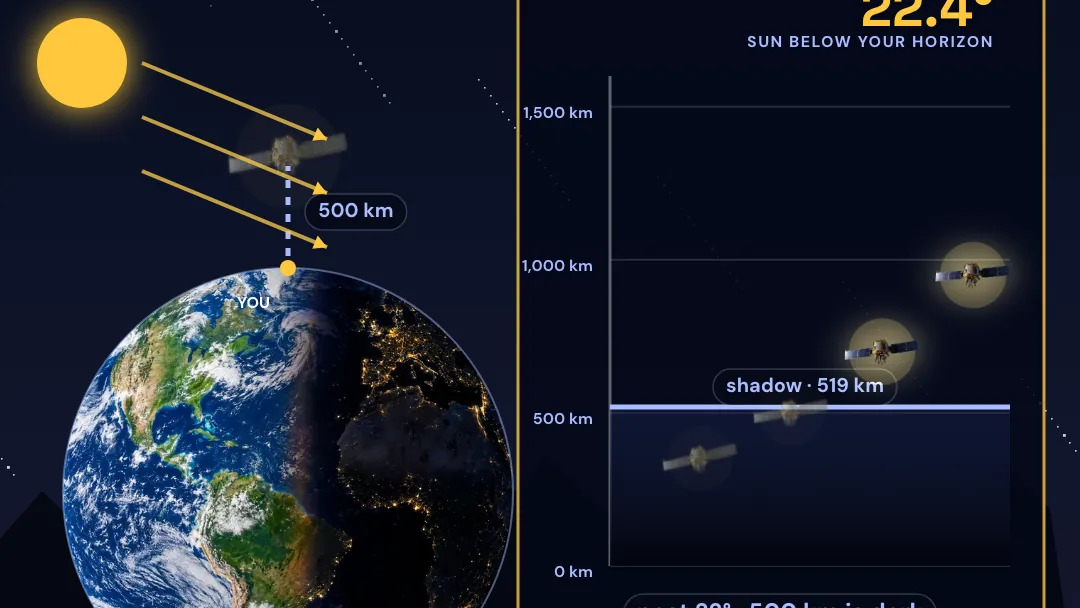 Interactive · Satellite DuskWhy do you mostly see satellites just after sunset?Move the Sun below the horizon and watch Earth’s shadow climb past a satellite in low orbit.
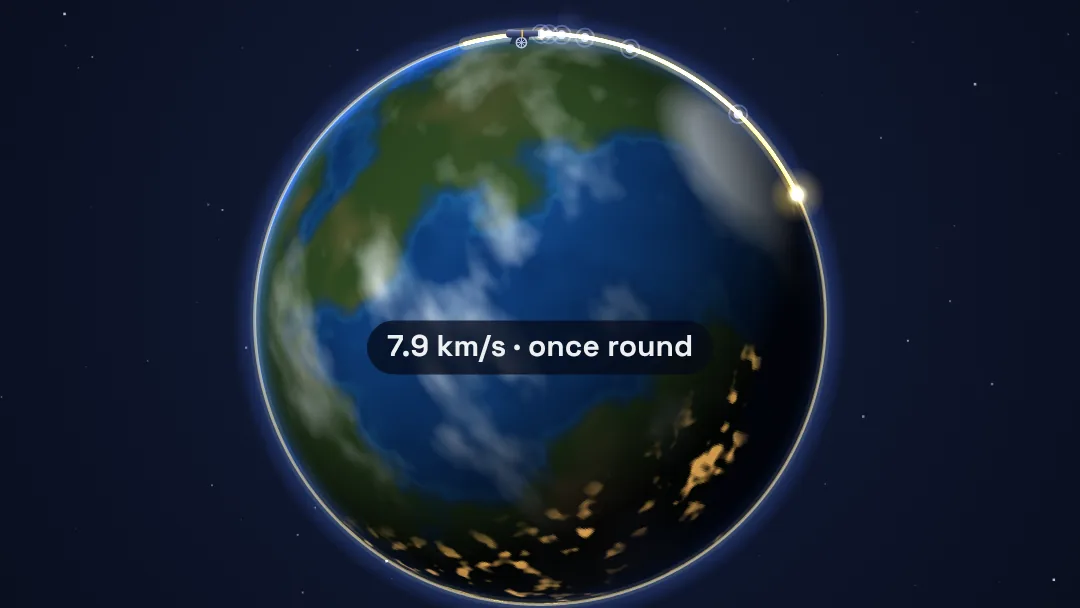 Interactive · Newton's CannonWhy don't satellites fall down?Fire Newton’s cannonball faster until the ground curves away as fast as it falls.
How a small opening makes an image
A flat mirror makes an image of the Sun the way a pinhole does, which is why its spot has a fixed size.
- Interactive articleCameras and LensesBartosz Ciechanowski’s interactive article on how cameras form images, from a simple pinhole to lenses.by Bartosz Ciechanowski
Common questions
Would a space mirror make night as bright as day?
Not one, or even hundreds. In our model Reflect’s 18 m test mirror gives about 0.84 lux and a 54 m mirror about 7.4 lux, while direct sunlight is about 100,000 lux. Matching sunlight on one spot would take about 13,500 of the 54 m mirrors at once.
Why can’t a bigger mirror make a smaller, brighter spot?
Because the Sun is a disc about 0.53° wide. A flat mirror’s reflection spreads at that angle, so from 600 km it lands about 5.6 km across whatever the mirror’s size. A bigger mirror only puts more light into the same spot. A curved mirror or a lower orbit could make the spot smaller.
How long can one satellite light a place?
About 4 minutes. At 600 km it moves at about 7.6 km/s and is more than 30° up in your sky for about 4 minutes of its 96.5-minute orbit. Reflect says its passes would last up to about five minutes. Light without gaps needs a new mirror every pass, about 24 around one orbit.
Has a mirror lit the ground from orbit yet?
Not as of late October 2026. The FCC approved Reflect Orbital’s 18 m demonstration satellite, Eärendil-1, in July 2026, but it had not launched. The company’s earlier tests used a small mirror under a hot-air balloon by day, and its October 2026 night demonstration near Mount Whitney used ground spotlights.
Why do astronomers object?
Air scatters part of the beam, so the glow spreads well beyond the spot: for one 54 m mirror, a sky brighter than a full-moon night out to about 14 km, by one 2026 estimate. Astronomers also warn of eye damage through telescopes and of bright moving lights crossing the sky. Reflect says it will avoid observatories, switch the light off quickly and turn idle mirrors edge-on.
Sources and credits
- Reflect Orbital · Reflect Orbital seeks collaboration with dark skies (2026) October 31, 2026: the company’s plan for its demonstration, passes of up to about five minutes within two hours of sunset at about full-moon brightness, and its mitigations for astronomers.
- arXiv · Atmospheric light pollution by proposed Reflect Orbital space mirrors (Kocifaj, Bakos and Kundracík, 2026) About 1.05 lux (four full moons) for an 18 m mirror and 9.5 lux for a 54 m one at 600 km; sky glow brighter than a full-moon night out to about 14 km, and visible from 80 km for 400 mirrors.
- Astronomy · FCC approves Reflect Orbital filing for mirror in space July 2026: the FCC approves Eärendil-1, an 18 × 18 m reflector with a 5 km beam, over objections from the American Astronomical Society and dark-sky groups.
- Space.com · Reflect Orbital just got permission to launch its 1st space mirror to orbit The approval, the company’s statement and an astronomer’s estimate of four times the full moon in the beam.
- MIT Technology Review · Space mirrors and the night sky (2026) The planned constellation of up to 50,000 mirrors of 54 × 54 m, the Kocifaj study and the company’s response.
- Payload · Reflect Orbital responds to its critics (2026) The company’s full-moon brightness figure, sites of about 6,000 acres, consent and exclusion zones, and edge-on idle mirrors.
- Space Mirror Lab · model notesThe spot and brightness equations, every constant and its source, the 30° pass, and what the model leaves out.
Every creator named here made the work we link to. Listing it does not imply a partnership or endorsement.