Topic guide · Cooling in space
If space is so cold, why is cooling a spacecraft so hard?
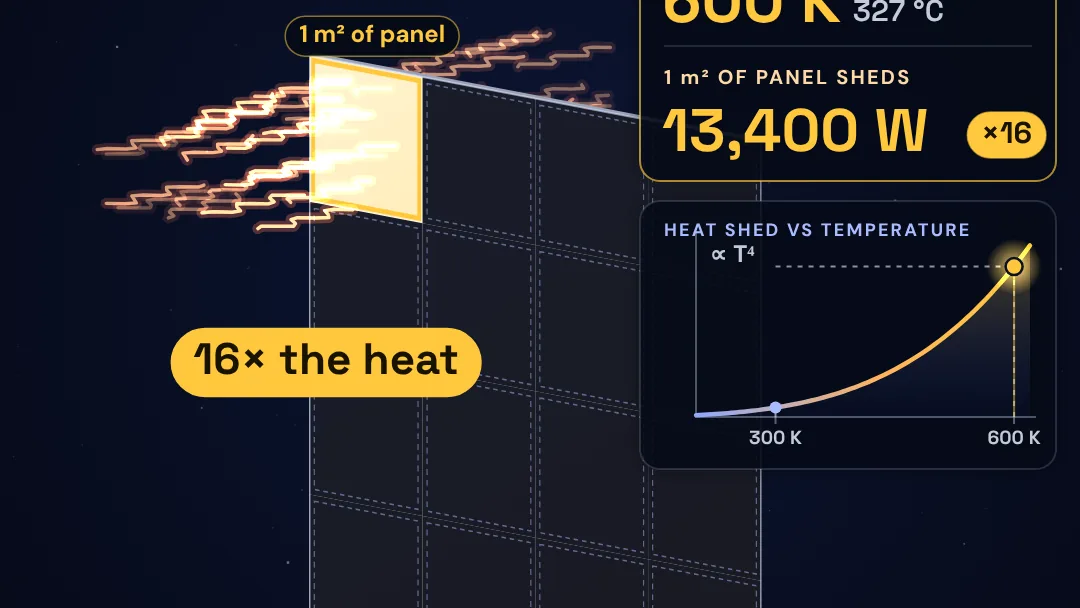
Because there is nothing to hand the heat to. Deep space is about −270 °C, but that is the glow of an almost empty sky, not something cold to touch. With no air or water flowing past, a spacecraft can’t carry heat away the way a fan or a radiator in a car does. The heat from its electronics, its crew and the sunlight on it can only leave as infrared light, from surfaces that see the sky. How much a surface sheds grows as the fourth power of its absolute temperature: in Space Radiator Lab, a square metre of white panel sheds about 840 W at 27 °C and 13,400 W at 327 °C. Electronics cook long before that, so radiators run cool, and big. NASA’s cooling system on the space station sheds up to 70 kW through six radiators, each 23.3 m long.
- Deep space’s glow
- 2.7 K, −270 °C
- 1 m² of panel at 27 °C
- ≈ 840 W
- Double the temperature
- 16× the heat
- 1 GW at 27 °C
- ≈ 1.2 km² of panel
Model · flat-plate radiator, Stefan–Boltzmann A white panel (infrared emissivity 0.91, solar absorptance 0.15) radiating from both faces into deep space, edge-on to the Sun, at one temperature all over, with no Earth below it.
Interactive · ExplainerTools
Space Radiator Lab
Change the radiator’s temperature from −73 °C to 347 °C, the heat it must dump from 10 W to 1 GW, and the sunlight on it. Watch the panel it needs grow or shrink beside a sheet of paper, a parking space or a soccer field drawn to the same scale.
Model · flat-plate radiator, Stefan–Boltzmann
How does a spacecraft get rid of heat?
Only one way works for long. Heat comes in from several places and has just one way out.
- Heat in
Every watt a spacecraft’s electronics use ends up as heat. Its crew, if it has one, adds more, and so does any sunlight it soaks up.
- No air
On Earth, air or water flows past a hot surface and carries heat off. In space there are almost no molecules, so nothing can. A vacuum is an insulator; it is the gap between the two walls of a vacuum flask.
- Light out
Every warm surface glows in infrared, and that light crosses a vacuum. A radiator is a big panel that glows the heat away into the cold, dark sky.
A loop of pumped fluid carries the heat from the electronics to the radiator. On the space station, water loops collect heat inside and hand it to two loops of liquid ammonia outside, which carry it to the radiators, NASA’s overview says. Spacesuits and the Space Shuttle could also let water evaporate into space to dump heat, but that uses up water, so it suits short jobs, not a station that stays up for years.
Why does a hotter radiator shed so much more?
Because the glow grows as the fourth power of temperature. The Stefan–Boltzmann law says a surface sheds power in proportion to T4, with T measured from absolute zero, in kelvin. Double the temperature and the glow is 24, sixteen times stronger. In Space Radiator Lab a square metre of white panel, radiating from both faces, sheds about 840 W at 300 K (27 °C) and about 13,400 W at 600 K (327 °C).
So why not run radiators hot? Because heat only flows from hot to cold, a radiator has to be cooler than the things it cools, and electronics cook at around 100 °C: Intel says its processors’ limits are usually between 100 and 110 °C. That keeps radiators down on the flat end of the curve, where each square metre sheds a few hundred to about a thousand watts. To dump the same heat at half the absolute temperature takes sixteen times the panel.
And the −270 °C? It is the temperature of the faint microwave glow that fills the sky, 2.725 K as NASA’s COBE satellite measured it. It matters because that sky sends almost nothing back: a radiator facing it keeps nearly all of the light it sheds. Near Earth, the planet fills much of the sky and sends back far more.
How big are real spacecraft radiators?
Big. NASA’s External Active Thermal Control System on the space station rejects up to 70 kW through six radiators, each eight panels long and 23.3 × 3.4 m, about as long as a tennis court. They are painted white with Z-93, a paint that glows well in the infrared but takes in little sunlight, and in daylight they are turned edge-on to the Sun; the ammonia comes back from them as cold as −40 °C. Its cousin AZ-93 absorbs about 15% of sunlight and has an infrared emittance of 0.91, the values the tool uses.
The station’s six offer about 475 m² a face, about three times what Space Radiator Lab asks for 70 kW at an assumed −15 °C. The model leaves out Earth: in low orbit the warm planet fills much of each panel’s sky with its own infrared and reflected sunlight, and the panels are sized for the hottest orbits.
Data centers in orbit make the problem bigger. In the model, a 1 GW data center with radiators at 27 °C needs about 1.2 km² of panel. In a debate on X in early November 2026, after Utrecht University professor Jan Broersen called space data centers nearly impossible to build, Elon Musk wrote that about 1,300 W/m² is easily achievable for an aluminum radiator pointed away from the Sun, and that solar panels would need about five times the radiator’s area. In the model, 1,300 W per square metre means a panel near 62 °C radiating from both faces, which cuts the gigawatt to about 0.77 km². Either way, the radiator is as big a part of the design as the power. Orbit Chip Lab shows what happens when one is too small.
Try it: heat the radiator
- 1 See
Open Space Radiator Lab and tap Server rack · 40 kW. At 40 °C, Each m² of panel sheds reads 991 W, so Radiator needed reads 40 m², about 3 parking spaces.
- 2 Change
Drag Radiator temperature to 600 K (327 °C), or drag along the curve. Each m² of panel sheds reads 13,400 W, Compared with 27 °C reads ×16, and the radiator shrinks to 3.0 m², about 2 doors. Electronics couldn’t run that hot.
- 3 Understand
Tap Server rack · 40 kW again, then Facing the Sun. The white paint soaks up 204 W per square metre, the panel sheds 786 W net, and the rack needs 51 m². Then tap 1 GW data center: about 1.2 km², 168 soccer fields.
Where does this model stop?
Space Radiator Lab is one flat panel at one temperature, radiating from both faces into deep space. Real radiators cool along the path of their coolant, so they are warmer where the fluid comes in and colder where it leaves. The model has no Earth below the panel, which is why it asks for less area than the space station carries, and it sees the Sun only when you turn the panel toward it.
It also leaves out what it takes to move the heat: the pumps, pipes and heat exchangers between the electronics and the panel, and any heat pump that would let a radiator run hotter than the electronics, at the cost of more power and so more heat. It ignores the solar panels that power everything.
The film uses short NASA footage of the space station, filmed from the departing Crew-2 Dragon in 2021, and two thermal-camera clips by @ivy_doll_too on TikTok, credited on screen; the spacecraft, the air, the radiator and the numbers are drawn from the model. The spacecraft’s warmth gauge in the film is illustrative.
Explore by question
A spacecraft keeps cool by glowing its heat away. Each card answers one part of the question.
Space Radiator Lab
Model · flat-plate radiator, Stefan–Boltzmann
 Interactive · Space Radiator LabIf space is so cold, why is cooling a spacecraft so hard?Change a radiator’s temperature, the heat it must dump and the sunlight on it, and watch the panel it needs grow or shrink, drawn to scale.
- Short · 48 secondsIf space is so cold, why is cooling a spacecraft so hard?No air to carry the heat, one square metre heated to 600 K for 16 times the glow, and the space station’s tennis-court radiators. Narrated and captioned.
- JournalIf space is so cold, why is cooling a spacecraft so hard?Deep space is about −270 °C, yet the space station needs radiators as long as tennis courts. With no air to carry heat away, it can only leave as infrared light.
When the radiator is too small
Our sister Original on computing in orbit: a radiator that can’t keep up turns a steady load into bursts.
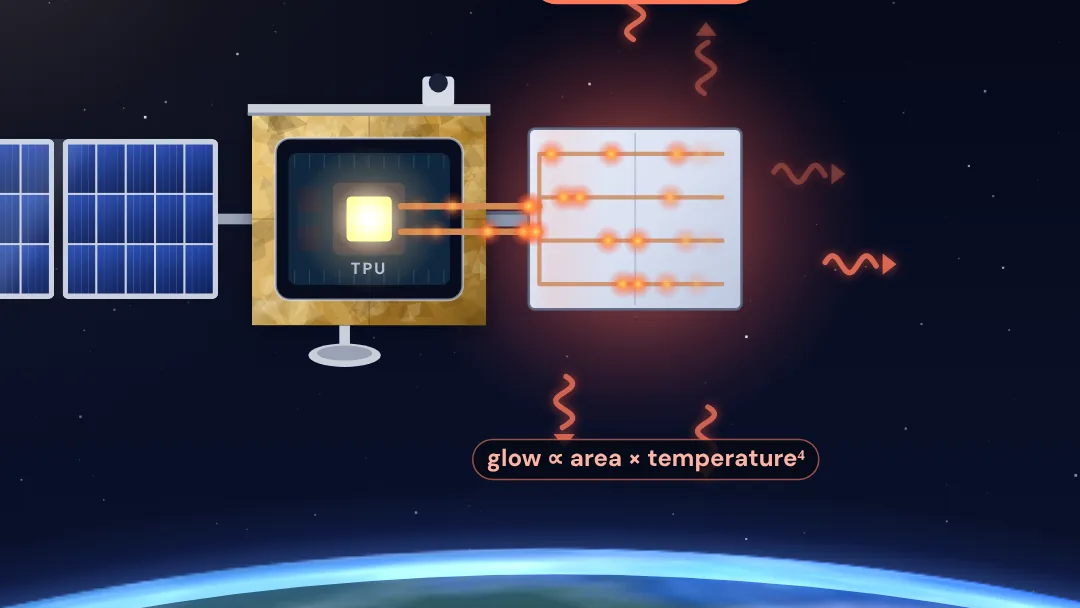 Interactive · Orbit Chip LabWhy can Google's AI chip in orbit only run in bursts?Turn up an orbiting chip’s power and watch a small radiator fall behind until the chip has to stop.
- Short · the sister filmWhy can Google's AI chip in orbit only run in bursts?Why a computer in orbit can only run in bursts, and how the radiator sets the limit.
Moving heat on Earth
With air and water around, heat can be carried. These show the loops that do it, and the same glow at work on the ground.
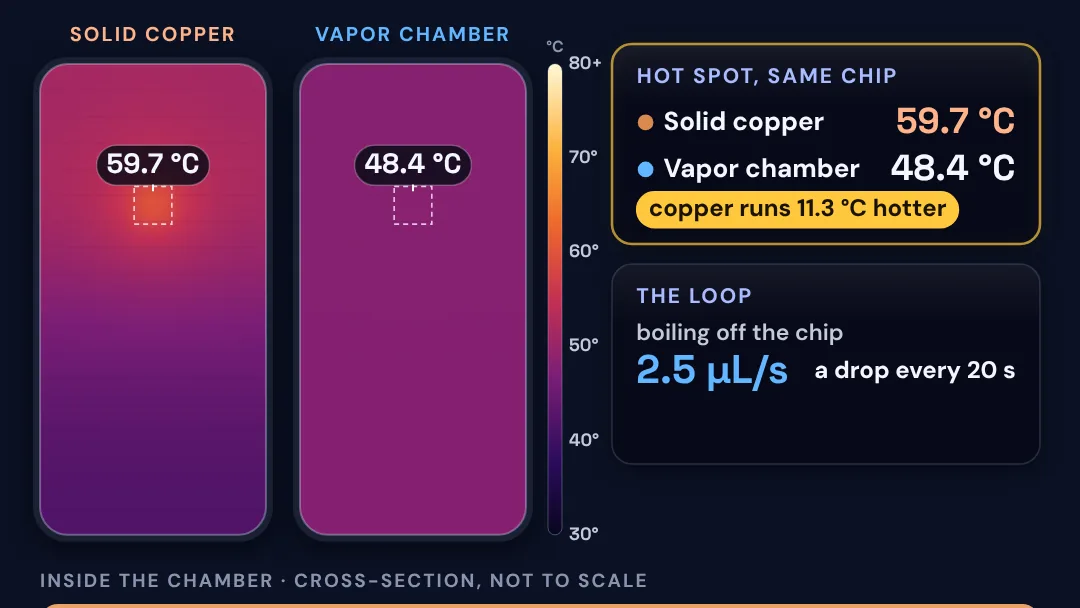 Interactive · Vapor Chamber LabHow can a few drops of liquid cool a phone?A few drops of water boil and condense inside a phone to spread a chip’s heat, the kind of loop that feeds a radiator.
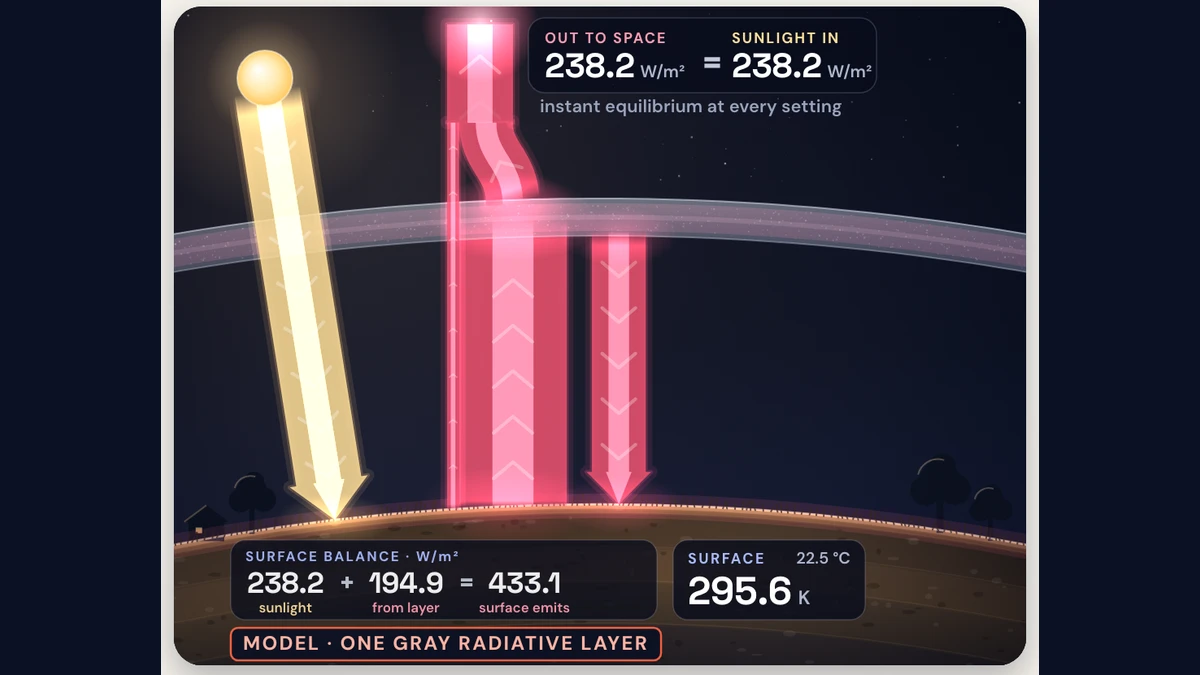 Interactive · Greenhouse BalanceWhy does the ground stay warm?The ground glows its heat to the sky by the same fourth-power law; an absorbing layer of air sends some of it back.
Heat in the real world
Two outside explainers on where the heat comes from and how people deal with it.
- VideoHow does a Spacesuit work? (NASA)A 3D breakdown of the systems inside a NASA spacesuit, which has to keep an astronaut comfortable in the same vacuum.by Jared Owen
- VideoWhy are AI data centers using so much electricity?How much electricity AI data centers use on Earth, every watt of which ends up as heat.by TED-Ed
Common questions
Is space cold?
Its sky is: the glow that fills deep space matches a temperature of 2.7 K, about −270 °C. But there is almost nothing in space to touch, so a spacecraft doesn’t simply cool to that temperature. In sunlight it can get hot, and its own electronics keep adding heat that can leave only as infrared light.
Why can’t a spacecraft use fans or a heat sink?
A fan pushes air, and there is none outside. A heat sink on Earth works because air flows between its fins and carries heat away. In space, fins that face each other only trade light, so a spacecraft needs broad panels that face the open sky.
Why are spacecraft radiators white?
White paint like the station’s Z-93 glows well in the infrared, where a radiator sheds its heat, but takes in little sunlight. AZ-93, a similar paint, absorbs about 15% of sunlight and has an infrared emittance of 0.91. Turned face-on to the Sun, such a panel still soaks up about 204 W per square metre, which is why the station turns its radiators edge-on.
How much radiator would a data center in orbit need?
In Space Radiator Lab, a 1 GW data center with radiators at 27 °C, edge-on to the Sun, needs about 1.2 km² of panel. At about 62 °C, the temperature behind Elon Musk’s figure of 1,300 W per square metre, it needs about 0.77 km². Near Earth it would need more, because the planet sends back infrared and reflected sunlight.
Why not just run the radiator hotter?
Heat only flows from hot to cold, so the radiator must be cooler than the electronics, and they cook at around 100 °C. A heat pump could push heat to a hotter radiator, but it uses more power, and that power becomes heat too.
Sources and credits
- NASA · Active Thermal Control System (ATCS) Overview The space station’s system: up to 70 kW through two ammonia loops; six radiators of eight panels, each 23.3 × 3.4 m, painted white with Z-93 and turned edge to the Sun in daylight; a −40 °C radiator-outlet goal.
- BigGo Finance · Musk pushes back on space data center cooling doubts (November 4, 2026) How the debate on X started: Utrecht University professor Jan Broersen called space data centers nearly impossible to build, and Musk replied with radiator and solar-panel figures.
- NASA Goddard · CMB intensity COBE’s FIRAS instrument measured the cosmic microwave background at 2.725 K: the “−270 °C” of deep space.
- Modus Advanced · AZ-93 white thermal control paint Solar absorptance 0.15 and thermal emittance 0.91, the coating values the model uses.
- Intel · Information about temperature for Intel processors Processor junction-temperature limits are usually between 100 and 110 °C.
- Wccftech · Elon Musk defends space AI satellites (November 3, 2026) Musk’s posts on X: about 1,300 W/m² for an aluminum radiator pointed away from the Sun, and solar panels at about 250 W/m² with about five times the radiator’s area.
- Space Radiator Lab · model notesThe equation, the coating, the sunlight, the presets, the station comparison and what the model leaves out.
Every creator named here made the work we link to. Listing it does not imply a partnership or endorsement.