Topic guide · Starship Flight 15
How do you catch both halves of a rocket?
In two catches almost a day apart. About six and a half minutes after liftoff, the Super Heavy booster flies back to the tower at Starbase, Texas, and the tower’s arms close around it, which has worked three times before. The ship goes on to orbit, about 275 km up at roughly 17,500 mph, drops off 26 Starlink satellites and then waits: each 90-minute lap ends about 23° farther west as Earth turns underneath, so only after about 14 laps is Starbase back under its path. Then it reenters, banks over Mexico and Texas, flips upright on three engines and is caught by two fittings under its forward flaps, about 22½ hours after launch. In Double Catch you can run the whole mission clock.
- Launch (no earlier than)
- Fri Nov 13, 2026 · 4:45–6:00 PM CT
- Booster catch
- T+6:35
- Orbit
- ≈ 275 km · ≈ 14 laps
- Ship catch
- T+22:32:34
SpaceX’s plan · pending regulatory approval Times are SpaceX’s Flight 15 event table, which it marks as approximate; they move with the actual liftoff time, and the date can slip. Check SpaceX’s mission page on the day.
Interactive · ExplainerTools
Double Catch
Drag the mission clock or press “Play the mission”: the booster flies back and is caught, then the ship’s ground track drifts west lap by lap until Starbase is back under it.
Model · SpaceX’s timeline, our ground-track model
When is the next Starship launch?
Flight 15 is set to launch from Pad 2 at Starbase, Texas, no earlier than Friday, November 13, 2026, in a 75-minute window that opens at 4:45 p.m. Central (5:45 p.m. Eastern), “pending regulatory approval”, according to SpaceX’s mission page. SpaceX’s live webcast starts about 30 minutes before liftoff on its website and on X, and it plans to keep showing views through the ship catch, the next afternoon. If it lifts off at the start of the window, the booster catch comes at about 4:51 p.m. Friday and the ship catch at about 3:17 p.m. Saturday, Central time.
Dates slip often, and on November 10 the FAA had finished the environmental reviews for bringing the ship back to the launch site but had not posted a licence for this flight. Check SpaceX’s page before you plan around it.
How does the tower catch the booster?
Super Heavy has no landing legs. Instead:
- Separate
At T+2:21 the ship lights its own engines while still attached and pushes away from the booster (hot staging).
- Fly back
The booster flips and fires its engines to cancel its speed away from the coast and head back toward Starbase. On Flight 7 it rose to about 90 km and went a little over 60 km downrange first.
- Land on the arms
It lights its landing burn at about T+6:10, comes down beside the tower on its engines, and the two arms (the “chopsticks”) close under its catch points at about T+6:35.
This has worked three times: on Flights 5 (October 13, 2024), 7 (January 16, 2025) and 8 (March 6, 2025). Flight 15 would be the first catch of the third-generation (V3) booster, whose three larger grid fins carry the catch point, and the first at Pad 2, whose arms are shorter and electrically driven so they can track the booster faster.
Why does the ship need about 14 orbits before it can land?
Because Earth turns underneath it. A 275 km orbit takes about 90 minutes a lap. In 90 minutes Earth turns about 22.6°, and Earth’s equatorial bulge drags the orbit itself about another half a degree west, so the ship’s ground track, the line on the map directly under it, lands about 23° farther west each lap.
The ship launched heading northeast over the Gulf, and it has to come home the same way: entering over the Pacific and flying across northern Mexico and South Texas, not down across the United States. A pass like that comes back over Starbase only once Earth has turned most of the way round. SpaceX says the ship coasts “~21 hours until its orbit aligns with Starbase for a return”, about 14 orbits in all. In our simple model, the 15th pass, about 22.4 hours after liftoff, comes within about 230 km of Starbase, close enough for the ship’s flaps to steer out the rest during entry. The long coast also leaves time to photograph the heat shield from Starlink satellites and to run go/no-go checks, with planned bail-out splashdowns off Hawaii and off Chile.
How is the ship caught?
- Deorbit
At T+21:35:57 a single engine fires to slow the ship enough to fall back in.
- Reenter
At about T+22:10 it hits the air over the Pacific, thousands of kilometres from Starbase, belly first behind its tile heat shield, and steers with four flaps through a series of banking turns over sparsely populated parts of northern Mexico and South Texas. People in Cameron County may hear sonic booms.
- Flip
Falling belly first toward the tower, it lights its three sea-level Raptor engines and flips upright at T+22:32:18, then drops to two engines to move between the arms and to one as it nears a hover.
- Catch
The arms close on two catch fittings just below its forward flaps at about T+22:32:34, and the last engine shuts down when the ship registers contact.
No ship has been caught before. If the ship or the tower is not healthy, the ship can be sent to a splashdown in the Gulf instead.
Why catch rockets instead of landing them on legs?
Legs are weight that has to be carried all the way up and back. A tower that does the catching stays on the ground, and a stage caught on the tower can be set straight back on the launch mount. SpaceX calls full and rapid reuse the key to flying rockets more like airliners: on Flight 15, it says, the 26 Starlink V3 satellites, each adding 1 terabit per second of capacity, equal about ten Falcon 9 Starlink launches. Claims about future cost per kilogram are targets, not prices.
Try it: run the mission clock
- 1 See
Open Double Catch and press Booster catch: the side view shows the booster’s trip out and back, and the tower view the arms closing at T+6:35.
- 2 Change
Press Lap 8, then drag the mission clock on: each lap’s track lands about 23° west of the last, and the bars show how close each lap’s northbound pass comes to Starbase.
- 3 Understand
Press Deorbit burn and Ship catch, and move Liftoff time to see when each event would happen in Central time.
Where does this model stop?
Double Catch uses SpaceX’s published event times, which SpaceX marks as approximate. Its ground track is a simple model of our own: a circular 275 km orbit tilted 26.5° to the equator (an assumption just above Starbase’s latitude; SpaceX has not published the tilt), with Earth’s rotation and the orbit’s drift from Earth’s bulge. It explains why the ship waits, not exactly where it flies. The booster’s path is a schematic, and the return over Mexico and Texas is drawn after SpaceX’s description, not from a published trajectory.
The ship-catch scenes in the film are SpaceX’s computer animation, labelled as such, because the catch has not happened yet. This guide will be out of date the moment Flight 15 flies.
Explore by question
Two catches, an orbit and the physics behind them. Each card answers one part of the question.
Double Catch
Model · SpaceX’s timeline, our ground-track model
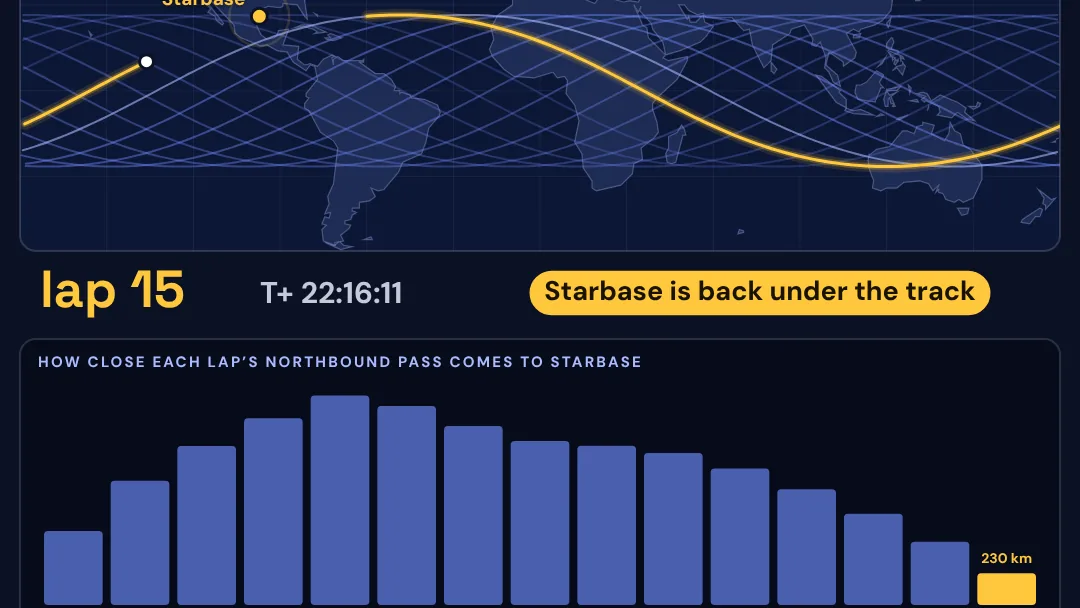 Interactive · Double CatchHow do you catch both halves of a rocket?Run Flight 15’s mission clock from liftoff to the ship catch.
- Short · 62 secondsHow do you catch both halves of a rocket?SpaceX’s booster catches, the ship in orbit and why it waits about 14 laps. Narrated and captioned.
- JournalHow do you catch both halves of a rocket?Starship Flight 15 is set to try two catches: the booster 6½ minutes after liftoff, the ship 22½ hours later, once Earth turns Starbase back under its path.
Coming back down on engines
Both catches end with a rocket slowing itself on its engines at just the right moment.
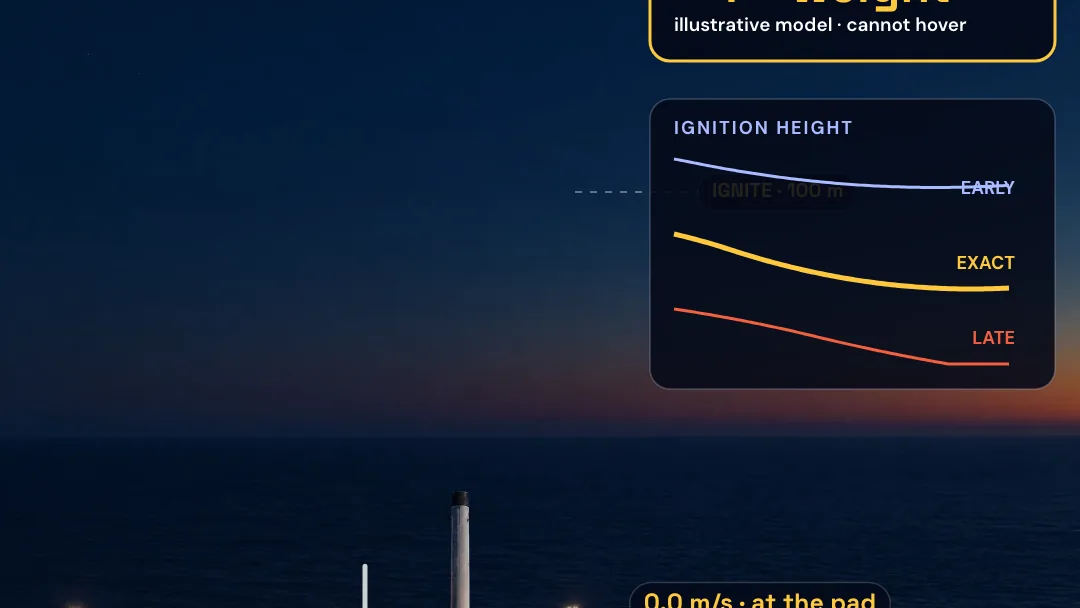 Interactive · Landing BurnWhen should a falling rocket light its engine?When should a falling rocket light its engine? Try to land it yourself.
Staying in orbit
The ship circles Earth for most of a day because it is falling around it.
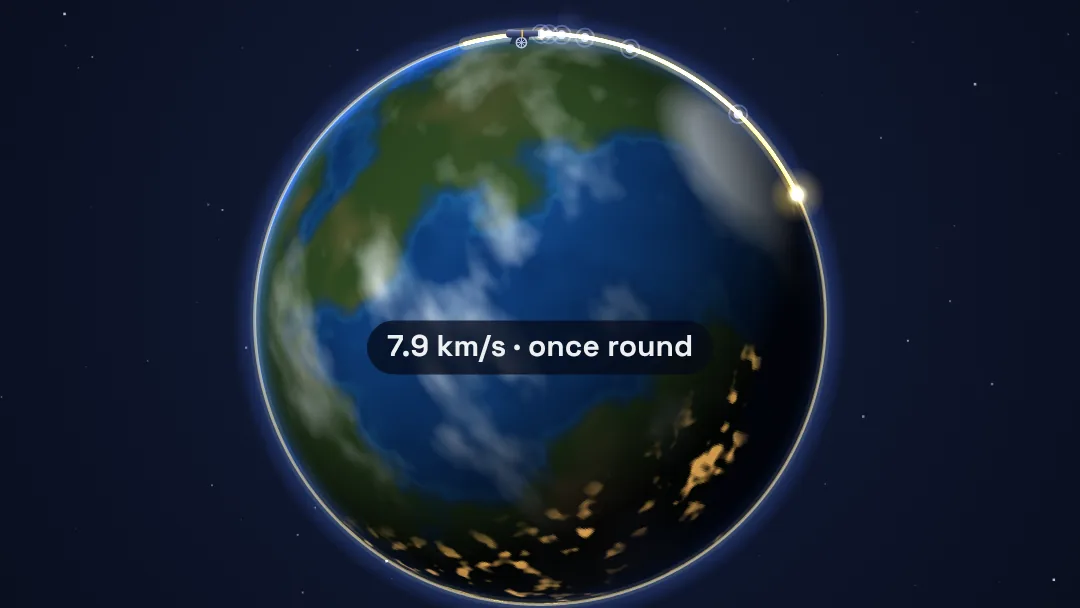 Interactive · Newton's CannonWhy don't satellites fall down?Why satellites don’t fall down: Newton’s cannon, faster and faster.
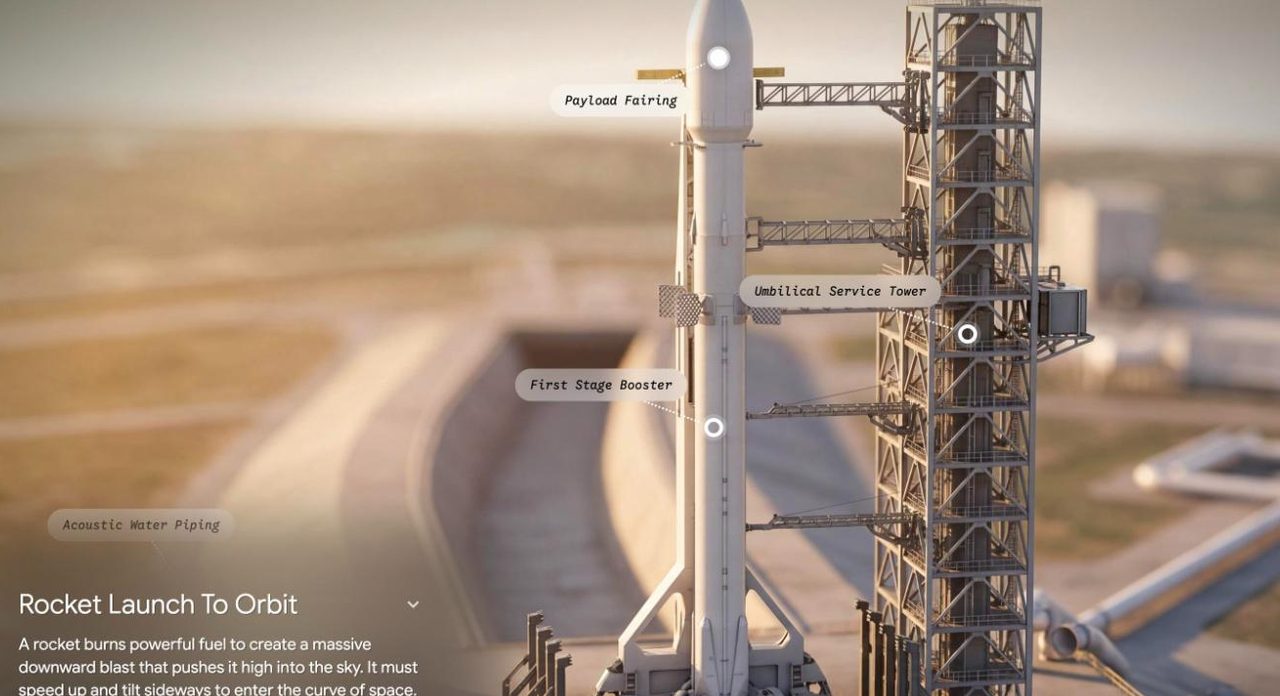 Interactive demoRocket Launch To OrbitRide a rocket from the pad to orbit in 3D.by Google Gemini · Opens on the creator’s site
Engines and launch
What the Raptor engines and the climb to orbit are doing.
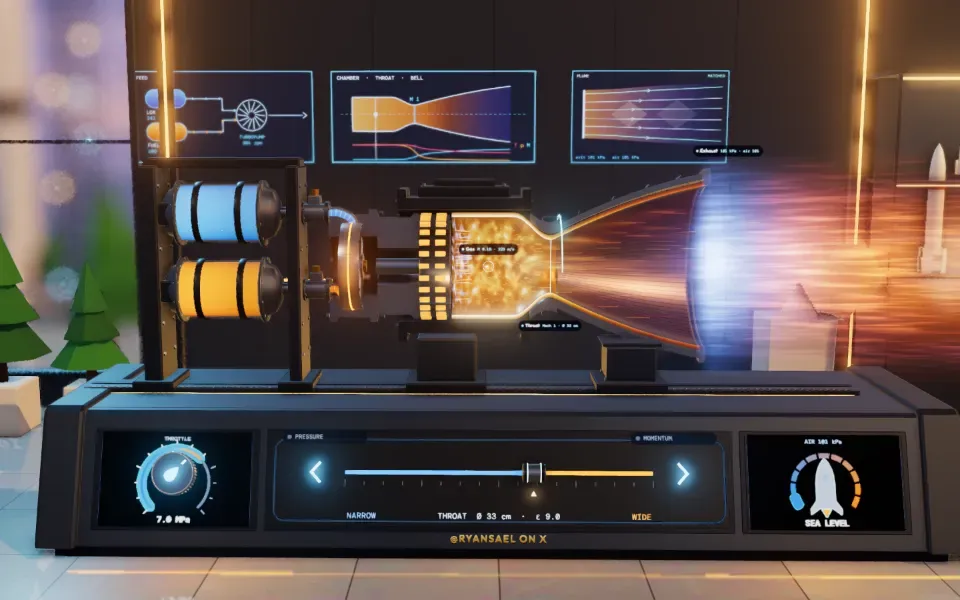 Interactive demoRocket Nozzle LabHow a rocket nozzle turns hot gas into thrust.by Ryan Sael · Best on a larger screen
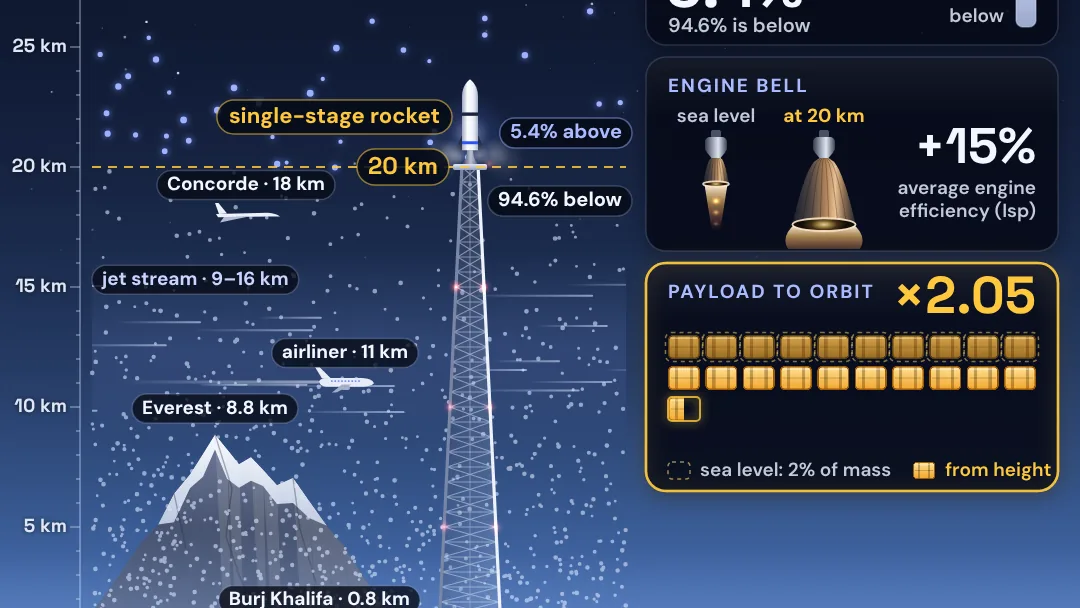 Interactive · Tall Tower LaunchWhy launch rockets from a 20 km tower?Why rockets are mostly fuel, and what a 20 km tower would change.
Common questions
When is the next Starship launch?
Flight 15 is set for no earlier than Friday, November 13, 2026, in a window from 4:45 to 6:00 p.m. Central, pending regulatory approval. SpaceX’s webcast starts about 30 minutes before liftoff on spacex.com and X.
Has SpaceX caught a Starship before?
It has caught the Super Heavy booster three times, on Flights 5, 7 and 8 (October 2024 to March 2025). It has never caught the ship, the upper stage; Flight 15 is set to try.
Why does the ship orbit for almost a day before landing?
Earth turns about 23° under each 90-minute lap, so the ship’s path drifts west. It has to wait, about 14 orbits, until a pass from over the Pacific lines back up with Starbase.
When will the booster and ship be caught?
If Flight 15 launches at 4:45 p.m. CT on Friday, the booster catch is planned at about 4:51 p.m. Friday and the ship catch at about 3:17 p.m. Saturday. Both move with the actual liftoff time.
What happens if the catch can’t be done?
The booster can be diverted to the Gulf, and the ship has planned bail-out splashdowns off Hawaii and Chile during its coast and a last option in the Gulf near the end.
Concepts in this guide
Each one has a plain one-line definition in Concepts A–Z, with every model, film and post where it comes up.
Sources and credits
- SpaceX · Starship Flight 15 Date, window, webcast, orbit (~275 km, ~14 orbits) and the full event table used in Double Catch.
- SpaceX · Returning Starship to the Launch Site (Nov 7, 2026) The ~21-hour coast, the bail-out options, the reentry over Mexico and Texas and the catch sequence.
- FAA · SpaceX Starship Environmental reviews for returning the ship to the launch site; licence decisions.
- SpaceX on X · first booster catch (Flight 5) October 13, 2024. Flights 7 and 8 followed in January and March 2025.
- SpaceX on X · Flight 7 booster precision About 90 km up, more than 60 km downrange, landing burn lit less than 40 m from the target.
- Double Catch · model notesThe orbit model, the assumed 26.5° tilt and what the drawings leave out.
Every creator named here made the work we link to. Listing it does not imply a partnership or endorsement.