Topic guide · Transport and flow
How can small cars move tens of thousands of people an hour?
Because the cars never stop on the main line. In the Las Vegas Loop, stations sit off to the side. A car loads in a bay while the line keeps moving. The gap between cars then sets the flow: a car every 2 seconds is 1,800 cars an hour. Short trips do the rest. A seat that empties at one station fills again at the next. The Boring Company says it aims for 90,000 people an hour. That is the company’s target, not a measurement.
- A car every 2 s
- 1,800 cars/h
- A car every 1 s
- 3,600 cars/h
- 20 stations, 1 s, 2 riders
- 36,000 people/h
- Company target
- 90,000 people/h
Model · steady flow, upper bound Cars an hour = 3,600 ÷ seconds between cars. The 90,000 is The Boring Company’s target.
Interactive · ExplainerTools
Loop Lab
Close the gap between cars and add stations. Watch people per hour climb, until the station bays run out.
Model · steady flow, upper bound
How can cars load without stopping the line?
On a street, a stopped car holds up everyone behind it. A bus at a stop does the same. The line waits while riders get on.
In the Las Vegas Loop, stations sit off to the side of the main tunnel. A car leaves the main line and pulls into a bay. Its riders get out, new ones get in, and it merges back into a gap. The cars behind never brake for it.
So slow loading does not slow the line. It only means a station needs more bays. Loop Lab counts the bays each station needs as you change the time to get in and out.
What sets how many cars pass an hour?
Stand at one spot in the tunnel and count cars. An hour has 3,600 seconds. A car every 2 seconds is 1,800 cars an hour. A car every second is 3,600. That spacing in time is the headway.
The headway depends on the space between cars and their speed. Loop Lab assumes 35 mph. There, a car every second leaves about 11 m between cars. Shrink the space, and more cars pass each point.
Short gaps have a cost. A human driver needs time to react and room to brake. Loop Lab’s notes say gaps of about 1 second at 35 mph would need automated driving. Stopping Distance shows where that room goes.
How does one seat carry many riders?
Cars an hour is only half the answer. A seat that empties at a station can fill again right there.
Say riders go 4 stops on average, on a loop with 20 stations. Each seat then carries 5 different riders every lap. At a car every second, that is 3,600 cars × 2 riders × 5. The result is 36,000 people an hour.
More stations mean more reuse. With 104 stations and a car every 2.1 seconds, Loop Lab reaches about 90,000 an hour. That matches the company’s target only on paper. It is an upper bound, not a forecast.
Try it: close the gap, then add stations
- 1 See
Open Loop Lab and tap LVCC-size · 5 stations. People per hour reads about 4,500.
- 2 Change
Tap The film · 20 stations, 1 s. The gap closes to one second, and each seat is refilled 5 times a lap. The count jumps to 36,000.
- 3 Understand
Now tap Slow boarding · 2 min. Limit that binds switches to station bays. The tunnel has room, but the stations cannot load cars fast enough.
What has the real Loop carried so far?
The Loop under the Las Vegas Convention Center was tested in May 2021. It met its contract target of 4,400 passengers an hour, News 3 Las Vegas reported. TechCrunch noted that the test put three riders in each of 62 cars.
Regular service carried fewer. By mid-July 2021, its busiest hour had moved 1,355 people, TechCrunch found. Cars averaged about two riders each.
The Boring Company says the wider Vegas Loop aims for 90,000 passengers an hour. That would take 104 medium-sized stations. It is the company’s target, not a measurement. In 2026, the company reported 123 stations approved and 14 open.
Where does this model stop?
Loop Lab is a steady-flow model. Every car carries 2 riders at one speed, evenly spaced. Riders take an illustrative average trip. Real cars can carry more, as the 2021 test showed, and demand is never even.
The model leaves out empty cars driving back to busy stations, merging conflicts and braking room. It also ignores breakdowns and evacuation. So every number it gives is an upper bound. It is not a forecast for any real tunnel.
Explore by question
Small cars, short gaps, many stations. Each card answers one part of the question, with why it belongs here.
Loop Lab
Model · steady flow, upper bound
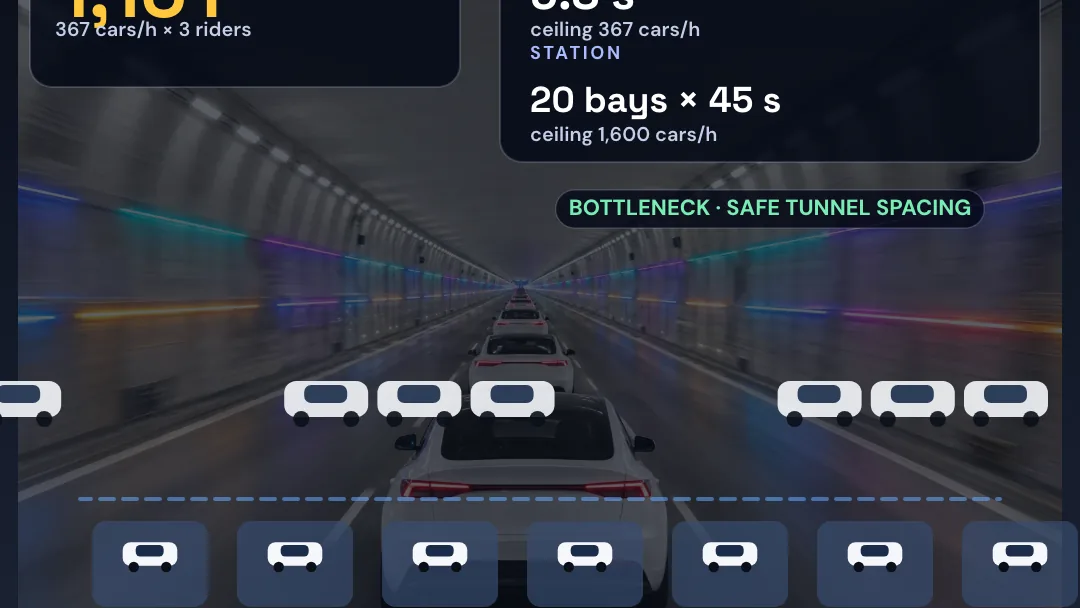 Interactive · Loop LabHow can two-rider cars move tens of thousands of people an hour?Close the gap between cars, change the time to get in and out, and add stations. Watch people per hour climb, or the bays run out.
- Short · 47 secondsHow can two-rider cars move tens of thousands of people an hour?Side bays, the gap between cars and seat reuse, narrated and captioned.
- JournalHow can two-rider cars move tens of thousands of people an hour?In the Las Vegas Loop, cars load in side bays off the main tunnel, so the line never stops. Then the gap between cars and the number of stations set how many people the loop can move.
Why short gaps are hard to drive
Loop Lab leaves out braking room. These models show why a close gap is hard for a human driver.
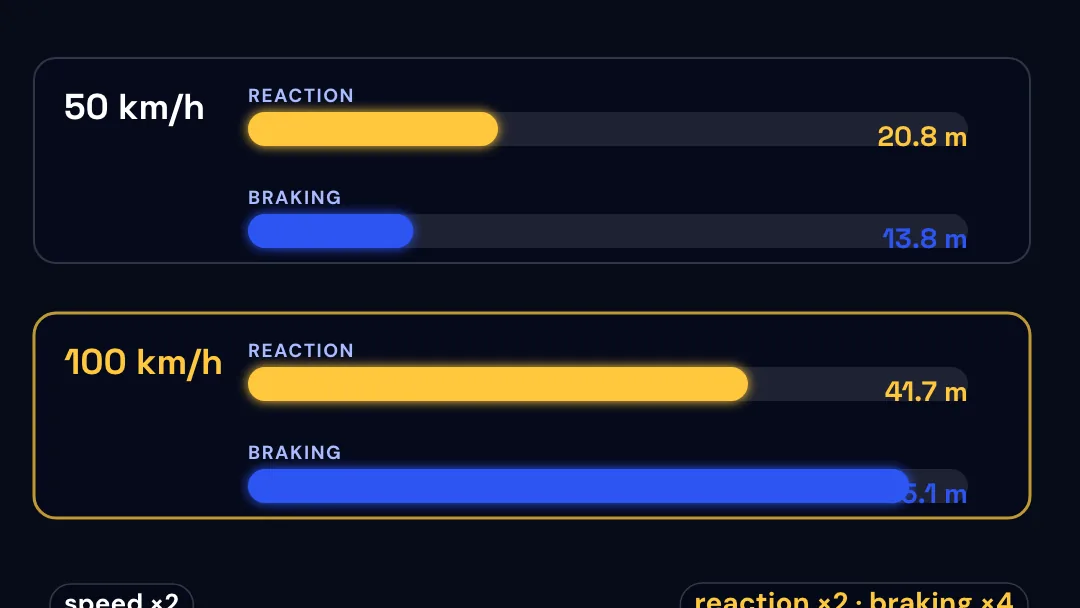 Interactive · Stopping DistanceWhy does twice the speed need four times the braking distance?Change speed and reaction time, and see how far a car travels before it can stop.
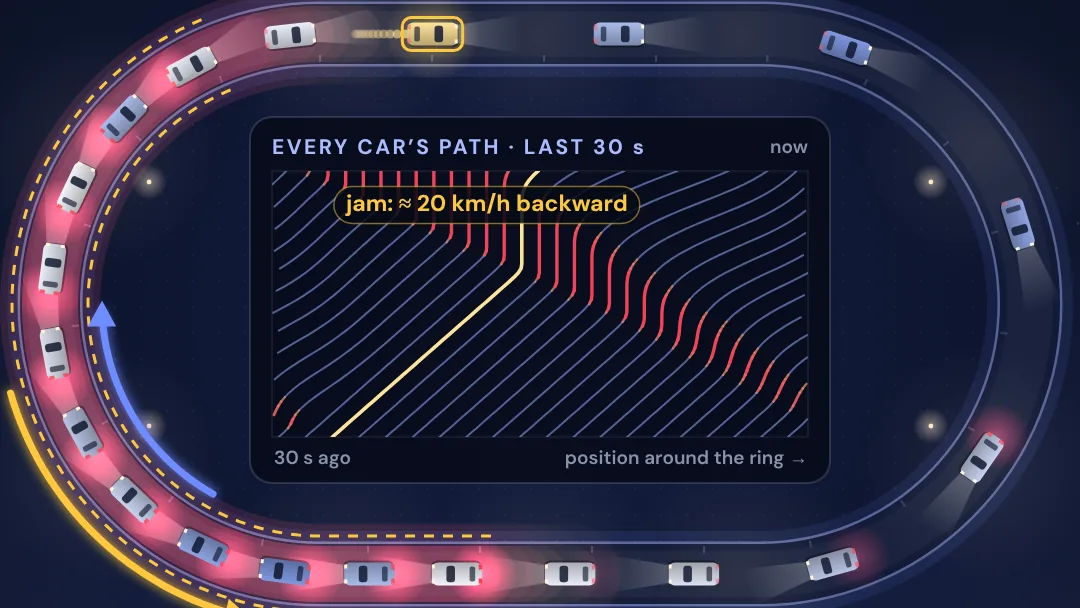 Interactive · Traffic Wave LabWhy do traffic jams appear out of nowhere?Add cars to a ring road and tap one driver’s brakes. On a busy road, the slowdown grows into a jam.
Why street traffic takes turns
At a crossing, each direction waits for its green. Loop Lab’s main line has no crossings.
- Interactive demoWho Gets the Green? — one intersection, adaptive signalsRun one city intersection and compare signal plans that share the green between directions.by Ryan Sael · Best on a larger screen
Another way to move people
A different question about transport: how a train can float at speed.
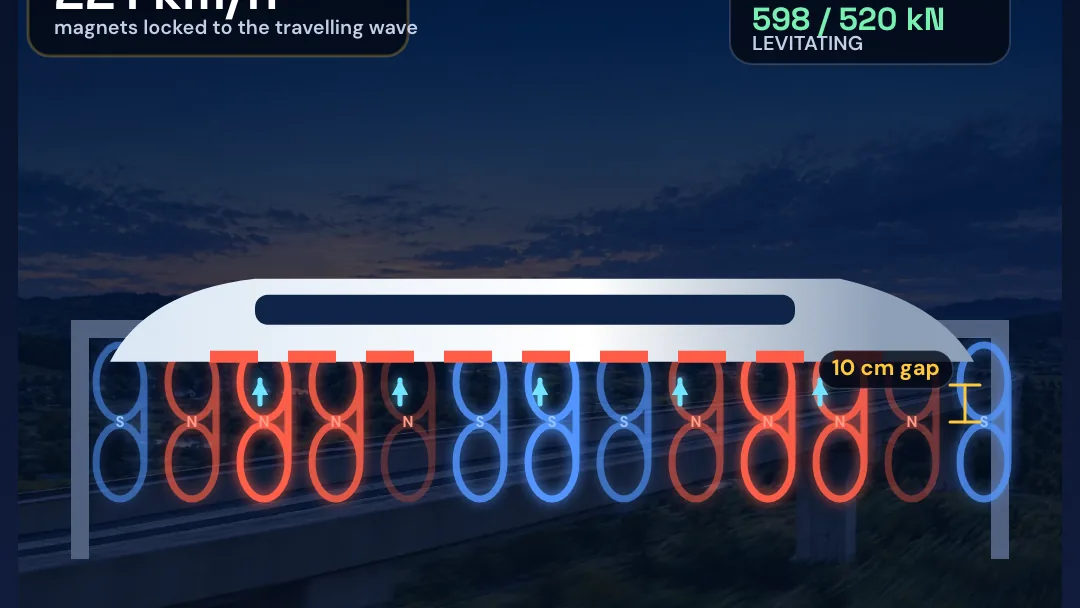 Interactive · Maglev LabHow does a maglev train float?Change the train’s speed and watch induced currents lift it off its guideway.
Common questions
Does the Loop move 90,000 people an hour today?
No. 90,000 is The Boring Company’s target for a network of 104 medium-sized stations. The busiest in-service hour TechCrunch reported, by mid-July 2021, was 1,355 riders. The 4,400-an-hour figure came from a planned test.
Why two riders a car?
It is close to what early service carried. TechCrunch found about two riders a car in mid-2021. The cars can hold more: the May 2021 test used three. Loop Lab uses two throughout.
Would closer cars always carry more people?
Only until the stations fill up. Each station has to load the cars the line sends it. When loading is slow, the bays run out first, and the gap stops mattering. Loop Lab shows this as the limit that binds.
How is this different from a highway?
A highway also carries more when cars are close, until one driver brakes. In dense traffic, that brake tap can grow into a jam that drifts backward. Traffic Wave Lab shows it. Loop Lab assumes perfectly even spacing, so it has no jams.
Sources and credits
- The Boring Company · Loop The company’s page. The Vegas Loop target of 90,000 passengers an hour, with 104 medium-sized stations, is the company’s claim.
- News 3 Las Vegas (KSNV) · LVCVA results of Las Vegas Convention Center Loop tests The May 2021 test met the 4,400-passengers-an-hour contract target.
- TechCrunch · Early data from Elon Musk’s Las Vegas Loop shows a slower, yet popular service November 12, 2021. A peak of 1,355 passengers an hour by mid-July 2021, with about two riders a car. The May test used three riders in each of 62 cars.
- The Boring Company on X · 123 stations approved Company post, August 2026.
- The Boring Company on X · 14 stations Company post, September 2026.
- Loop Lab · model notesThe equations, fixed values and omissions behind the model numbers on this page.
Every creator named here made the work we link to. Listing it does not imply a partnership or endorsement.