Aviation · FAA ground stop
Why ground planes that are working fine?
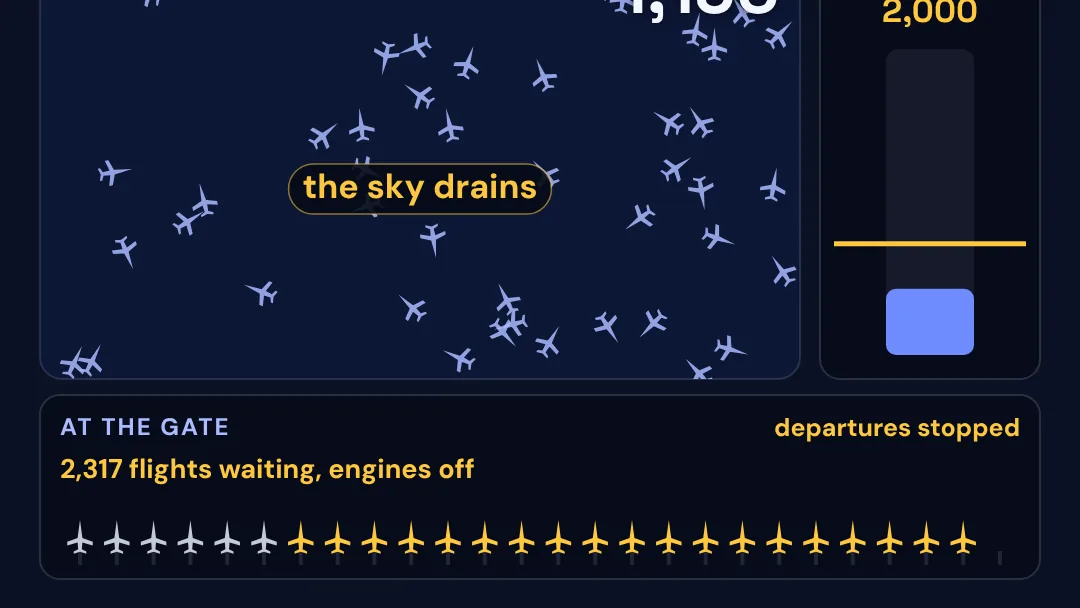
Set “Departures” to zero and watch the sky drain under the safe line. Then try half measures, or change what controllers can safely handle.
1 See
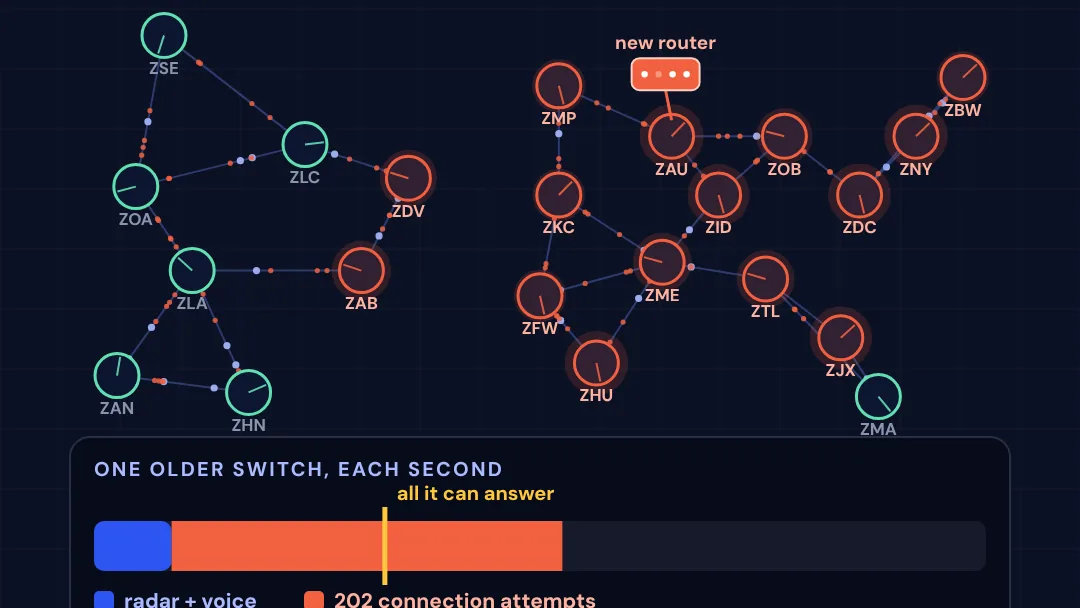
When air traffic control’s radar and radio feeds went unstable on November 13, 2026, the planes on the ground were working perfectly. So why were they the ones that got stopped?
2 Change
3 Understand
Model notes and sources
Where this comes from. On November 13, 2026 the FAA ordered a nationwide ground stop at 20:54 UTC (Flightradar24). In its Q&A of November 15 the FAA said instability in aircraft communications and radar feeds led to the stop and that approximately 3,500 aircraft in the air landed safely. Transportation Secretary Sean Duffy wrote that “3,500+ planes were in the air” when the trouble began, fewer than 400 by 8 p.m. Eastern, and that the stop was lifted at 8:15 p.m. (his post); he also said controllers did not lose all radar or telecommunications. News reports described it as the longest nationwide ground stop in 25 years. A ground stop holds aircraft at their departure airport; flights already in the air continue to their destinations.
The idea. A plane at a gate can wait without burning fuel and without anyone watching it. A plane in the air cannot: it has a limited amount of fuel and it needs a controller keeping it separated from every other aircraft. When controllers’ tools degrade, each of them can safely handle fewer aircraft, so the number that the whole system can watch drops. The only quick way to shrink the number in the air is to stop adding to it. Every landing then makes the job smaller, and the waiting moves to the ground, where it is cheap and safe.
The model. This is a teaching model, not FAA traffic data. It starts with 3,500 aircraft in the air. Every flight lasts 90 minutes, so with departures at the normal 39 a minute the number in the air stays level, and with departures stopped it falls in a straight line: airborne(t) = 3,500 × max(0, 1 − t ÷ 90) + departures × min(t, 90). Controllers can safely handle 5,000 aircraft with everything working; the “capacity” control scales that down, and the default 40% (2,000 aircraft) is an illustrative figure for degraded radar and radio. With departures stopped the sky fits under that line after about 39 minutes; with normal departures it never does. Real traffic is not uniform: flights differ in length, international arrivals were handled case by case, and controllers also use holding, rerouting and spacing, none of which is modelled.
The film. The mechanism is drawn in code by ExplainerTools, with no AI-generated pictures. The Short also uses short real excerpts, picture only, a few seconds each and credited on screen: Flightradar24 (X), a replay of US air traffic on November 13; and @daziahgreen (TikTok), baggage at Atlanta’s airport that evening. The numbers in the film come from the FAA’s Q&A and from the model, not from the footage.
Sources: FAA, “Nationwide Ground Stop: Questions and Answers” (November 15, 2026), via the FAA Newsroom; Flightradar24, ground stop issued 20:54 UTC; Secretary Sean Duffy, aircraft airborne and the time the stop was lifted; FAA Air Traffic Control System Command Center, which issues ground stops; Al Jazeera, report of November 14, 2026.
An ExplainerTools Original. Facts: FAA Q&A (Nov 15, 2026), Secretary Duffy, Flightradar24. Footage: Flightradar24; @daziahgreen.