Networks · FAA ground stop
How did one router ground every flight?
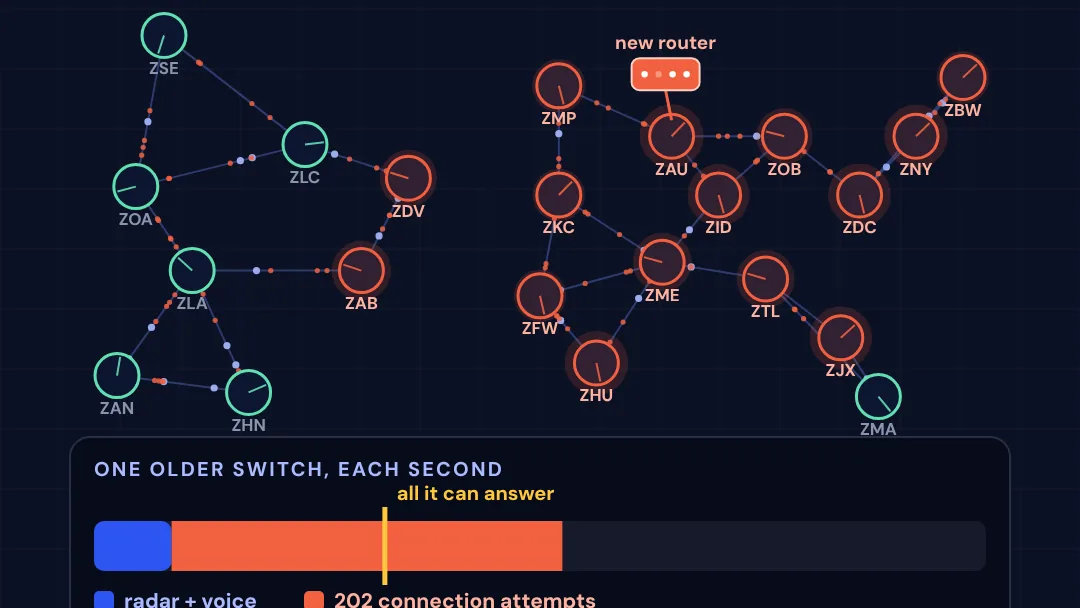
Turn “Connection attempts” up and watch centres tip one by one. Switch “Rate limit” on, or add “Equipment headroom”, and see what protects the real traffic.
1 See
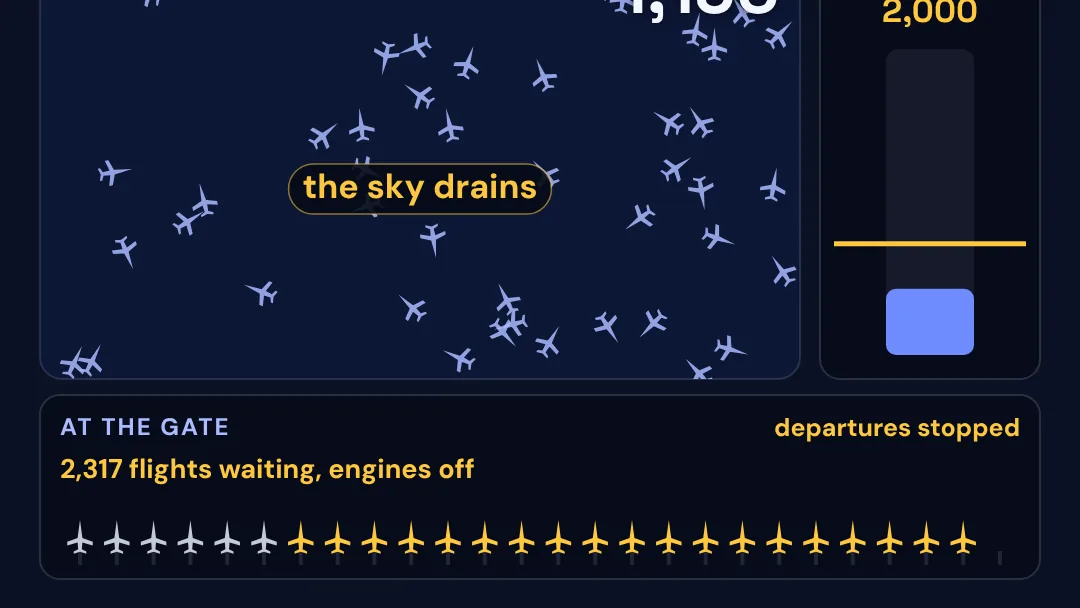
On November 13, 2026, every departure in the United States was held for more than four hours, and it was not an attack. How can one misbehaving router take down air traffic control’s network?
2 Change
3 Understand
Model notes and sources
Where this comes from. On November 13, 2026 the FAA ordered a nationwide ground stop at 20:54 UTC (3:54 p.m. Eastern), which Flightradar24 recorded as it happened; Transportation Secretary Sean Duffy said it was lifted at 8:15 p.m. Eastern, more than four hours later (his post). The FAA’s “Nationwide Ground Stop: Questions and Answers” (November 15) says legacy equipment became unstable when data began flooding the FAA’s FTI telecommunications network at about 1,000 connection attempts every 4 to 5 seconds, disrupting aircraft communications and radar feeds. Secretary Duffy said a newly installed router sent the flood and that switches and routers were overloaded (CBS News). Al Jazeera reported on November 15 that 17 of the FAA’s 22 en route centres were affected and that the FAA saw no evidence of anything nefarious. The root cause was still under investigation when this was written.
The idea. A network device answers requests from a queue, and it can answer only so many each second. If the queue has no priorities, a request that carries radar data waits in the same line as a pointless connection attempt. So a flood does not have to break anything to do damage: it only has to fill the line. The share of real traffic that gets through falls to capacity ÷ (real traffic + flood), and the centres with the least spare capacity fail first. Engineers call the runaway version congestive collapse. The usual protections are rate limiting (refuse most new connection attempts at the door), priority for critical traffic, and isolating a misbehaving device.
The model. This is a teaching model, not the FAA’s network. Each of 22 centres has a link that can answer C requests a second and carries 40 units of real traffic (radar and voice). A flood of F connection attempts a second shares the queue with no priority, so the share of real traffic delivered is min(1, C ÷ (40 + F)). A centre is drawn as unstable below 80%. The capacities are spread so that about 220 attempts a second, which is 1,000 every 4.5 seconds, tips 17 of the 22 centres, matching the reported count; the real capacities, the topology and which centres failed are not public, so the map positions and the order in which centres tip are illustrative. “Rate limit” caps new connection attempts at 20 a second. “Equipment headroom” multiplies every capacity. The model leaves out retries, routing protocols, timeouts and every other way a real network reacts to overload.
The film. The mechanism is drawn in code by ExplainerTools, with no AI-generated pictures. The Short also uses short real excerpts, picture only, a few seconds each and credited on screen: Flightradar24 (X), a replay of US air traffic; and the FAA’s own animation Air Traffic Control 101 (YouTube) for its map of en route centres. The numbers in the film come from the FAA’s Q&A and from the model, not from the footage.
Sources: FAA, “Nationwide Ground Stop: Questions and Answers” (November 15, 2026), via the FAA Newsroom; Flightradar24, ground stop issued 20:54 UTC; Secretary Sean Duffy, timeline of the stop; CBS News, Duffy on overloaded routers; Al Jazeera, reports of November 14 and 15, 2026; Wikipedia, “Network congestion” and “Rate limiting”.
An ExplainerTools Original. Facts: FAA Q&A (Nov 15, 2026), Secretary Duffy, Flightradar24, Al Jazeera. Footage: Flightradar24; FAA.